Hyundai-Kia Overtake Ford in US Quarters—What Detroit Missed
Hyundai and Kia posted their first 500,000-unit US quarter, edging past Ford for third place. Hybrids powered the surge while EVs collapsed—revealing a market pivot that reshapes Detroit's recovery timeline.
A Number That Changes the Conversation
Hyundai and Kia sold 506,200 vehicles in the US during the third quarter. That is the first time the pair has crossed half a million in a single quarter, and the milestone is bigger than it looks on paper. It puts them in position to claim third place in the US market for the first time on a quarterly basis, passing Ford—a result that would have been unthinkable inside Detroit’s strategy rooms even two years ago.
The numbers tell a clearer story than the headline. Combined US sales rose 5.4% year over year. Hyundai moved 269,541 units, up 3.5%, including 22,645 Genesis models. Kia moved 236,659 units, up 7.8%. Ford’s figures have yet to be released, but Hyundai and Kia already topped Ford in July and August individually, making the quarterly crossover all but certain.
What makes this quarter distinctive is not merely the volume but the composition. For years, Korean automakers built their American growth on low-priced crossovers and competitive warranty positioning. This quarter confirms they have graduated into volume players who can outpace legacy Detroit brands without relying on deep discounting—a transition that redefines competitive dynamics across the segment.
The Hybrid Engine, Not the EV Dream
The surprise in these results is not that Korean automakers are selling well in America. The surprise is what kind of vehicle is doing the heavy lifting.
Hybrid electric vehicles surged 53.4% to 138,112 units—Hyundai with 69,776 and Kia with 68,336. That is a record quarter for hybrids from the pair and it accounts for roughly 28% of total US sales. The Santa Fe Hybrid and Sonata Hybrid were September standouts for Hyundai. For Kia, the Sorento hybrid climbed 37.5% and the Telluride added 41.9% on the back of its newer model cycle.
Electric vehicles, by contrast, collapsed. EV sales dropped 51% to just 22,311 units. The brand-new EV3, launched in the US for the first time, managed only 514 units in September. That is not a launch failure in absolute terms for a first-month entry, but it is a stark signal that the Korean playbook has pivoted hard away from battery-electric and toward the hybrid middle ground.
Put together, the xEV figure—hybrids plus EVs—grew only 18.4% from a year earlier. The engine of that growth is almost entirely the hybrid side. This split reveals a critical second-order effect: Korean automakers are not abandoning electrification, but they are reallocating production capacity and marketing spend toward powertrains that buyers are actually purchasing. Dealerships that once struggled to move EV inventory are now rotating hybrid units faster than traditional gasoline models, compressing days-to-sale and improving lot turnover rates across the Korean brand network.
The implication extends beyond the Korean brands themselves. Suppliers and logistics partners who bet heavily on EV infrastructure—charging networks, battery assembly lines, high-voltage component supply chains—are now recalibrating alongside manufacturers who anticipated steady EV growth. Hyundai and Kia’s hybrid pivot is a leading indicator that the market’s electrification curve has steepened less than many forecasters predicted in 2024 and early 2025.
Who Is Buying What
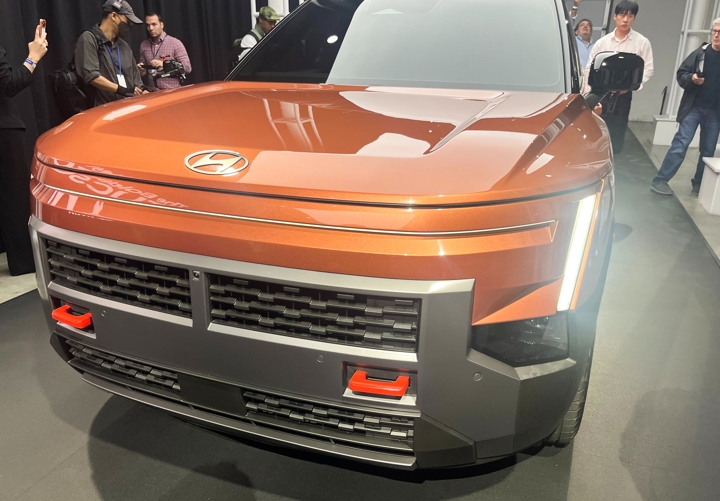
The Tucson remains Hyundai’s anchor. It sold 64,075 units in the quarter even before the refreshed “All New Tucson” world premiere took place in New York on October 1 in front of 160 global media and influencers. In September alone, the outgoing Tucson still climbed 31.8% to 23,164 units—nearly matching its then-record set in November 2025 at 23,762. The Santa Fe added 20.9% to 12,227 units and the Palisade surged 52.1% to 11,032 units. Genesis, meanwhile, hit an all-time September high of 8,063 units, up 13.4% year over year.
Kia’s top sellers were the Sportage at 50,839 units, the new K4 at 37,633, and the Telluride at 36,436. Kia’s September total of 77,009 units represented a 17.6% jump.
The product mix tells another important story. Both brands are winning in the compact and mid-size crossover segments—the exact bracket where Ford’s Bronco Sport, Escape, and Edge portfolio has struggled to generate consistent momentum. The K4, positioned between the Forte and the Sportage, captures first-time buyers and young families who previously would have considered a Honda Civic or a Mazda3. Its strong sales suggest Korean designers and engineers are reading American taste shifts ahead of Detroit rivals, particularly around infotainment depth, cabin space efficiency, and value-loaded trim sequencing.
Genesis’s rise is a longer-game signal. An 8,063-unit September with a 13.4% gain shows the luxury subsidiary is no longer a niche curiosity. It is establishing repeat purchase rates and brand loyalty in a segment where Lexus and Acura have historically enjoyed deep incumbency advantages. For Ford, which has yet to launch a competitive luxury division, Genesis’s trajectory represents a potential multi-year erosion of share among affluent buyers who might otherwise consider a Lincoln.
Why Detroit Should Be Concerned
Ford has spent the past two years chasing volume through incentives and restructuring, trying to stabilize a portfolio that has drifted in the mid-size SUV and truck segments—the very spaces where Hyundai and Kia have been most aggressive. The loss of third place, even temporarily, is symbolic. But the real concern for Detroit runs deeper.
Korean automakers are executing a different product rhythm than American rivals. While Ford and GM reposition around trucks and full-size SUVs, Hyundai and Kia are filling the compact and mid-size crossover aisle with hybrid variants that American consumers appear to be choosing over both gasoline-only and fully electric options. The 53.4% hybrid growth rate is not a seasonal blip; it tracks a structural shift in buyer preference that Detroit’s current lineup is not positioned to match at pace.
The EV retreat matters, too. A 51% drop in Korean EV sales in the US suggests the companies are not chasing volume at any cost—they are redirecting capital toward configurations that move. That discipline may look cautious to investors expecting every manufacturer to go all-in on battery electric. But it is a rational response to a market where hybrid demand is running far ahead of EV demand.
Detroit’s concern should also extend to margin dynamics. Korean brands have historically competed on price, but rising hybrid and crossover share may improve their effective transaction prices. Buyers who choose a Santa Fe Hybrid over a Ford Escape are often stepping up from base trims, and the hybrid premium embedded in those trims lifts overall average selling prices. If Korean brands can sustain this trajectory while preserving or even expanding margins, Ford’s volume-driven incentive strategy becomes increasingly costly relative to its return.
There is also a reputational dimension. Third place is not a permanent ranking, but it signals to fleet buyers, leasing companies, and automotive analysts that the Korean brands have achieved a level of scale and consistency previously reserved for the Big Three. Every quarter that follows this one strengthens that narrative; every quarter that does not risks it becoming a single standout episode. The pressure now sits squarely on Ford to demonstrate that its restructuring efforts will produce tangible market-share recovery rather than accounting improvements.
What Comes Next
Ford’s third-quarter results will clarify whether the third-place slip is a one-quarter anomaly or the start of a trend. If Detroit cannot respond with competitive hybrid offerings within the next two model years, the gap will widen. If it can, the US market remains contested.
For Hyundai and Kia, the next test is sustainability. The Tucson refresh is arriving, the K4 is new, and Genesis continues to gain traction. But relying on incumbent models for another full year carries risk—especially if Ford or GM uses this quarter as a catalyst to accelerate hybrid development. The tariff environment adds another variable: US production capacity in Alabama, Georgia, and Kentucky gives Korean automakers a trade advantage domestic rivals do not fully share, but policy shifts could alter that calculus quickly.
One thing is now clear. The assumption that Korean automakers would plateau in America after their initial surge no longer holds. They have adapted to what buyers actually want instead of what executives predicted they would want. That flexibility is the real shift—not the quarter, but the strategy behind it. Detroit did not lose third place because Hyundai and Kia outproduced it. Detroit lost ground because it misread the hybrid moment while Korean brands leaned into it with conviction. The question going forward is whether American automakers will adjust fast enough to reclaim the initiative, or whether 2026 will mark the beginning of a longer realignment in the US market.