Hyundai and POSCO Build a Steel Fortress in Louisiana
Hyundai and POSCO are partnering on a $5.8 billion steel plant in Louisiana to supply high-value automotive steel directly to US automakers — bypassing 50% tariffs and reshaping how Korean companies serve America.
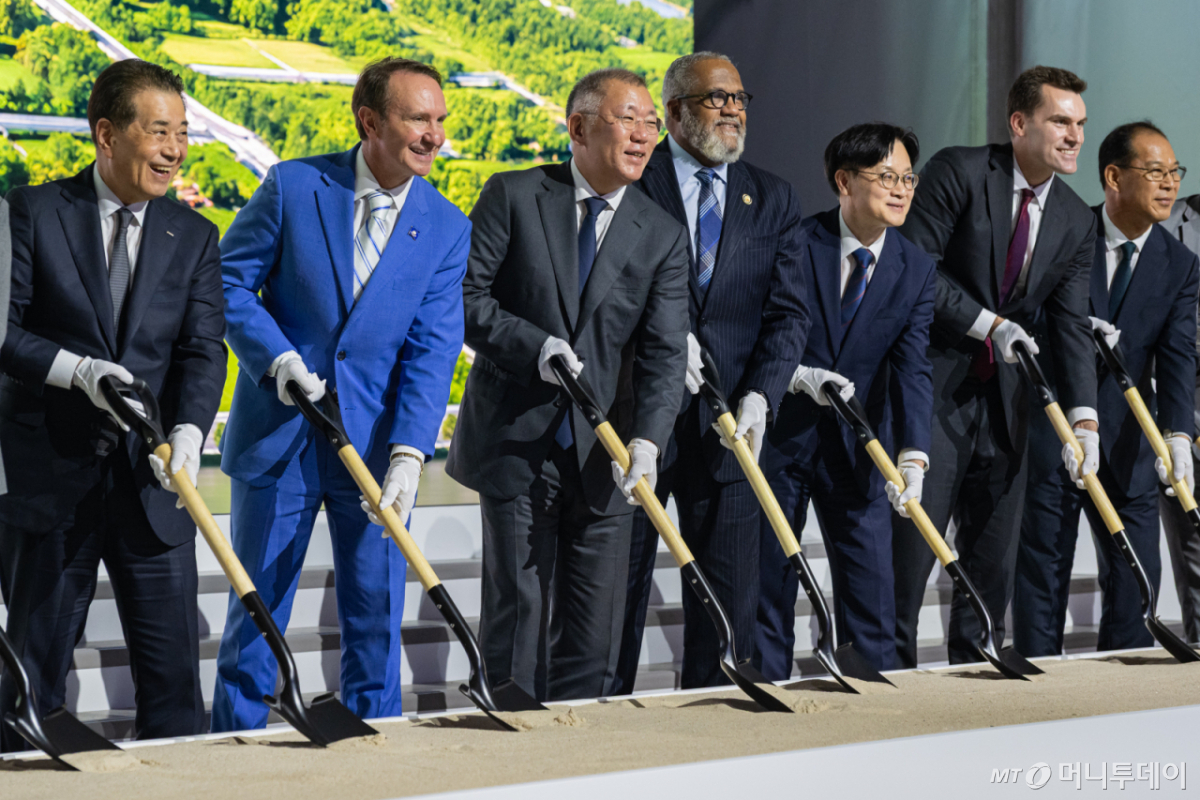
A Steel Plant With a Mission
The groundbreaking ceremony for the Hyundai-POSCO Louisiana Steel plant in Donaldsonville, Louisiana, was stacked with symbolism. Sitting side by side were Jeong Eon-sun, CEO of Hyundai Motor Group, and Cha In-hwa, chairman of POSCO Group — two men whose companies are fierce competitors in Korea but are now joining forces on American soil. Behind them stood Louisiana Governor Jeff Landry, Commerce Secretary William Kimmitt, and Trade Representative Troy Carter. The message was deliberate: this is not a Korean project. It is an American one.
What makes HPLS unusual is not just its size — $5.8 billion, roughly 8 trillion won — but what it signals about how Korean corporations are responding to a world that has become far less friendly to their export model. The United States has imposed 50% tariffs on foreign steel under Section 232 of the Trade Expansion Act, raised from 25% earlier in 2025. Korean steel exports to the US fell 8% last year, to 2.54 million tons, from 2.76 million the year before. The writing was on the wall. HPLS is the answer.
The Market They Are Targeting
Jeong Eon-sun laid out the opportunity with characteristic directness. The US imports roughly 20 million tons of steel annually. About 10 million tons of that is high-value-added, low-carbon steel — the kind used in modern vehicles, robotics, and aerospace. HPLS plans to capture a meaningful slice of that half. “We need to produce low-carbon and high-value-added steel here to improve the quality of vehicles we manufacture,” Jeong said at the ceremony. “Producing better products locally is more important.”
That phrasing matters. This is not about replacing cheap Korean steel in the US market. It is about supplying a premium segment that US automakers desperately need but cannot easily source domestically. The United States has chronic steel shortages in the specialty grades required for advanced vehicle manufacturing. HPLS is positioned to fill that gap — and to lock in customers before any competitor moves in.
The Technology Bet
HPLS is not a conventional electric arc furnace. Most EAFs in the US run primarily on scrap metal, which limits the purity and consistency of the steel they produce. Automotive-grade steel requires higher purity. HPLS combines scrap with direct-reduced iron (DRI), a feedstock that delivers the cleanliness needed for car body panels and structural components. The plant is designed as a mini-integrated facility, moving from raw material input through molten steel production, continuous casting, and hot and cold rolling under one roof — something Jeong called a first for an EAF-based plant at this scale in the US.
Jose Munoz, head of Hyundai Motor America, confirmed that inquiries are already coming in. “From the perspective of emission regulations and the environment, as well as the fact that this is produced in the United States, that will attract other companies,” he said. Hyundai also disclosed a desire to localize as much steel as possible for its plants in Alabama and Georgia. That is a supply chain tightening that benefits both companies.
The Competitive Partnership
Cha In-hwa acknowledged the unusual nature of the alliance. “POSCO and Hyundai Steel are competitors domestically, but globally we are both Korean companies,” he said. “The goal is to cooperate when going global and elevate the position of our companies worldwide.”
That framing is significant. For decades, Korean chaebol affiliates operated in separate silos. Hyundai and POSCO competed for the same customers, the same suppliers, the same government support. Now they are sharing risk and reward on a project that neither could have undertaken alone at this scale, in this location, in this timeframe. The groundbreaking came just 16 months after Jeong announced the plan to President Trump at the White House in March 2025. The speed of execution suggests both companies understood the window was narrow.
POSCO’s existing customer base — GM, Ford, Stellantis — gives HPLS an immediate channel to market. Hyundai brings manufacturing expertise, scale, and a captive demand stream from its own US plants. The 20% stake POSCO is taking in HPLS cements the alignment. Whether this partnership model spreads to other Korean industries remains to be seen, but the blueprint is now visible.
What Happens Next
Production is scheduled to begin in 2029. Until then, the project faces construction risk, labor uncertainty, and the ever-present possibility that US trade policy shifts again. A second Trump term or a different administration could adjust tariff levels, environmental regulations, or incentive structures. The project was announced under one set of conditions and will come online under another.
But the broader trajectory is clear. Korean manufacturers are no longer betting on exporting from Korea to the US. They are building inside the US. Hyundai has its EV hub in Georgia. LG Energy Solution and Samsung SDI are building battery plants across the American South. Now POSCO and Hyundai Steel are adding steel to that list. The pattern is a restructured supply chain — one that keeps Korean industrial capability intact while anchoring it to American demand.
For US automakers, the upside is straightforward: a reliable source of high-quality steel without tariff exposure. For Korean industry, the upside is survival in a market that otherwise could have shut them out entirely. The question is whether this model can scale beyond autos and steel, or whether it remains a defensive maneuver specific to sectors most exposed to US trade policy.
The Louisiana dirt being turned on September 4 was not just the start of a factory. It was the start of a new chapter in how Korean industry meets America.