Why a Korean Steelmaker Is Building a $5.8B Plant in Louisiana
Hyundai Steel is breaking ground on America's first electric-arc furnace auto-steel plant in Louisiana — a $5.8 billion bet that US soil is the only safe place to make steel for the US market now.
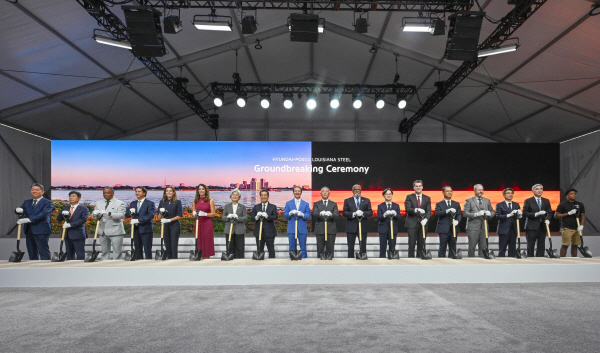
The Steel That Doesn’t Cross Borders
Hyundai Steel is pouring concrete in Donaldsonville, Louisiana — far from Seoul’s foundries and Korea’s familiar coal-fired blast furnaces. The site sits on roughly 223万평 (about 880 hectares) along the Mississippi River, chosen not for sentiment but for logistics: barge access, rail connections, and proximity to Hyundai’s Alabama plant and Kia’s Georgia facility.
The numbers are blunt. Fifty-eight hundred million dollars in committed capital. Twenty-seven zero thousand tons of annual capacity — hot-rolled, cold-rolled, and galvanized sheets for auto bodies — aimed at 2029. Five thousand four hundred jobs, including 1,300 direct hires. A joint venture split between Hyundai Steel (50%), POSCO (20%), Hyundai Motor (15%), and Kia (15%).
This is not a satellite office or a distribution hub. It is a full-scope, electric-arc-furnace steel plant making automotive-grade steel on American soil, something the US has not had at this scale before.
Who Wins, Who Loses
The winners are legible. The US government gets a flagship project that validates its “critical manufacturing reshoring” narrative — exactly the kind of plant Washington has been dangled in incentives through the Inflation Reduction Act and DOE loan programs. Louisiana’s governor and commerce officials framed it as a job-creation anchor. Hyundai and Kia’s North American supply chains shed import-risk exposure overnight.
The losers are quieter but real. Korean steelmakers’ existing export model — produce at home, ship to the US — loses its economic sense under a 50% tariff wall that the Trump administration has already imposed on steel and aluminum imports. Every ton of Korean-origin steel heading to American customers now carries that surcharge. Building in Louisiana neutralizes it. But it also means Hyundai and POSCO are investing billions in a country whose policy environment can shift with an election cycle. The plant itself is a hedge against that volatility, but hedges cost money.
POSCO’s participation is the most strategically interesting element. The two companies are direct competitors in Korea’s domestic steel market and in many third-country export channels. Sharing a $5.8 billion US plant requires a level of operational trust that Korean industrial firms rarely demonstrate. It signals that the US market imperative is overriding traditional competitive instincts — a meaningful break from how Korea’s chaebol-affiliated suppliers usually behave.
Why Electric Arc, Why Now
The choice of electric arc furnace (EAF) technology over the conventional blast furnace is not incidental. EAF steelmaking cuts carbon emissions by an estimated 70% compared to coal-based blast furnace routes. That matters for two reasons.
First, the US auto industry’s Scope 3 emissions accounting is tightening. Ford, GM, and the Japanese brands with US plants are all facing pressure to report the carbon content of their supply chains. Steel made with green electricity in Louisiana — potentially powered by the Mississippi River basin’s energy mix — looks very different on a supplier sustainability scorecard than steel shipped from Ulsan or Gwangyang.
Second, and more urgently, the 50% tariff is a structural wall, not a temporary friction point. Hyundai Steel’s own framing of the project — that local production “responds to domestic steel demand while hedging against import tariff and trade environment changes” — reads like a company that has accepted the tariff is permanent and is now optimizing for life inside it.
The plant’s first-of-its-kind status as a dedicated auto-steel EAF in the US is also a technology bet. Korean steelmakers have decades of blast-furnace know-how. EAF auto-grade steel is a different skill set, one that the US has struggled to build since its domestic steel industry contracted. Hyundai and POSCO are effectively exporting their metallurgical capability to a market that no longer produces this class of steel at scale.
The SpaceX Signal
Chairman Chung Euisung’s remarks at the groundbreaking deserve attention beyond the ceremonial framing. He said the steel from HPLS would serve not just auto but “next-generation mobility production” and specifically named AI data centers and the power sector. The implied pitch extends to aerospace — a claim that Hyundai Steel has been testing privately: that this steel could supply SpaceX’s rocket structures.
SpaceX does not yet publicly disclose its steel sourcing, but the company’s rapid expansion at Boca Chica and its contracts with the US Space Force make it a logical customer for a new domestic specialty-steel supplier. If Hyundai Steel lands even a fraction of that demand, the Louisiana plant’s revenue base diversifies well beyond automotive, which is precisely the risk-reduction argument the company needs to make to skeptical investors.
What Happens Next
Construction begins in Q4 this year. First steel flows in 2029. That timeline exposes the project to political risk — a second Trump term could reshape tariff policy, trade agreements, and even the IRA incentives that may underpin part of the plant’s economics. The 2028 US election is a ticking clock embedded in every capital expenditure decision.
Supply chain integration will be the harder test. DRI (direct reduced iron) feedstock — the key input for EAF auto-steel — must be secured at scale. Korea has no domestic iron ore. The US has some, but not at the volumes this plant will consume. Whether Hyundai Steel sources DRI from domestic producers, imports it, or builds its own reduction capacity remains unclear. This is the single largest operational uncertainty.
And there is the geopolitical layer that English-language coverage rarely picks up: China’s steel overcapacity is flooding Southeast Asian and Middle Eastern markets, pushing Korean exporters toward the US as a final growth destination. The Louisiana plant is, in part, a flight from Chinese dumping — a hedge that assumes Washington will keep treating steel as a national security category rather than a commoditized export.
If that assumption holds, HPLS becomes a template. If it fractures — if the US pivots toward accommodation with Beijing on industrial policy — the plant sits on the Mississippi with $5.8 billion of concrete and a question mark.
The more immediate story is simpler: Korean heavy industry is no longer exporting to America. It is building inside it. That distinction matters more than any single plant’s tonnage.