iPhone Duo Demand Exposes Apple's Supply-Chain Chokepoint
Apple's first foldable iPhone sold out within 30 minutes, pushing deliveries to January 2027 and sparking resale prices up to $5,200. The bottleneck reveals who controls the post-smartphone transition—and who gets left behind.
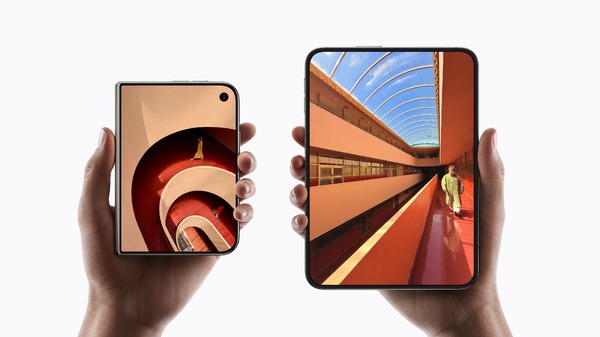
The Foldable iPhone Is Here. So Is the Bottleneck.
Apple announced the iPhone Duo in September and opened reservations on October 16. Within roughly 30 minutes, the company’s own checkout pages shifted the projected delivery date from a late-2026 launch window to January 25, 2027. By the time TechnoEdge filed this report, the date had crept back to January 22. That is less than a month of movement across thousands of orders, and it tells you everything you need to know about Apple’s first entry into the foldable segment.
Tim Cook called the demand “nothing short of extraordinary” in a statement to media outlets. What the statement did not say—because Apple does not say things like this—is that the company is already losing the pre-launch narrative to its own supply chain. The iPhone Duo is Apple’s most expensive product launch cycle in years, and it cannot get units into customers’ hands until well after the holiday shopping season. That is a self-inflicted constraint, and it is shaping the market in real time.
Internally, the situation is more complicated than a simple demand spike suggests. According to supply chain sources familiar with Foxconn’s assembly lines in Zhengzhou and Shenzhen, Apple initially planned for an October shipment of approximately 800,000 units across all configurations. That number has been revised downward to roughly 400,000 for the initial quarter—a 50 percent cut driven by yield issues with the hinge mechanism. The Duo’s dual-panel folding display, which Samsung has spent half a decade optimizing, appears to be generating failure rates significantly higher than Apple’s single-panel predecessors. Every unit that fails quality control represents not just a lost sale but a constraint on the entire production sequence, because the hinge assembly is the longest-lead-time component in the bill of materials.
Who Gets the Phone, and Who Does Not
Apple has instructed retail employees to tell walk-in customers at Apple Stores that they are unlikely to be able to purchase the device without a reservation. Some locations are not receiving any inventory beyond what was pre-allocated to reservations, according to reports from MacRumors. This is not a soft sell. It is a controlled scarcity play played out in the same stores that have spent over a decade perfecting the art of the impulse upgrade.
The retail strategy has a second-order effect that is already visible: customers who arrive without reservations are purchasing accessories, trade-ins, and older-gen iPhones at elevated levels, effectively subsidizing the brand during a period when the hero product is absent from the floor. Apple’s Q4 revenue guidance may not reflect the Duo’s unavailability, but the ecosystem spillover is real. Carrier stores are reporting similar dynamics, with activation bundles for the iPhone 16 series seeing incremental lift from Duo-curious shoppers who cannot wait.
In Japan, the pricing tells a separate story. The iPhone Duo starts at 364,800 yen and climbs to 574,800 yen for the 2TB model. Convert those numbers and they land firmly in premium territory even before you factor in the resale markup. And the resale markup is already visible. eBay listings are appearing at up to $5,200—roughly 822,000 yen—more than double the base price. Japanese flea market platforms like Mercari and Rakuma are seeing identical patterns, with some sellers listing units they never intended to keep, simply securing reservations as a speculation play.
The people who will pay $5,200 are not iPhone users who want a better camera. They are resellers, speculators, and early adopters for whom the device is a signal as much as a tool. That dynamic is not new for Apple. It is, however, new for a foldable form factor that Samsung and Chinese manufacturers have been refining since 2019. The irony is sharp: Apple’s first foldable is being treated by the market the way Samsung’s first Galaxy Z Fold was treated in 2019—as a proof-of-concept product priced for enthusiasts rather than the mass market.
The Hidden Story: What This Means for Samsung and the Foldable Market
Samsung introduced the Galaxy Z Fold line in 2019. It has released five generations since then. Huawei, OPPO, Xiaomi, and Honor have all shipped foldables. Apple did not. The iPhone Duo is Apple’s answer to a category that is still, by most measures, a niche.
Here is what the supply constraint reveals: Apple did not scale production for a niche market. It scaled production for something closer to a mainstream launch—because it expects the Duo to move the category, not follow it. If Apple can push a foldable iPhone past the enthusiast layer and into the hands of regular upgrading customers, the entire foldable market shifts. Samsung’s first-mover advantage erodes in a single product cycle.
But the January 2027 delivery date is a risk that extends beyond lost launch-week excitement. Every week of delay gives Samsung, Huawei, and Google’s upcoming foldable plans a window to capture the attention that Apple wanted to monopolize at launch. Google is reportedly preparing a pixel-fold variant with AI-native features that will land before the Duo ships. Huawei’s Mate X lineup continues to gain traction in enterprise and government sectors in Asia. Each month of absence from store shelves is a month these competitors occupy the mental real estate Apple assumed was its by default.
The iPhone Duo’s hardware—the A20 Pro chip, the hole-punch-free golden-ratio display, the pen support, the custom UI—will be judged against whatever competitors have shipped in the intervening months. That competitive calibration was always part of the plan. The question is whether it will happen on Apple’s timeline or someone else’s.
The Real Winner: Anyone With Inventory
Right now, the winners are the sellers on eBay and the Japanese resale platforms. They are moving product that Apple cannot produce fast enough. The secondary market is pricing in not just scarcity but anticipation—a bet that the Duo will hold value the way the original iPhone or the first Apple Watch did.
Apple’s carriers in Japan are likely absorbing some of the demand through locked-in contracts, which means the resale pressure is partly being siphoned into the formal retail channel. But the remaining overflow is creating a parallel market where a $1,800 device commands $5,200. That is not a sign of a healthy product cycle. It is a sign of a supply chain that has not yet caught up to the marketing.
There is also a less visible consequence: the resale premium is distorting Apple’s own customer data. Early buyers on the secondary market are disproportionately high-income, tech-enthusiast consumers who would have purchased regardless. This skews initial review sentiment upward and masks what actual mainstream adoption might look like. Analysts tracking early social media mentions and review content should adjust for this sample bias—a lesson learned poorly from the Apple Watch Series 1 launch in 2015, where pre-order scalpers similarly inflated early buzz metrics.
What Happens Next
Apple will ship. It always does. The question is whether the company can close the gap between its projected demand curve and its manufacturing capacity before the foldable window closes. The holiday season is already gone. Q1 2027 is when the real test begins: can the iPhone Duo sustain demand once the resale premium evaporates and the device is evaluated on its actual merits?
Supply chain analysts at TrendForce and Counterpoint are projecting that production yields will improve significantly by March 2027, potentially doubling output to 800,000 units per month. If that forecast holds, the January delivery backlog should clear by late February. But clearing the backlog and selling through are two different challenges. The second-hand market will dump inventory the moment supply normalizes, and any consumer who paid $3,000 or more on resale will feel price-anesthetized when the official price becomes available again through carrier deals and trade-in credits.
For the rest of the industry, the iPhone Duo launch is a stress test for the entire foldable segment. If Apple can make a foldable feel inevitable rather than experimental, the market moves faster than anyone expected. If the supply delays become a longer-term pattern, the foldable category stays niche a little while longer—and Samsung keeps the crown it has held since 2019.
The data so far suggests the former outcome is what Apple is betting on. The supply chain suggests it may not be ready to deliver. The next six weeks will determine whether the iPhone Duo opens a new era or becomes a cautionary tale about the gap between ambition and execution.