iPhone Duo Reservations Crush Supply in China Before Launch
Over a million Chinese consumers pre-registered for the iPhone Duo on JD.com against an estimated 200,000-unit initial allocation. The gap signals a supply crunch that could reshape Apple's China strategy and the foldable market.
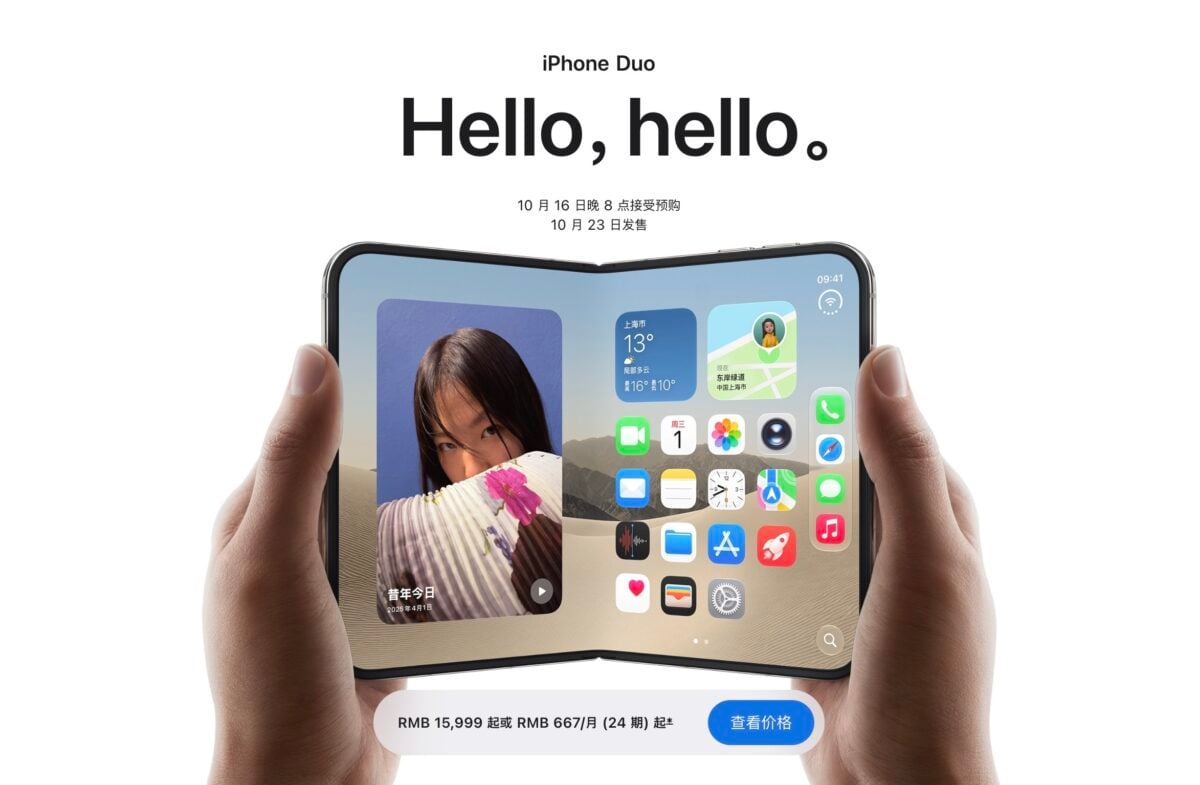
The numbers are staggering, even if they aren’t final
More than one million Chinese consumers have already registered to buy the iPhone Duo on JD.com — before the official preorder window even opens. The platform displays 1,068,000 pre-registrations as of now, with reservations officially starting October 16 at 8 p.m. local time and deliveries expected October 23.
Meanwhile, the initial allocation for China is reported to be roughly 200,000 units. That gap — a ratio of over five to one between expressed interest and available stock — is the kind of demand signal that doesn’t just make headlines. It forces a recalibration of how Apple plans its China strategy, its supply chain, and its pricing power in the world’s most competitive smartphone market.
It is also worth noting what these numbers are not. They are pre-registrations, not confirmed purchases. And the 200,000-unit allocation has not been officially confirmed by Apple or any retailer. The figures come from Apple industryWatcher yeux1122, who posted the JD.com screenshot on Naver Blog, and from analyst estimates. No official press release backs them up. But the consistency across sources — and the specificity of the JD.com interface — makes this the sharpest demand signal yet for Apple’s most ambitious product in years.
What happens when demand vastly outstrips allocation
A five-to-one gap between reservations and allocation almost guarantees three things: immediate sellouts, a secondary resale market, and frustrated consumers. In China’s e-commerce ecosystem, all three have happened before with high-demand products. The iPhone 16 series saw scalper markups of 10 to 20 percent at launch. The iPhone Duo, positioned as a premium foldable at approximately 368,498 yuan (roughly the same as the Japanese price of 364,800 yen), will face even sharper competition for limited units.
The resale risk is real. yeux1122 explicitly warned that scalping will intensify after the October launch. Scammers are likely to follow close behind — fraudulent sites advertising discounted Duo units have already been a pattern with major Apple launches in China, and this cycle appears no different.
But the more consequential outcome is strategic. If Apple intentionally holds allocation low, it is making a calculated bet: scarcity drives urgency, urgency drives culture, and culture drives long-term demand. This is a playbook Apple has used successfully with the Vision Pro and with special edition iPhone colorways. The risk is that the patience of Chinese consumers — the very segment that has sustained Apple’s revenue growth in the region — is thinner than it used to be. Huawei’s Mate series and its rival foldables have closed the innovation gap considerably.
Why the China numbers matter globally
Chinese demand for the iPhone Duo isn’t just a local curiosity. It is a leading indicator for Apple’s global supply chain decisions. If 200,000 units are earmarked for China at launch and demand already exceeds that five-fold, Apple will need to decide quickly whether to reallocate production from other regions or accelerate capacity expansion. Supply chain adjustments made in October ripple through November and December — the critical holiday selling season.
This is where the analyst forecasts become relevant. Jeff Pu of GF Securities projects iPhone Duo shipments of 7 million units by end of 2026. TrendForce sees 5 million units and a 24.8 percent share of the global foldable smartphone market that year. Both numbers are ambitious for a first-generation foldable from Apple, and both assume that demand doesn’t saturate the initial allocation window and fade.
The reservation data suggests the opposite of saturation. It suggests the launch window could be the narrowest point of the entire product cycle — the moment when supply constraints bite hardest and brand excitement is hottest.
The foldable market just got a new heavyweight
TrendForce also noted that the iPhone Duo will shift the competitive dynamics of the foldable market beyond hardware. The race is no longer just about thinner hinges and less visible creases. It is about AI-powered interfaces and new interaction models that only a device with Apple’s software integration can deliver. That is a different battleground — and one where Huawei, Samsung, and Honor currently hold the field.
Apple’s entry changes the calculus. Chinese consumers who have been waiting for a foldable that feels like an iPhone rather than an Android phone with a fold are clearly expressing that preference in large numbers. The 1 million-plus pre-registrations are not just purchase intent. They are a statement about what Apple product category could finally break through in China.
What to watch next
The official preorder opening on October 16 will be the first real test. If the 1 million pre-registrations convert to actual orders at a rate comparable to previous iPhone launches, the initial allocation will be exhausted within minutes — possibly seconds. That outcome will confirm the demand signal and force Apple into a rapid supply response.
If the conversion rate is lower — if many registrants were casual browsers rather than serious buyers — the picture changes. Apple could then hold allocation steady and avoid the worst of the scalper chaos.
Either way, the iPhone Duo launch in China will be the first major stress test of Apple’s ability to manage ultra-premium hardware demand in a market where consumer patience is no longer infinite and competition is fiercer than at any point in the last decade. The numbers on JD.com suggest the pressure is already building.