Iran's Economic Siege Is Accelerating De-Dollarization
As US economic warfare pushes Iran's rial to historic lows and food prices explode, the crisis reveals why Global South nations are quietly building alternatives to the dollar system.
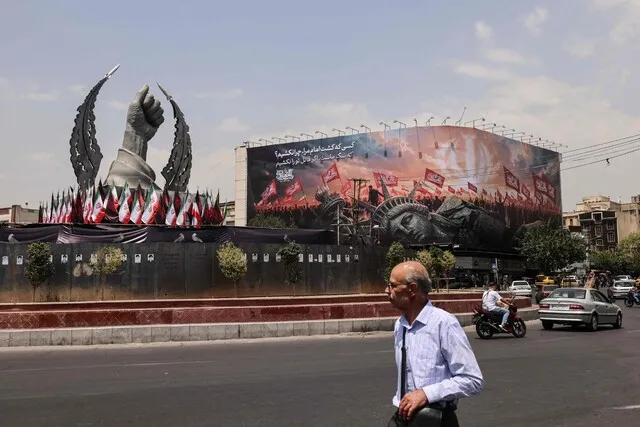
Tehran’s Price Tags, Not Rhetoric
The numbers coming out of Iran this week are brutal in their specificity. Edible cooking oil has surged 400 percent. Imported rice, up 211 percent. Infant formula, 93 percent. Insulin for diabetic patients — 642 percent.
These are not abstractions. They are what a 35-year-old mother in Tehran means when she tells reporters her family’s sole concern now is surviving until the end of the month, after both parents work and daycare costs have climbed to 5 million rials daily. The statutory minimum wage sits at 166 million rials a month — roughly $82 on the official rate, but closer to $40 if you trade at the unofficial market where 99 percent of real commerce happens.
That market rate hit 2.05 million rials per dollar on April 25, a new low, before recovering slightly the next day. The central bank’s posted rate is about 1.5 million. The gap between them is the gap between government fiction and household reality.
The War Is on the Balance Sheet
Iran’s finance minister admitted on April 24 that crude exports have fallen to zero. The US economic isolation operation, announced the same day, expanded sanctions to third-country companies and banks that still trade with Tehran — a move that effectively closes every door that has remained slightly ajar.
Iran depends on imports for a substantial share of its food and medicine. Agriculture Minister Gholam-Reza Nouri put the numbers plainly: $80 billion in annual agricultural exports against $160 billion in imports. The trade deficit is structural. The sanctions make it paralyzing.
But the Iranian leadership is not panicking publicly. Governor of the Central Bank Abdolnaser Hemmati told business leaders on April 20 that Iran has cash reserves stored in places the US cannot reach. Mossa Rezai of the Supreme National Security Council urged young people to enter production and build local supply chains. Economy Minister Seyed Ali Madanjzadeh told reporters on April 24: “We have our own methods. We know this game.”
The regime’s calculus is stark. Four decades of sanctions have produced deep institutional knowledge of evasion. The question is no longer whether Iran can survive economically — it is whether the survival strategy has consequences beyond Tehran’s borders.
The Second-Order Move
Here is what most English-language coverage of Iran’s crisis misses. The story is not just about suffering in Tehran. It is about what Tehran’s pain teaches other countries that are watching.
Trump has spoken openly about a “Pax Dollar” — the idea that American power should be reinforced by making the dollar more indispensable, not less. The sanctions on Iran fit that architecture perfectly. They send a message to every country that trades with Washington’s adversaries: you can do business, or you can do business with us. Not both.
The message lands. But it also produces the opposite of what Washington intends.
Every nation that sees how quickly its currency can be weaponized — how a trade partner can be cut off overnight, how dollar clearing can become a chokepoint — learns the same lesson. Diversify. Find alternatives. Build parallel systems.
This is already happening at scale. India has been paying for Russian oil in rupees and dirhams. China and Brazil have expanded local-currency trade between them. Saudi Arabia is discussing yuan settlement for some oil sales. The BRICS bloc continues to discuss alternative payment mechanisms. None of these movements are about replacing the dollar tomorrow. They are about ensuring that tomorrow never arrives unprepared.
Who Wins, Who Loses
The immediate losers in Iran are clear. Households. The poor. Patients who need imported medicine. The data from Al Jazeera shows that a family that could buy four kilograms of tomatoes, half a kilogram of chicken, and a liter of cooking oil for two million rials before the crisis now buys half that amount for the same money.
The regime wins survival, for now. It has gold. It has stash points. It has sanctions expertise. But survival is not prosperity, and the gap between them will widen.
Washington wins coercive leverage in the short term. It has demonstrated that it can isolate a major oil producer from the global financial system. That demonstration has value.
The longer-term winner, though, may be the very system Washington is trying to reinforce. De-dollarization does not accelerate because of ideology. It accelerates because of self-defense. Every sanction regime that functions as described — precise, painful, effective — makes other sovereigns ask a practical question: what happens when I am the one on the receiving end?
The Warning No One Is Publishing
Iran’s government has decided to stop publishing poverty statistics without approval from the Supreme National Security Council. That admission, buried in a routine government broadcast on April 25, tells you everything you need to know about the severity of the situation and the regime’s confidence that transparency would be politically dangerous.
The government spokesperson warned on state television that there should be no expectation of improvement for at least a year. A year of zero oil exports. A year of accelerating inflation. A year of watching your currency lose value while your wages stand still.
This is the kind of crisis that does not resolve quietly. It either produces political change inside Iran — which the regime is clearly trying to prevent through information control — or it produces political change outside it, as neighboring countries and trading partners recalibrate their relationships.
What Comes Next
The most important metric to watch is not the rial. It is the speed at which other countries reduce their dollar exposure in bilateral trade with Iran and with each other.
If Iran’s crisis pushes even a fraction of the countries currently exploring local-currency arrangements to actually implement them, the dollar’s share of global reserves and trade finance will continue its slow decline. Not dramatically. Not in a single year. But directionally.
That is the second-order effect of what is happening in Tehran right now. The images of empty shelves and soaring price tags are real and tragic. But the deeper story is about what those images teach the rest of the world about the costs of dollar dependence.
Iran is not leading de-dollarization. It is living proof that the dollar system can be weaponized. And living proof tends to be more persuasive than any policy paper.