Iran Mines Trigger Global Oil Shock Risk at Hormuz
Iran's IRGC claims two supertankers hit by mines in the Strait of Hormuz, paralyzing vessels carrying 4.5 million barrels of crude. The attack marks the most serious maritime disruption since the 1980s tanker war and raises urgent questions about whether Tehran is manufacturing an energy shock for political ends.
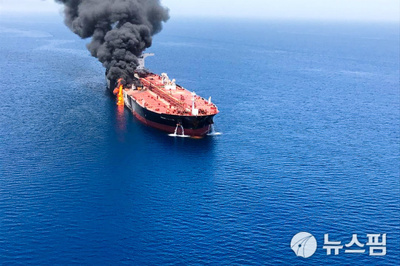
A Chokepoint Choked
Iran’s Islamic Revolutionary Guard Corps made a claim on October 23 that rewrites the risk calculus for global energy markets: two supertankers transiting the Strait of Hormuz struck sea mines and are now dead in the water, carrying a combined 4.5 million barrels of crude. The crew abandoned both vessels, which sit abandoned in one of the world’s most critical maritime arteries.
The IRGC did not mince words. It stated the tankers had attempted an unauthorized passage through a southern route of the strait. Mine explosions and fires disabled the engine rooms. The ships — immobilized, uncrewed, and potentially vulnerable to further damage — represent a direct and deliberate act of maritime warfare.
This is not a piracy incident. It is a state actor deliberately targeting commercial shipping in a chokepoint that handles roughly 21 million barrels of crude per day, or about 21 percent of global petroleum consumption, according to International Energy Agency figures.
The 1980s Parallel Is Not Metaphorical
The last time the world saw supertankers mined in the Gulf was the Iran-Iraq War of the 1980s, during what became known as the Tanker War. Iran and Iraq both targeted commercial vessels, and the U.S. Navy deployed minesweeping operations to keep the strait open. The conflict did not escalate into a broader regional war at the time, but it came close — and it sent oil prices spiraling.
What makes this moment more dangerous than the 1980s is the concentration of global demand around the Strait of Hormuz today. In the 1980s, alternative supply routes and production capacity existed elsewhere. Today, Japan, South Korea, and China — three economies that together consume more oil than the United States — rely heavily on Hormuz-transit cargoes. A sustained closure or even a credible threat of closure would trigger immediate price volatility and force emergency policy responses in capitals that have spent decades assuming energy flows from the Gulf would remain uninterrupted.
4.5 Million Barrels Is a Signal, Not Just a Number
The 4.5 million barrels immobilized in two supertankers is roughly equivalent to a single VLCC’s cargo — about 2 million barrels — doubled and a half. It is a symbolic target as much as a physical one. The IRGC’s message is that it can seize or sink whatever it chooses in the strait, and that the international response has been too slow, too divided, or too unwilling to enforce consequences.
The choice of an unauthorized southern route is notable. Iran has long patrolled its side of the strait and has previously harassed vessels it deemed to be violating its claimed shipping lanes. The mine attack escalates that harassment into a kinetic strike. The distinction matters: harassment creates insurance premiums and delays. Mines create incidents, wrecks, and insurance withdrawals. Marine war-risk insurers have already pulled back from covering some Gulf routes during periods of heightened tension. One more major incident could push the cost of transiting the strait into unviable territory for commercial operators.
The Election Angle Is Hard to Ignore
Donald Trump has already framed the attack as politically motivated, tying it to the U.S. election cycle. Whether Tehran intended to influence the outcome directly or simply to demonstrate leverage, the timing is striking. An energy shock in late October would reverberate through gasoline prices, inflation data, and consumer sentiment in the weeks before Americans head to the polls. That is not a theory — it is a playbook that has roots in earlier Iranian actions, including the 2020 drone strike at Saudi oil facilities that coincided with U.S. polling cycles.
What is less certain is whether the IRGC acted on orders from Tehran’s political leadership or followed its own strategic calculus. The Guards have a history of independent military operations that sometimes diverge from the president’s diplomatic preferences. If this was unilateral, it signals internal friction at the top. If it was directed, it signals that Iran has chosen escalation over restraint — and that the energy weapon is now being aimed at global markets, not just at regional adversaries.
Who Wins, Who Loses
Iran wins credibility among its proxies and signaling power among its enemies. A single mine attack in the strait forces every naval power in the region to respond, and it forces every oil importer to feel the pressure immediately. The cost to Iran is limited — it has little to lose if the world punishes the act, and the blame can be deflected or denied.
The losers are clear. Shipowners and insurers face higher premiums or refusal to cover routes. Japan and South Korea, the two largest importers of Gulf crude, face the prospect of rationing or price spikes that their governments have spent years trying to insulate against. The United States faces a strategic dilemma: intervene militarily and risk a wider conflict, or stand aside and watch the global economy absorb the shock.
What Happens Next
The immediate question is whether the two disabled tankers can be towed free or whether they become total losses. The second question — and the one that matters globally — is whether the IRGC signals that more mines are incoming, or that the strait is now closed to certain categories of traffic. A single incident is an attack. A pattern is a blockade.
The U.S. Navy’s Fifth Fleet in Bahrain will likely respond with increased patrols and possibly minesweeping assets. The International Maritime Organization will convene emergency sessions. Oil traders will price in risk premiums that could add several dollars per barrel within days.
The longer-term risk is far more concerning. Iran has demonstrated that it can strike commercial shipping in the strait without provoking a full-scale war. If that calculus holds — if the international response remains calibrated and fragmented — then the Strait of Hormuz becomes a recurring hostage to Tehran’s demands, and the global energy system learns to live with periodic shocks instead of preventing them.
That is the real consequence of these mines. Not the 4.5 million barrels trapped in the water, but the precedent that one nation can now weaponize a strait that the world depends on.
The 1980s tanker war ended because the cost of inaction became higher than the cost of intervention. There is no guarantee the same logic applies today.