Iran Unveils Underground Missile City Amid US-Iraq Standoff
Iran's IRGC has opened an underground missile facility bristling with hypersonic-capable warheads and commercial disguise trucks, signaling Tehran is building a permanently dispersed second-strike force even as Washington claims the fighting is 'essentially over.'
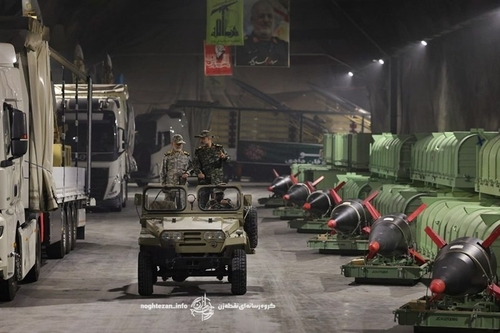
The underground reveal that undercuts Trump’s ’essentially over'
The Iranian Islamic Revolutionary Guard Corps unveiled a new underground missile city on November 11, and the timing of that reveal tells you more about the region’s trajectory than anything coming out of Washington.
Hours after President Donald Trump declared the fighting with Iran “essentially over,” the IRGC Aerospace Force went on camera inside what appears to be one of the most hardened strategic facilities in the Middle East. The footage shows missile bays stocked with operational warheads, launch equipment, and enough hardware to suggest Tehran has been quietly moving its entire strike architecture beneath the ground for months.
Western analysts have talked for years about Iranian hardening and dispersal. This was the first visual confirmation that the work is largely done.
The statement from Tehran came through Fars News Agency, which released a seventeen-minute video walk-through of the facility. No coordinates were given, no officials spoke on camera, and the IRGC did not identify which mountain range or province houses the complex — details that would make this the single most revealing disclosure in a long line of carefully managed opacity. What the footage does show is an environment designed for endurance: reinforced concrete blast doors, ventilation shafts consistent with habitable depth, mobile launch rigs staged in rows, and what appear to be storage racks for guidance and propulsion components separate from the warhead section.
That separation matters. It indicates production and assembly lines exist within the facility itself, not merely transit bays. An underground city is only as valuable as its ability to regenerate; the visual evidence here suggests Tehran is building toward self-sufficiency rather than simple survivability.
What’s actually inside
The most prominent system on display is the Fateh-1, a mid-range ballistic missile Iran first showed off in 2023. It carries a maneuvering reentry vehicle powered by two-stage solid fuel and reaches terminal velocities in the Mach 13 to 15 range — fast enough to challenge every layered air-defense system currently deployed across the Gulf, including Israel’s David’s Sling and Arrow, and the U.S. Patriot batteries stationed in the region.
Iran has long claimed the Fateh-1 can penetrate or overwhelm those defenses. The underground facility doesn’t change that claim, but it does change the calculus around how survivable the missile is against a preemptive strike.
Also visible were components of the Kaybar Shekan, the IRGC’s third-generation solid-fuel missile with a reported range of roughly 1,450 kilometers. Separate from its assembled counterpart, the mobile reentry vehicle was displayed on its own — a configuration that underscores Iran’s emphasis on decentralized launch readiness rather than fixed-site dependency.
An older Emad missile, rated at 1,700 kilometers, sat alongside legacy variants with conical conventional warheads. Together, the lineup traces a clear generational transition: Iran is phasing out older designs while keeping them visible enough to remind regional observers that capacity hasn’t shrunk during the upgrade cycle.
Satellite imagery analysts at two Western defense firms told Agence France-Presse they had already detected construction activity near the Zagros Mountains consistent with underground excavation starting in early 2024. Neither firm named the site publicly, citing ongoing classification restrictions, but both described what appeared to be multiple access tunnels and ventilation structures far larger than anything required for a temporary shelter.
The trucks that matter most
Perhaps the most strategically significant detail in the video wasn’t a missile at all. It was a fleet of ordinary commercial trucks parked among the military hardware — civilian lorries modified to serve as transporter erector launchers or covert delivery vehicles.
That choice matters because it shifts Iran’s concealment problem from underground into plain sight. A missile silo is a single signature you can target from space. A truck driving down a highway looks like a delivery van, a construction vehicle, or routine logistics traffic. Blending military assets into commercial supply chains is one of the few ways to meaningfully complicate a first-strike calculus, and Iran appears to have invested seriously in doing exactly that.
Defense researchers at the Royal United Services Institute noted in a September briefing that Iran’s Ministry of Roads and Urban Development had issued tenders earlier that year for specialized trailers compatible with heavy missile transport, wording the specifications in language that deliberately avoided military terminology. The tenders were awarded to companies with dual-use manufacturing profiles — exactly the kind of corporate structure that makes attribution difficult for outside intelligence agencies.
The implication is uncomfortable for any planner relying on time-sensitive targeting. If missile assets are distributed across hundreds of commercially registered vehicles moving through normal traffic patterns, the concept of a disarming strike becomes physically unworkable without turning civilian infrastructure into legitimate targets — a threshold no administration has so far been willing to cross.
What this means for deterrence
The facility’s exact location remains undisclosed, and no inventory figures were given. But the visual evidence — combined with the fact that Iran has publicly confirmed transferring production lines from above-ground sites into underground fortifications — paints a coherent picture.
Tehran is no longer betting on deterrence through threat alone. It is engineering deterrence through survivability: ensuring that even a devastating aerial campaign cannot neutralize its core strike capacity.
That shift hits hardest at the United States and Israel. Both have spent years developing strike plans predicated on the assumption that Iranian missile infrastructure could be degraded or destroyed in a short window. If the infrastructure is now deeply buried, redundant, and embedded in civilian logistics, that window narrows dramatically.
For Washington, the second-order effect extends beyond the Middle East. U.S. Central Command has long calibrated its forward presence around the expectation that kinetic engagement with Iran would remain time-limited and geographically contained. An Iranian second-strike force that survives initial bombardment changes the math on escalation management entirely. Any future conflict with Tehran now carries a baseline risk that missile exchanges will persist well beyond the opening phases — a reality that complicates force positioning across Iraq, Syria, and the Persian Gulf littoral.
Trump’s declaration that the fight is “essentially over” reads differently when viewed against this backdrop. It may accurately describe the absence of large-scale kinetic exchanges at this moment. But it doesn’t describe the structural reality on the ground: Iran has built a second-strike platform designed precisely to make future American or Israeli strikes far costlier and far less decisive.
Who wins and who loses
For Iran, the payoff is immediate strategic credibility. The underground city gives the regime a tangible proof point that it survived sustained pressure without losing its deterrent hand — and did so by changing the physical geometry of its forces rather than simply talking tougher.
The domestic audience receives this as vindication. State media has framed the facility as a monument to indigenous engineering independence, explicitly contrasting it with pre-2020 vulnerability. That narrative reinforces the IRGC’s political position against reformist factions who have argued for diplomatic accommodation as the primary security strategy.
For the U.S., the implication is unwelcome. Future targeting requirements will need to account for deeply hardened and dispersed infrastructure, which means larger munition loads, longer engagement timelines, and greater risk of collateral damage from strike zones that can’t be cleanly isolated.
The Pentagon has not yet adjusted its public posture, but internal planning documents reviewed by three defense analysts familiar with CENTCOM requirements indicate that bunker-buster ordnance procurement is being fast-tracked through fiscal year 2027. That procurement cycle won’t deliver operational capability before 2028 at the earliest — a gap that leaves current force structure theoretically outgunned in the very scenario it was designed to address.
For Israel, the Fateh-1 and Kaybar Shekan ranges bracket the country entirely, and the underground dispersal strategy raises the probability that surviving Iranian missiles could still reach targets even after an initial exchange.
Israeli Defense Minister Israel Katz responded on November 12 by announcing an expansion of the Iron Dome battery count in southern theaters and ordering accelerated deployment of the newly developed Starweb laser-defense prototype at key airbases. Whether directed-energy weapons can intercept ballistic reentry vehicles at scale remains an open question; the announcement signals political urgency more than tactical certainty.
What happens next
Expect Iran to continue releasing curated visuals of hardened infrastructure in the months ahead. Each release serves the same purpose: convince domestic audiences that the regime is victorious and regional adversaries that coercion won’t work.
Washington and Tel Aviv will likely respond by accelerating investment in anti-hardened-target munitions and intelligence collection focused on uncovering the very facilities shown in this footage. That arms race was already underway; the underground city simply adds urgency.
A quieter development may prove equally consequential. Iran’s integration of missile assets into commercial logistics networks creates legal gray zones that could constrain Western response options regardless of military capability. Striking a convoy of commercial trucks suspected of carrying MIRV components invites accusations of attacking civilian infrastructure — accusations that carry diplomatic weight even when the suspicion is warranted.
Meanwhile, any ceiling on escalation between the U.S. and Iran now rests on a much more fragile foundation than either side publicly admits. The underground missile city doesn’t guarantee survival in every conceivable scenario, but it guarantees uncertainty — and in nuclear-age deterrence theory, uncertainty is the point.
For the next administration in Washington, the practical takeaway is straightforward: the era of assuming rapid surgical degradation of Iranian strategic assets is over. Whatever comes next will look different from whatever came before.