Iran Warns Seoul in Korean: The Hormuz Flashpoint No One Is Following
Iran’s foreign ministry spokesperson posted a warning in Korean directly to South Korea about Hormuz Strait deployment — a rare escalation that links Middle East energy risk to East Asian geopolitics. Here’s what it means.
Iran Spoke Korean to South Korea. That Is the Point.
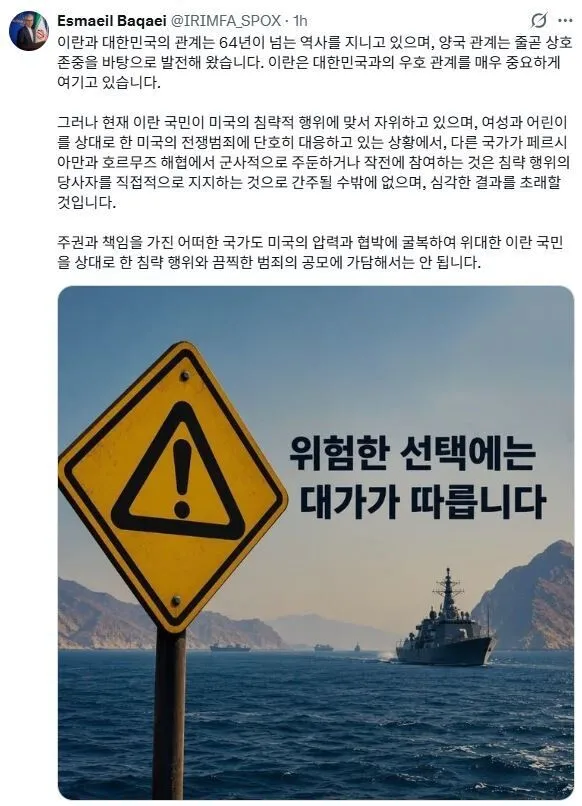
Esmaeil Baghai, the Iranian foreign ministry spokesperson, posted a message on X on the 7th in Korean. Not English. Not Arabic. Korean.
The warning was unmistakable: if South Korea deploys military forces to the Hormuz Strait in support of US operations, Tehran will treat it as direct participation in American aggression and respond with serious consequences.
Iran and South Korea have maintained diplomatic relations for over 64 years. Baghai made sure to mention that — right before the threat. The post was accompanied by an image of warships navigating the narrow strait, with the Korean caption: “Dangerous choices come with a price.”
This is not routine diplomatic posture. Iran has occasionally addressed other countries in their own language on social media before. But targeting Seoul specifically, in Korean, at a time when Washington is actively pressuring allies to contribute military assets to Hormuz, changes the calculus. It signals that Tehran sees South Korea not as a distant partner but as a potential belligerent — and is giving it a chance to step back before things escalate.
The choice of language matters more than analysts are admitting. By posting in Korean, Iran bypassed the usual English-language diplomatic circuit and went straight to Seoul’s strategic community — including policymakers, military planners, and energy officials who consume geopolitical analysis in Korean. This is information warfare aimed squarely at the decision-making apparatus, not just foreign ministries. It suggests Tehran has a functioning Korean-language capability within its foreign policy establishment, which reflects years of deliberate investment in reaching East Asian audiences directly.
The Timing Is Not Accidental
The US has been pressing partners hard. On the 6th, Energy Secretary Chris Wright told Fox News that the US hopes allied military assets from outside the region will enter the Hormuz Strait area quickly. The message to Seoul, Tokyo, and others was clear: the ball is in your court.
South Korea is reportedly weighing its options — military contribution among them. Iran does not want that. Two days earlier, on the 4th, a senior Iranian security official had already gone through a Lebanese media outlet to warn Korea directly: if Seoul cooperates with what Iran calls an illegal US military operation, Tehran will consider it a direct military participation in the US-Israel campaign against Iran.
The two warnings are coordinated. One went through formal diplomatic channels on social media. The other used a regional intermediary. Both were aimed at the same audience: Seoul’s leadership. The progression from backchannel to public messaging suggests a deliberate escalation of pressure — a classic coercive diplomacy sequence where each step raises the cost of ignoring the threat.
Washington’s public pressure campaign has created a diplomatic trap for Seoul. The US is explicitly asking allies to demonstrate commitment through forward deployment, while Iran is offering a direct off-ramp if Seoul refuses. This puts South Korea in the rare position of being squeezed from both directions simultaneously — a scenario that tests alliance loyalty against national interest in real time.
Who Is Being Targeted — And Why Korea Specifically
Most English-language coverage of the Hormuz crisis frames it as a US-Iran showdown. Iran is angry at Washington. That is true, but incomplete. Tehran is also deliberately reaching out to countries that have not yet picked a side — and signaling that neutrality will not protect them if they cross certain lines.
South Korea is a particularly sensitive case. It is a US treaty ally. But it is not a Middle East power. Its energy security is deeply tied to the Hormuz Strait — roughly 20 percent of Korea’s oil imports pass through it. Seoul has a direct interest in keeping the strait open, which creates a complicated incentive structure. Deploy troops and risk Iranian retaliation against Korean shipping or citizens in the region? Stay away and risk angering Washington, the security guarantor?
Iran understands this tension. The Korean-language post is calibrated to exploit it — reminding Seoul of the 64-year friendship, suggesting that partnership with America does not have to mean confrontation with Tehran, and warning that the cost of choosing wrong will be borne by Koreans, not Americans.
The economic dimension is often understated. South Korea is one of the world’s largest importers of Iranian-origin crude, even under sanctions, via indirect supply chains. A significant disruption to Hormuz would raise fuel prices in Seoul almost immediately, with political consequences for whichever party is in power. Iran appears to be calculating that Seoul’s domestic political calculus makes it more vulnerable to energy price shocks than Washington’s — a asymmetric vulnerability that Tehran can leverage without firing a shot.
Second-Order Effects: The Alliance Question and Regional Ripple
The Korean warning carries implications that extend well beyond the Strait itself. If Iran succeeds in keeping South Korea out of a Hormuz operation, it would set a precedent that could reshape how Washington views its alliance network. The US has long counted on allied burden-sharing in crisis scenarios — from Kuwait to Djibouti to the South China Sea. A successful Iranian deterrence campaign against a major East Asian ally would demonstrate that coercive signaling can fracture multilateral responses to US-led operations.
Japan is watching closely. Tokyo shares South Korea’s energy dependency on the Middle East and faces its own US pressure to contribute. If Seoul declines, Japan may feel emboldened to do the same — or equally constrained by the example. The regional alliance architecture that the US has built over decades rests partly on the assumption that commitments are mutual and predictable. Iranian direct appeals to non-regional powers introduce a variable that complicates that predictability.
There is also a naval dimension worth noting. South Korea operates a blue-water navy with experience in anti-piracy missions off the Horn of Africa. Deploying vessels to Hormuz would be a credible capability for Seoul to offer. But it would also place Korean sailors in a high-risk zone where Iran has already demonstrated willingness to interdict commercial shipping. The moral hazard of sending a navy into contested waters without a clear escalation management framework is substantial — and Iran seems to know that Seoul is aware of it.
What Happens Next
The immediate risk is miscalculation. Iran has already demonstrated a willingness to disrupt maritime traffic in the strait during its recent exchange with the US. A Korean military presence — even a limited one — could be interpreted as a hostile act and trigger a response that Seoul did not anticipate and did not want.
The longer-term implication is sharper. If Iran can successfully pressure a US ally to stay out of a conflict Washington wants it in, it wins a strategic victory without firing a shot. That is exactly the kind of asymmetric leverage Tehran specializes in.
Seoul’s government will need to navigate between two impossible positions: appearing weak to its American ally and appearing reckless to its own economic interests. The Korean-language warning from Iran is a door left open. Whether Seoul walks through it remains to be seen.
One outcome deserves serious attention: South Korea could respond with its own calibrated messaging — reaffirming its alliance commitments while leaving ambiguity about concrete military contributions. This would satisfy Washington’s political need for alliance solidarity without crossing Iran’s stated red line. It is a diplomatic path that both capitals have used before with other stakeholders. But it requires both sides to accept a degree of ambiguity, and neither Washington nor Tehran has shown much patience for that approach lately.
The Hormuz crisis is no longer just a Middle East problem. It is a test of whether regional powers can project coercive diplomacy across theaters, and whether US allies can maintain autonomous decision-making when caught between a patron’s demands and an adversary’s threats. Iran’s Korean-language post was not a diplomatic oddity. It was a preview of a more fragmented and unpredictable geopolitical landscape — one where warnings travel faster, cross more borders, and land directly on the desks of leaders who never expected to be part of the conversation.