Iran's Oil Lifeline Hits Zero — What December Means
Iran's offshore oil stash will run out by mid-December after the US blockade cut exports to one-ninth. The question is whether economic strangulation forces Tehran into diplomacy or a military gamble.
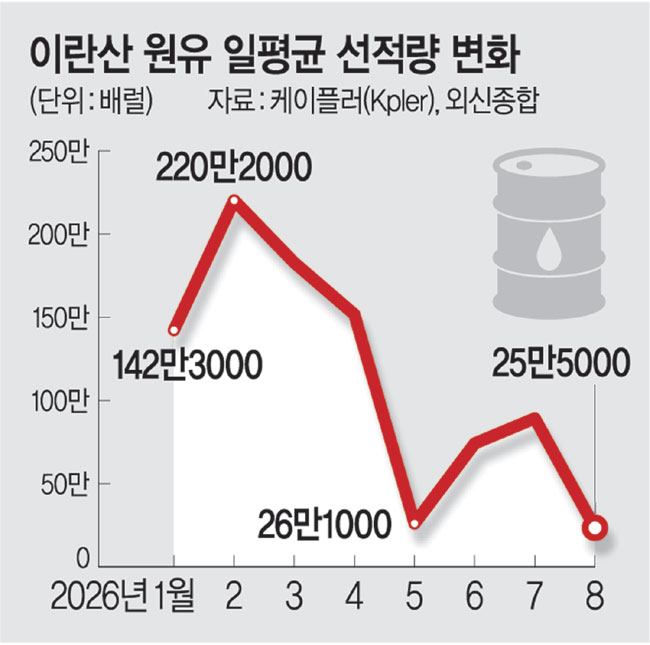
The December Deadline
Iran’s last drops of exportable crude will vanish from global markets by mid-December. That is the uncomfortable arithmetic emerging from US maritime blockade enforcement and financial pressure that is squeezing Tehran’s oil dollars into near-total suffocation.
The numbers are stark. Before the US reimposed its blockade in July, Iran was shipping roughly 2.2 million barrels per day — comparable to pre-conflict levels from late February. By August, that figure cratered to 255,000 barrels per day. The Strait of Hormuz, the artery through which the bulk of Iran’s energy exports flow, has been effectively sealed. Only 29 million barrels remain sitting on tankers outside the blockade line. At an export rate of approximately 1 million barrels per day heading to China, those stocks will be exhausted before Christmas.
This is not merely a statistics problem. It is a structural collapse with cascading consequences that reach far beyond the oil terminals and into the heart of Iranian governance, regional power dynamics, and global energy markets.
Who Gets Crushed First
Iran’s economy was already gasping under Western sanctions before the blockade tightened the noose. Inflation hit over 80 percent between June and August compared to the same period last year. The rial has plummeted. Domestic prices have spiraled. But the new variable is timing — the blockade does not just suppress revenue, it eliminates the possibility of recovery.
Oil revenue funds roughly one-third of Iran’s state budget. More critically, it sustains the financial apparatus of the Islamic Revolutionary Guard Corps, the institution that effectively controls Iran’s strategic direction today. When the money stops, the soldiers stop getting paid — or they find other ways to get paid.
That second option is the one Washington should worry about most. The IRGC’s Quds Force operates across Lebanon, Syria, Iraq, and Yemen through proxy networks that require constant financial injection. When direct oil revenue dries up, those same channels may be repurposed — not toward subsidy and protection, but toward extraction. Smuggling operations already running along Iran’s western and eastern borders could expand dramatically. Hard currency earned through illicit trade would flow directly into IRGC coffers, bypassing the central bank entirely.
Meanwhile, ordinary Iranians face a winter they cannot afford. Heat subsidies are tied to oil revenue. When that revenue vanishes, the government either cuts heating for millions of households or prints money to cover the gap — and printing money in an economy already experiencing 80 percent inflation is a prescription for hyperinflation. The social contract that has held Iran together, however frayed, begins to unravel at the edges.
The Referendum Gambit
Hassan Rouhani, Iran’s former president and a figure associated with the country’s more pragmatic political wing, recently called for what amounted to a peace referendum. Speaking in substance if not in explicit terminology, he argued that if the Iranian people rejected continued confrontation, the leadership had no moral basis to ignore that verdict. Restore infrastructure. Renew hope for youth and investors. End the conflict with honor.
The language is significant. It signals that at least a faction within Iran’s political establishment sees economic exhaustion as a mandate to de-escalate. If Rouhani’s camp gains traction, it could produce a diplomatic opening before December. The European Union has already begun signaling willingness to re-engage on nuclear questions, and Turkey and Oman have offered quiet mediation channels that could provide an off-ramp for both sides.
But counting on that outcome assumes rational cost-benefit calculations guide Iranian decision-making. That assumption may be dangerously naive. Iran’s leadership has survived worse economic collapses before. The 1980s endured eight years of war with Iraq while the economy contracted by an estimated 30 percent. The regime did not fall — it consolidated. Hardliners used external pressure as justification to crack down domestically and deepen ideological commitment. Economic pain, in the Iranian political tradition, is often weaponized inward as much as endured outward.
The Military Option
Several analysts within Iran and abroad warn that economic strangulation could produce the opposite of submission — it could produce desperation-driven escalation. The IRGC, whose finances depend on oil revenue, has demonstrated repeatedly that it does not passively accept external pressure. When economic tools are removed, asymmetric military options become comparatively more attractive.
A confined coastline, proximate US assets, and a military doctrine built around proxy networks and short-strike capabilities create a scenario where losing economically could translate into winning tactically — through disruption, intimidation, or provocation designed to force negotiations from a position of controlled chaos. Mining the Strait of Hormuz, harassing commercial shipping, or directing proxy attacks against Gulf energy infrastructure are all within Iran’s demonstrated capability and would send shockwaves through global oil markets even without a full-scale war.
Washington appears to dismiss this risk. President Donald Trump told reporters that US victory over Iran would send oil prices tumbling alongside all other inflation pressures, predicting gasoline could fall below $2 per gallon. The simplicity of that claim obscures the volatility that any military escalation in the Gulf would introduce to global energy markets. Hormuz carries roughly 20 percent of global oil consumption. Even the threat of its closure sends price premiums spiking. Iran does not need to sink a single tanker to make that point — it needs only to lay mines or fire a warning shot across the bow of a commercial vessel.
The second-order effects extend well beyond energy prices. Insurance rates for Gulf shipping would surge. Alternative routes through the Red Sea and around Africa would face capacity constraints already evident during the 2023 Red Sea disruptions. Food security imports for Gulf states — many of which arrive by sea — would become more expensive and less reliable. The entire logistical architecture of the region rests on the assumption that Hormuz remains open, and that assumption is now under active stress.
Who Wins, Who Loses
If Iran capitulates diplomatically before the oil runs out, Washington achieves its stated objective without firing a shot — but the IRGC retains institutional power and the regime’s coercive apparatus survives intact. Iran loses economic sovereignty but not political structure. The question is whether a regime that survives on humiliation proves more stable or more dangerous in the long term. History suggests the latter.
If Iran chooses military escalation instead, the Strait of Hormuz faces renewed threat, global oil prices spike, and regional war becomes a real possibility. That outcome hurts American consumers even as it satisfies hawkish objectives — a contradiction that has defined US Iran policy for decades. Gulf allies would demand expanded US military commitments, tying Washington further into a region it has repeatedly struggled to disengage from. China, Iran’s primary oil buyer, would face its own economic disruption and likely apply quiet pressure on Tehran to de-escalate — adding another layer of external influence to an already complex equation.
If the blockade holds and Iran simply endures, the economy continues its slow hemorrhage. Rouhani’s referendum push gains little traction. The IRGC tightens its grip domestically while finding alternative revenue through smuggling, corruption, and proxy operations. No clear winner emerges — only a prolonged grinding decline that destabilizes the entire region. Afghanistan and Pakistan feel the pressure of displaced economic migrants. Iraq watches its own energy sector convulse from Iranian political interference reborn as desperation. Syria’s fragile recovery stalls entirely.
What Comes Next
The critical window closes in mid-December. Every day until then represents a diplomatic opportunity — for backchannel negotiations, for prisoner swaps, for a face-saving de-escalation that avoids both economic catastrophe and military confrontation. Every day past that point narrows Iran’s options and raises the probability of violent adaptation.
The blockade is working as designed. The question is whether design and outcome are the same thing. An economy hollowed out by starvation-level sanctions does not necessarily bend — it can break, and when it breaks, it breaks outward. The world watched what happened when Iraq’s economy collapsed under sanctions in the 1990s. The consequences took decades to fully unfold.
December will not be the end of the story. But it will be the point of no return — the moment when Tehran’s choice between negotiation and escalation stops being theoretical and becomes operational. How Washington responds, how Europe positions itself, and whether China offers Iran a financial lifeline through alternative payment mechanisms will determine not just the fate of one country but the stability of an entire region built on the assumption that oil keeps flowing and politics stays separate from commerce.