Japan Just Made Battery-Free Infrastructure Sensors Real
Osaka University and Daicel have built a 3mm sensor that listens to building stress and gas leaks from 50 meters away — forever, without a battery. It could change how Japan monitors its crumbling infrastructure.
A Sensor That Never Dies — And Doesn’t Need a Battery to Prove It
Japan has a quiet infrastructure problem. Much of the bridge, tunnel, and dam construction boom from the 1960s and 70s is now entering its failure window, and the country’s inspection regime is strained. Engineers check these structures by hand — visual surveys, hammer taps, sporadic sensor placements that go offline within months as batteries drain or wiring fails.
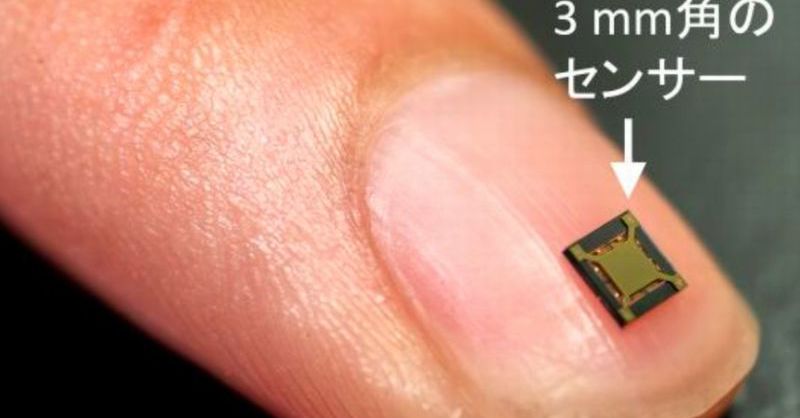
Osaka University and Daicel have just shown a way out. In August 2026, the research team led by Professor Hajime Ogihori and doctoral researcher Moyuki Hamana demonstrated a 3-millimeter-square sensor that can measure structural strain and gas concentrations from over 50 meters away — wirelessly, without any power source, and indefinitely.
The trick is not new in principle but the execution is. The sensor contains a quartz micro-bell, a plate approximately 10 micrometers thick, suspended inside the package. When you send a radio-frequency tone at the right frequency, the quartz bell resonates. It rings like a tuning fork. Even after the excitation signal stops, the bell continues vibrating for roughly one-thousandth of a second, radiating its own signal back. Measuring that decay frequency tells you the bell’s resonant state — and any change in the structure to which it’s bonded shifts that frequency.
The team achieved measurement precision below 0.001 percent across 50 meters, sampling up to 500 times per second. That last number matters: it means the sensor can capture vibrational signatures up to around 100 Hz, which covers the frequency range of most structural anomalies — resonance shifts in a bridge deck, the onset of fatigue cracking, the subtle breathing of a deteriorating support column.
Why This Design Is Different From Everything Else
Most wireless sensor networks today solve the power problem with energy harvesting — piezoelectric pickups, solar cells, or RF rectennas — and then pair them with low-power radios. The result is fragile. Harvesting works when the environment is generous. It fails on the shaded side of a bridge pylon, inside a damp tunnel, or in structures designed precisely to shield themselves from the sun. Batteries die. Harvested power fluctuates. Maintenance windows creep up.
This sensor takes a different path. It doesn’t harvest energy to run a transmitter. It harvests energy to resonate — and the resonance itself carries the signal home. There is no battery to deplete, no power management circuit to fail, no firmware to corrupt. The sensing element and the communication channel are the same physical object: the quartz bell.
That distinction is easy to undersell. It means the sensor has no on-off cycle, no sleep-wake scheduling, no duty-cycling to conserve charge. It is listening constantly, from the moment it is attached, as long as something — any ambient RF, any intentional interrogation pulse — can excite it.
The team also demonstrated hydrogen detection by coating the quartz bell with a palladium alloy film. Hydrogen absorption changes the bell’s mass and stiffness, shifting its resonant frequency. They measured gas concentration changes at tens of meters distance without power. That opens a parallel use case — leak detection in gas pipelines and industrial sites — beyond structural monitoring.
The Market That Actually Needs This
Japan is the canary. Its public infrastructure, particularly the thousands of concrete bridges built during the rapid growth era, is widely acknowledged to be past mid-life. The Ministry of Land, Infrastructure, Transport and Tourism has estimated that over 60 percent of the nation’s bridges are now 40 years or older, and inspection backlogs are a political issue. But the problem is not Japan-only. Europe, North America, and much of East Asia share the same aging inventory — and the same labor shortage for manual inspection.
The global structural health monitoring market was valued at roughly $2.5 billion in 2024 and is growing at about 8 to 10 percent annually, according to industry estimates. Most of that spending goes toward wired sensor networks, periodic drone surveys, and human-led inspections. A truly perpetual wireless sensor that costs pennies to manufacture and lasts decades would not just improve existing workflows — it would replace entire categories of inspection contracts.
Here is the non-obvious part: Western companies have dominated the IoT sensor conversation for years, but they have been chasing the wrong metric. The headline for most Western proposals has been “low power” or “energy harvesting.” Few have delivered systems that are actually battery-free across realistic deployment conditions. Japan’s approach sidesteps that trap by eliminating the need for continuous power at the sensor entirely.
Who Wins, Who Loses
Daicel, the materials partner in this project, is a Japanese chemical company with deep expertise in polymers and thin-film processing. The palladium-alloy coating for hydrogen detection and the MEMS fabrication path for the quartz bell both fall within its capabilities. If this technology moves toward production, Daicel gains a defensible position in a market where sensor manufacturing has historically been fragmented between academic labs and large instrument companies like Endress+Hauser or Bentley Systems.
Osaka University’s involvement signals that this came out of fundamental research in MEMS resonators — a field where Japan has historically been strong but has struggled to commercialize. The partnership model, university-to-corporate, is a familiar Japanese pattern. It also means the IP will likely be jointly controlled, which could slow or shape licensing decisions.
Western IoT players — Silicon Labs, Texas Instruments, and the many startups building LPWAN sensor networks — face a different reality. Their entire business model rests on the premise that sensors need power management, connectivity stacks, and periodic maintenance. A sensor that does none of those things is not a competitor in the same lane. It is a different lane entirely. The question for Western firms is whether they can adapt their architectures or whether they will be left maintaining networks that compete against systems that simply do not need maintaining.
What Comes Next
The Osaka University team has demonstrated the principle. The sensor works in a lab setting at 50 meters. Several questions remain open.
The first is scale. The 3mm sensor is a research prototype. Manufacturing millions of them at cost requires MEMS foundry capacity and packaging expertise that the team has not yet addressed publicly. Daicel’s involvement suggests a production path exists, but the unit cost — the number that determines whether this replaces wired networks or remains a niche solution — is unknown.
The second is deployment. The sensor requires an RF interrogation signal to excite the quartz bell. In a lab, that is a benchtop generator. In the field, it could be a fixed reader unit, a drone, or a rolling vehicle. The 50-meter range means each reader covers a有限 area. A full bridge monitoring system would need multiple readers or a mobile interrogation strategy. How that geometry works in practice has not been published.
The third is environmental durability. The quartz bell is 10 micrometers thick — incredibly fine. Bonding it to a structure and exposing it to rain, freeze-thaw cycles, UV degradation, and vibration for decades is a materials challenge that the team has not yet demonstrated. The palladium alloy coating for gas sensing adds another layer of degradation risk.
None of these are showstoppers. They are engineering problems. The science is solid.
The Bigger Picture
What makes this development worth watching is not the sensor itself but what it represents. Japan has spent decades building capabilities in precision MEMS, quartz resonance, and materials science — fields that occasionally get overshadowed by the country’s more visible consumer electronics and automotive stories. This project is a convergence of those strengths: a fundamental physics insight, a MEMS fabrication capability, a materials science partnership, and a market need that the country understands better than most.
The Western IoT industry has been obsessed with making batteries last longer. Japan is quietly building sensors that do not need batteries at all.
The infrastructure inspection market is about to get a lot more interesting.