Japan's Phobos Gamble: Why MMX Matters Beyond the Red Moon
Japan is about to attempt the world's first Phobos sample return, a mission that could rewrite origins theories and shift deep-space exploration dynamics. While Western agencies study the Red Moon, Japan is already reaching for it.
The launch that nobody saw coming
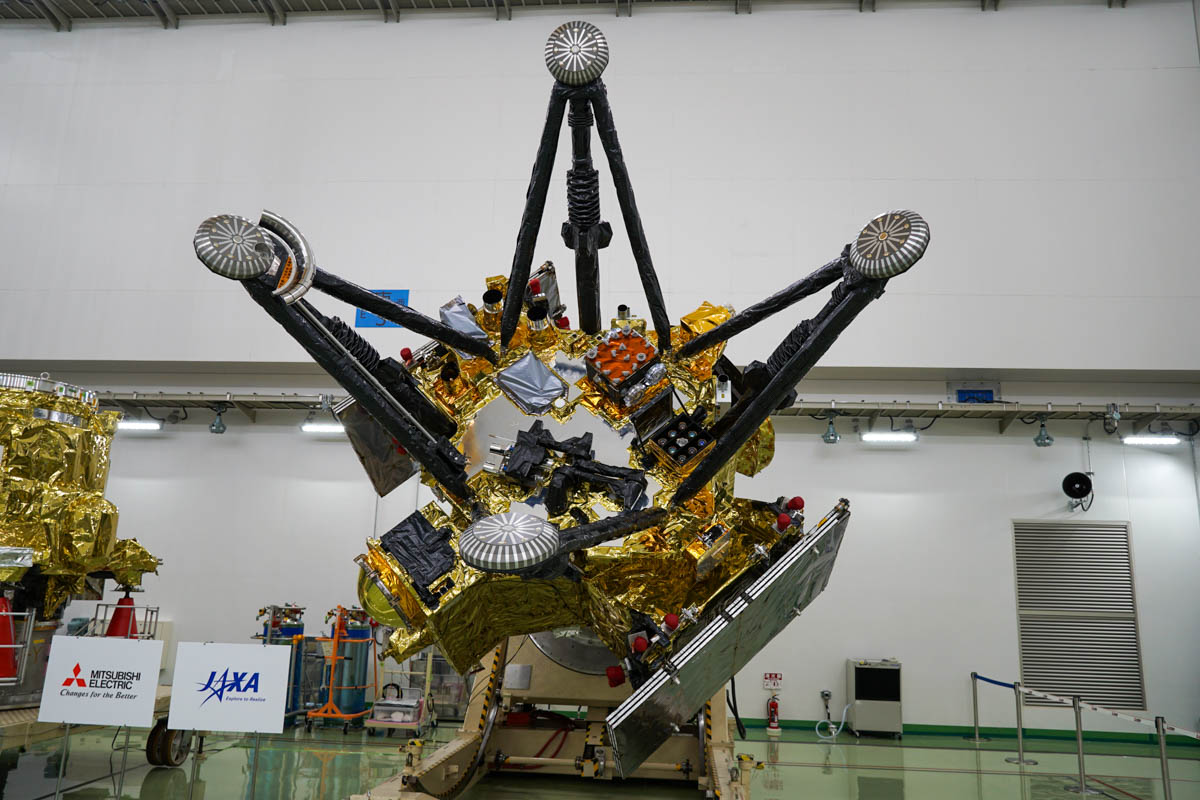
On October 20, a Japanese rocket will lift off from Tanegashima carrying MMX, a probe that aims to do what no nation has attempted before: land on Phobos, scoop up Martian moon soil, and bring it back to Earth. If successful, the samples arrive in 2031.
This is not a rerun of Japan’s earlier asteroid missions. It is an upgrade — and a quiet statement about where Japan intends to sit in the hierarchy of deep-space explorers.
MMX builds on the technical DNA of Hayabusa and Hayabusa2, both of which returned asteroid samples to Earth. But Phobos is a different animal. It is larger, more complex, and sits in an environment where communication delay with Earth stretches to 20 minutes one way. The mission design reflects that reality in ways that matter far beyond Japan’s space program.
Why Phobos? Why now?
The core scientific question is deceptively simple: where did Phobos come from? There are two competing theories, and neither has been settled by observation alone.
One hypothesis holds that Phobos is a captured asteroid — a rocky stray pulled into Mars’s gravity well billions of years ago. The other argues it formed from debris ejected when a massive impact struck the Martian surface, material that later coalesced in orbit.
A rock from Phobos would answer that question definitively. The sample would reveal whether the moon’s composition resembles that of the Martian crust or that of typical carbonaceous chondrite asteroids. It would also tell us something about the early Solar System’s delivery of water and organic materials.
Western space agencies have talked about Phobos missions. Russia floated a Phobos sample return in the 1990s and again in recent years, though those plans never left the drawing board. NASA has discussed orbital visits. None have publicly committed to a landing and return. Japan is the only nation moving hardware toward that goal.
That gap is significant. Whoever lands first and brings back material from Phobos controls the narrative around one of the most important unanswered questions in planetary science.
A different sampling strategy
What makes MMX technically interesting is how it approaches sample collection — and why Japan could not simply repeat the Hayabusa2 method.
Hayabusa2 used a device called a samovar horn, which fired a projectile at the asteroid surface to kick up regolith and catch it. That approach worked brilliantly for Ryugu, returning over 5 grams against a target of 0.1 grams. But MMX needs at least 10 grams, from a depth of 2 centimeters or more. Scaling up the projectile method to achieve that reliably on Phobos was judged too risky.
Instead, Japan developed C-SMP, a core-sampling mechanism mounted on a robotic arm. Think of it as a geological drill bit operated in microgravity, near Mars. A spring-loaded cylinder approximately 2 centimeters in diameter and 10 centimeters long drives into the surface, captures a core of regolith, and seals itself on retraction.
Two landing attempts are planned. The first uses both C-SMP and NASA’s P-SMP, a gas-assisted sampler borrowed from OSIRIS-REx. The second landing relies on C-SMP alone. The design goal is not 10 grams combined — it is 10 grams per C-SMP attempt. That gives scientists a meaningful quantity even if the NASA system underperforms.
The robotic arm is doing double duty: positioning and operating the core sampler, and handling sample containers during the NASA-operated sequence. It also serves as the transfer mechanism between the two collection systems, moving sealed containers between instruments.
Dust is the silent enemy here. Phobos regolith is known to be abrasive and finely particulate — the kind of material that jams bearings and shorts circuits. JAXA’s arm has been designed with dust-resistant joints and multi-layer thermal shielding, tested to survive more than 50 operation cycles in dusty conditions. That level of engineering detail does not make headlines, but it determines whether the mission succeeds or fails on arrival.
The human-in-the-loop problem
One of the most telling design choices in MMX is where human judgment enters the loop.
After landing, the probe projects a grid of laser lines across the surface, capturing three-dimensional topography in real time. That data streams back to Earth, where scientists identify promising采样 points. The coordinates are sent to the spacecraft, which then executes the sampling autonomously.
The 15-to-20-minute one-way light delay makes real-time remote operation impossible. Every action after landing — positioning the arm, driving the core, sealing the sample — must be autonomous. But the choice of where to sample remains a human call, made in the newly established MMX operations center at JAXA’s Sagamihara campus.
This hybrid model — human targeting, machine execution — is a template for future missions to increasingly distant destinations. It will be tested on Phobos first.
What this means for the race to Mars
MMX is not a Mars mission in the traditional sense. It does not land on the planet, does not search for life directly, and does not carry the high-visibility nameplate of a rover.
But it is strategically consequential.
The first nation to return Phobos samples will own a major chapter in planetary science for decades. It will also demonstrate that a space agency can execute a landing, sampling, and return operation around another planet — a capability that transfers directly to future Mars sample return efforts, whether Japanese-led or international.
NASA’s Mars Sample Return architecture has stalled under cost overruns and schedule slips. Europe’s Rosalind Franklin rover sits ready but without a clear ascent vehicle. Russia’s Phobos ambitions have repeatedly faltered. In this landscape, Japan’s decision to move forward with MMX is not just a science play. It is a positioning move.
The samples themselves will likely address multiple questions at once: the origin of Phobos, the early delivery of volatiles to the inner Solar System, and the geological history of Mars as preserved in its moon’s crust. Any one of those findings would justify the mission. All three together would make it historically significant.
What happens next
MMX launches October 20 on an H3 rocket. It reaches Mars orbit in late 2020s, performs two Phobos landings, and begins its journey home. Samples touch down in Australia in 2031.
The scientific community will be watching closely, because whatever those samples reveal will reshape how we understand Mars and its moons. Japan, for its part, will be proving that its small-body exploration expertise can scale up to planetary environments — and that it can do so independently.
No Western agency has made a comparable public commitment. That silence speaks louder than any press release.