How One Silicon Valley Announcement Moved Trillions Across Asia
Jensen Huang's reappointment sent KOSPI soaring 7% and Korean chip stocks into stratospheric territory — revealing the outsized emotional leverage one man holds over East Asia's most critical supply chain.
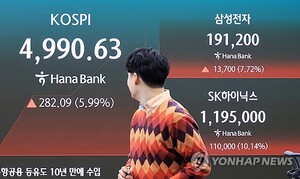
When One Man’s Job Security Moves $10 Billion in Minutes
On November 24th, 2026, the financial markets of two continents moved almost simultaneously on news that originated from a single corporate governance announcement.
Jensen Huang was reappointed chief executive officer of Nvidia. By afternoon in Seoul, the KOSPI had vaulted 7.10 percent to close at 5,042.95 — the first time the benchmark had breached 7 percent in a single session since November 16th. Three weeks earlier, it had been struggling to hold 4,800. In three hours, it added more than 160 points and crossed a psychological barrier that many analysts had written off for months.
Samsung Electronics rose 8.17 percent to 192,000 won per share. SK Hynix climbed 8.94 percent to 1,182,000 won. LG Energy Solution added 7.72 percent. Samsung Electro-Mechanics surged nearly 11 percent. Foreign investors alone poured roughly 7 billion won into the market in net buying, while institutional investors contributed another 6.7 billion.
Retail investors, typically the counterweight, sold off about 1.76 trillion won worth of positions — a sign that much of the momentum was being absorbed by professional money managers who understood exactly what this news meant.
That night, American markets followed. The Dow jumped 1,448 points or 3.01 percent to 49,595.31. The S&P 500 gained 327 points or 4.73 percent to 7,237.17. The Nasdaq Composite surged 1,472 points or 6.51 percent to 24,089.56.
The sequence matters. Seoul moved first because its markets open six hours before New York. But both were reacting to the same signal: that Nvidia’s leadership stability was not in question, and that the artificial intelligence infrastructure build-out continues to accelerate without interruption.
The Unseen Architecture of Trust
What makes this particular market event noteworthy is not simply the magnitude of the move. It is the channel through which that move traveled.
Nvidia’s market capitalization has become the unofficial benchmark for global AI sentiment. When that number climbs or drops, entire regional economies absorb the shock. Korean semiconductor stocks — particularly Samsung Electronics and SK Hynix — exist in an asymmetric relationship with Nvidia that goes well beyond supplier-customer economics.
SK Hynix supplies high-bandwidth memory chips that are essential for Nvidia’s GPU clusters. Samsung Electronics fabricates advanced nodes for Nvidia’s custom silicon designs. The value chain runs deep enough that any signal suggesting disruption at the apex ripples downward with unusual velocity.
But the ripple here was upward as well as outward. The news did not arrive as earnings guidance, regulatory approval, or technical breakthrough. It arrived as personnel continuity. A board vote. A letter of reappointment. And yet the market treated it with the gravity of a major policy shift.
This reveals something unsettling about the current state of semiconductor geopolitics: trust in a single individual’s continued stewardship of a company that controls perhaps the most consequential technology stack of the decade has become a pricing factor on par with interest rates, trade tariffs, and export controls.
Who Wins, Who Loses, Who Gets Left Behind
The immediate winners are clear. Korean blue-chip chipmakers captured billions in market value within minutes. International institutional investors who held positions through the preceding weeks of consolidation saw their thesis validated overnight. Retail speculators who bought the early morning surge benefited, though they faced competition from better-capitalized foreign buyers who pushed prices higher in the first thirty minutes alone.
Buy-side circuit breakers — known locally as sidecars — triggered twice within the first hour on both the KOSPI and KOSDAQ indices. These mechanisms activate when the related futures market moves five percent or more in a single direction within one minute. Their activation signals that the price discovery process itself came under stress, forcing trading systems to slow down and reassess order flow.
One group lost ground: domestic retail investors who sold approximately 1.76 trillion won in net selling. Their exit liquidity funded much of the institutional accumulation. Whether this reflects rational profit-taking from smaller shareholders or panic-driven divestiture at the wrong moment remains unclear, but the directional flow was unmistakable.
The longer-term question concerns what happens next. Markets do not permanently reprice on personality alone. If Nvidia’s competitive position shifts — whether through accelerated Chinese competition, design failures, or customer diversification away from its hardware ecosystem — the Korean semiconductor complex will feel it immediately. The asymmetry works both directions.
The Second-Order Implications for Global Supply Chains
Beyond the headline numbers lies a structural insight that English-language coverage of this story has largely missed.
For years, analysts have mapped the semiconductor supply chain in terms of geography and capacity: Taiwan dominates fabrication, Japan controls materials, Korea produces memory, America designs the core architectures. This framing assumes that market movements reflect real economic fundamentals distributed across physical facilities and contractual obligations.
The November 24th session suggests that an additional variable now operates at equal weight: confidence in the continuity of leadership at the single point where the highest-value node converges. Nvidia’s CEO is simultaneously a technology visionary, a strategic operator, and a symbol. All three roles matter to valuation. All three get punished or rewarded jointly.
When Huang stepped back from public appearances earlier in the year amid speculation about succession planning, the market had already priced in some degree of risk. The correction was gradual, measured, and institutional. The reversal was equally sharp once the uncertainty lifted.
This pattern has implications far beyond Korea. Japanese chip equipment makers, Taiwanese foundries, and even European semiconductor investment funds all track Nvidia’s trajectory as a leading indicator. The next time Nvidia’s leadership faces even minor questions — whether from health concerns, governance disputes, or unexpected departures — the ripple will travel through Asian markets faster than most participants can react.
What Comes Next
Three scenarios merit monitoring over the coming months.
First, if Nvidia’s revenue growth sustains or accelerates — driven by new chip generations, expanded data center demand, or broader software ecosystem lock-in — the Korean semiconductor premium may stabilize at elevated levels rather than revert to prior baselines. Buyers would treat current valuations as justified.
Second, if competitive pressure from AMD, custom silicon from major cloud providers, or regulatory restrictions on China exports compress margins, the correlation between Nvidia’s stock and Asian chip equities could weaken. The market might begin pricing decoupling risk rather than convergence optimism.
Third, and most important for policymakers: the concentration of systemic risk in a single leadership appointment exposes a fragility that neither Korean regulators nor American securities authorities currently have tools to hedge against. Circuit breakers exist. Sidecars exist. But none of them address the fundamental mismatch between instantaneous information propagation and delayed risk assessment frameworks.
The 5,000-line milestone on the KOSPI was always going to be temporary or permanent depending on what came next. What matters more is recognizing that milestones like this one are increasingly set by events that have nothing to do with local economic conditions and everything to do with the whims of a single person in a different hemisphere holding a different title.