Kerch Bridge Strike Signals New Phase in Ukraine War
Ukraine's partial destruction of the Kerch Bridge marks more than a tactical blow — it recalibrates the entire logistics calculus of Russia's war in Crimea. Kyiv has proved it can strike deep, but Moscow will now face a brutal winter without its most vital supply artery.
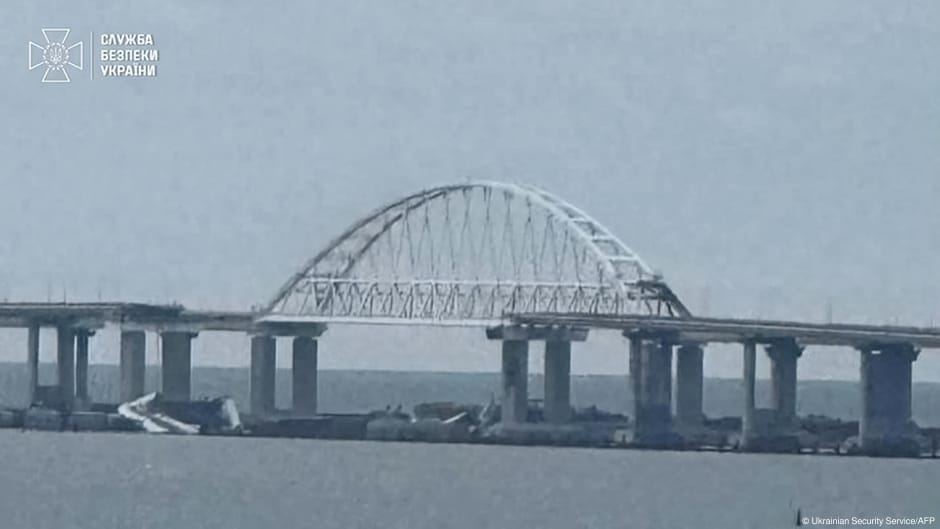
The bridge that broke
Ukraine did not just hit a road. It cracked open the spine of Russia’s southern war effort.
In his nightly address, President Volodymyr Zelenskyy confirmed that Ukrainian forces carried out what he called “an unprecedented operation in response to Russian strikes on our infrastructure.” Footage showed at least one of the two steel arches supporting the road section of the Kerch Bridge lying in ruins over the water. The railway span below appeared intact, but the loss of a primary deck lane is far from cosmetic damage.
Russia built the bridge as the single most symbolic and practical link between the mainland and occupied Crimea after it annexed the peninsula in 2014. Since then it has carried tens of thousands of military convoys a month, along with the commercial freight that keeps Crimea’s population of roughly 2 million supplied. Destroying even part of it changes the arithmetic of the entire southern front.
A calibrated escalation
Zelenskyy laid out the operational sequence with care. Ukrainian engineers spent weeks taking out air defense systems, radar installations and electronic warfare positions around the Crimean coast before the final strike. The road surface was hit by Palianytsia drones while the rail corridor beneath took Neptune anti-ship missiles and Ruta drones. That division of labor suggests not a desperate lunge but a months-long planning cycle with multiple contingencies.
The message to Moscow is blunt: Ukraine can reach deeper now than it could twelve or eighteen months ago, and it is willing to pay the cost of rebuilding these systems again and again. The Kremlin dismissed the damage as temporary. Deputy Prime Minister Marat Khusnullin reported to Putin immediately, and Kremlin spokesman Dmitry Peskov insisted the bridge would be restored “even better than before.” That claim rings hollow when the physical reality is one collapsed arch spanning the main navigation channel.
Russia will attempt repairs. But every ton of steel dragged across remaining lanes slows military traffic further down the line. Winter is coming, and Crimea’s garrison cannot easily survive on ferries through the Kerch Strait.
Who wins and who loses
Kyiv wins the initiative on information and logistics. After months of absorbing Russian attacks on energy grids, water systems and heating plants across nine regions, the strike reframes the narrative from defense to offense. Zelenskyy’s framing — “Enough of striking bridges, cities and villages,” followed by “Ukrainian missiles have once again reached a key Russian military artery” — is calculated political communication aimed at both domestic audiences and hesitant Western partners.
Moscow loses credibility faster than it loses asphalt. The bridge was always vulnerable. Its location in occupied territory meant that even early in the war Ukrainian planners understood it could be targeted. What has shifted is Ukraine’s ability to execute repeated deep strikes despite intense Russian air defense coverage. Each successful penetration erodes the myth of an impenetrable shield around Crimean assets.
The civilian cost on the Ukrainian side remains staggering. Deputy Energy Minister Artem Nekrasov confirmed power outages across Dnipropetrovsk, Donetsk, Zaporizhzhia, Mykolaiv, Odesa, Rivne, Sumy, Chernihiv and Chernivtsi following renewed Russian attacks. The energy system is under sustained assault, and winter amplifies every outage into a human crisis.
European rift opens wider
The strike exposed a fracture in the Western coalition even as it unified some voices in support of Kyiv.
German Defense Minister Boris Pistorius attacked US criticism directly. US Defense Under Secretary Elbridge Colby had told a NATO gathering that Ukraine’s deep strikes were ineffective and risked hardening Russian public opinion. Pistorius called such criticism “quite a stupid thing” and redirected attention to what he described as Russian terrorism against Ukrainian energy and water infrastructure. Germany and Norway also announced a fresh air defense package including Patriot interceptors, IRIS-T systems and ammunition for F-16s, signaling continued commitment regardless of American hesitation.
French officials moved quickly to deny Russian allegations that French troops were fighting on Ukrainian soil. Deputy Defense Minister Alice Rufo stressed that deployed personnel were there for training and maintenance only. The accusation itself reveals Moscow’s strategy of widening the conflict narrative, creating diplomatic friction among allies while manufacturing pretexts for further escalation.
Hungary suspended rail traffic to and from Ukraine after a Russian drone landed near the Mukachevo station in Zakarpattia, underscoring how regional instability is spreading beyond active combat zones.
The looming question
Can Ukraine sustain this level of deep-strike operations through the winter? Can Russia repair and reopen the bridge fast enough to prevent cascading logistical failures in Crimea?
The answer matters because the Kerch Bridge is no longer just infrastructure. It is a barometer of Ukraine’s capacity to impose costs on its adversary’s rear areas, and of Russia’s willingness to absorb them without triggering broader retaliation. Every month the bridge stays partially closed squeezes Crimean logistics. Every missile trajectory that reaches it proves the range of Ukrainian precision strike capabilities.
European leaders like German Foreign Minister Johann Wadephul are calling for negotiated settlement talks before winter worsens the humanitarian picture. But negotiations require leverage, and Ukraine has just demonstrated new leverage in the form of verified deep-strike capability against hardened Russian targets.
What emerges is a war where neither side can claim permanence over contested terrain or critical infrastructure. The Kerch Bridge may look like a single target destroyed. In reality it marks the moment Ukraine stopped reacting to Russian violence and started reshaping the conditions of the fight itself.