Kim Yo-jong's Border Inspection Signals North Korea's Hardening Stance
North Korea's Kim Yo-jong appeared at a southern border fortification site alongside military chiefs, marking the first time a senior female figure has been visibly involved in frontline military positioning. The move underscores a measurable hardening of Pyongyang's posture toward Seoul.
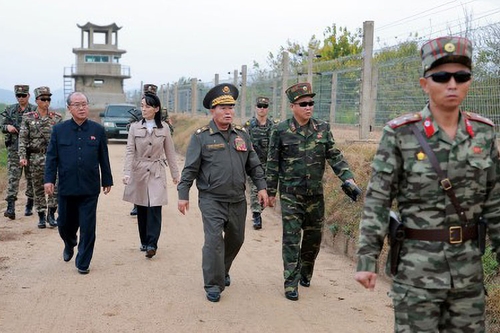
A New Face at the Border
For decades, North Korea’s military posturing has been the exclusive domain of men in uniform — generals, marshals, and party officials who appear on state media inspecting missile bases and artillery positions. Kim Yo-jong has never been part of that visual language. Her public appearances have always been political, ceremonial, or humanitarian. But on October 20, she appeared at a southern border fortification construction site alongside General Park Jeong-chun, the powerful advisor to the National Defense Commission, and other senior military commanders. It was the first time a senior female figure in the North Korean regime has been visibly involved in frontline military positioning.
The inspection was reported by Korean Central News Agency on October 21. Ri Il-hwan, a secretary of the Workers’ Party Central Committee, accompanied the pair. KPA General Staff officers were also present. The presence of Kim Yo-jong — the youngest daughter of Kim Jong-il and sister of Kim Jong-un — at a military fortification site is not merely symbolic. It signals a deepening integration of the party’s political leadership with military command structures at the most sensitive frontier.
Immediate Retaliation — No More Warnings
What makes this visit significant goes beyond who was present. It is what was said there. Park Jeong-chun told the troops at the site that the concept of a “moonseon” — a term used by South Korea to describe potential border incidents or unauthorized crossings — was an intentional, premeditated pretext manufactured to shift blame for regional tensions onto the North. He did not stop at rhetoric.
“When the enemy moves beyond warning broadcasts and warning shots to actual provocations that threaten the safety of our soldiers, we must never tolerate it and must retaliate immediately,” Park told the troops, according to KCNA. “The time for heated debates and sitting idle is over.”
That language is deliberately specific. Warning broadcasts and warning shots are the traditional escalation ladder that has defined inter-Korean military friction for years. By explicitly stating that North Korea will now skip those steps and move directly to armed retaliation, Park is rewriting the rules of engagement. This is not standard guard rhetoric. This is a calibrated message intended for Seoul and Washington simultaneously.
The Permanent Border
Kim Yo-jong’s remarks at the site were equally pointed. She quoted what she described as instructions from the state leader — Kim Jong-un himself — demanding no concession whatsoever in the exercise of territorial sovereignty and ordering that the border with hostile nations be made “the most permanent line possible.”
She then issued a direct threat aimed at South Korean forces: “Our military command must make those thugs aware that our new firepower demarcation lines and shooting positions are already established.”
The phrase “new firepower demarcation lines” is the most concrete operational detail to emerge from the report. North Korea has previously referenced the 2018 Panmunjom Declaration, which agreed to eliminate disputed military zones along the northern limit line in the West Sea. If Pyongyang is now establishing new firepower positions that replace or extend beyond those previously agreed limits, it represents a unilateral rewiring of the military status quo — one that South Korea’s Defense Ministry would need to respond to formally.
Who Wins and Who Loses
The domestic audience for this display is clear: North Korea’s military and civilian population will see a reinforced narrative of readiness and strength, delivered by the regime’s most trusted political operative. Kim Yo-jong has long served as Kim Jong-un’s chief liaison to the south, including during the period when inter-Korean relations briefly thawed. Her appearance at a military site now suggests that the thaw has definitively frozen over.
South Korea loses strategic ambiguity. The message is unambiguous — Pyongyang intends to escalate without the traditional warning phase. That removes a layer of deterrence that Seoul has relied on for years. Seoul’s defense establishment will now need to account for a scenario where North Korean forces can cross into disputed waters or along the border with minimal or no prior signaling.
Washington also faces a narrowed response window. The “immediate retaliation” doctrine means any future incident along the Northern Limit Line or the military demarcation line could trigger armed conflict before diplomatic channels can engage. That compresses decision-making time for U.S. forces in the region and raises the stakes of any miscalculation.
What Happens Next
The most likely immediate consequence is a South Korean military response — whether through heightened alert status, reinforcement of forward positions, or public counter-statements. The ROK Defense Ministry has not yet issued a formal comment on the inspection, but sources suggest internal reviews are underway regarding the implications of the “new firepower demarcation lines.”
On the diplomatic track, expect no near-term engagement. Kim Yo-jong has historically been the regime’s primary conduit for soft messages to Seoul. Her presence at a military fortification site — and the aggressive language attributed to her — suggests she is now tasked with delivering the harder message as well. That shift aligns with a broader pattern: the North has steadily dismantled its previous agreements with the South, including the 2018 military accord, and has recently conducted its longest war games in decades targeting South Korean leadership.
The border fortification project itself appears to be entering an accelerated phase. The inspection of construction sites by top party and military figures typically precedes a ramp-up in labor mobilization and material deployment. South Korean intelligence agencies will likely monitor construction activity along the border over the coming weeks for signs of increased force positioning.
The Bigger Picture
This is not an isolated incident. It is part of a measurable hardening of North Korea’s posture that has been building throughout 2026. The regime has abandoned its earlier rhetorical openings, revoked longstanding military agreements, and increasingly framed the South as an enemy rather than a counterpart. Kim Yo-jong’s border visit is the visual and verbal capstone of that trend.
The message is no longer about leaving room for diplomacy. It is about preparing for conflict — or at least convincing Seoul and Washington that Pyongyang is willing to start one without warning.