Kioxia's CXL Memory Bridge Could Redefine AI Server Economics
Kioxia is betting that a new CXL-attached flash module can fill the performance-cost gap between DRAM and SSD — a move that could ease the memory crunch constraining AI server deployment. The real question is whether it arrives fast enough to matter.
The gap between DRAM and SSD is where AI memory economics go to die
Every AI server builder knows the hierarchy by heart. At the top sits HBM — high-bandwidth memory, stacked vertically, fast enough to keep a GPU fed during training. It costs a fortune and holds a fraction of what you actually need. Below that is DRAM, cheaper per gigabyte but still expensive at the scale modern models demand. And then there’s a cliff. Drop below DRAM and you land on SSDs made from NAND flash — vastly cheaper, massively more capacious, and orders of magnitude slower.
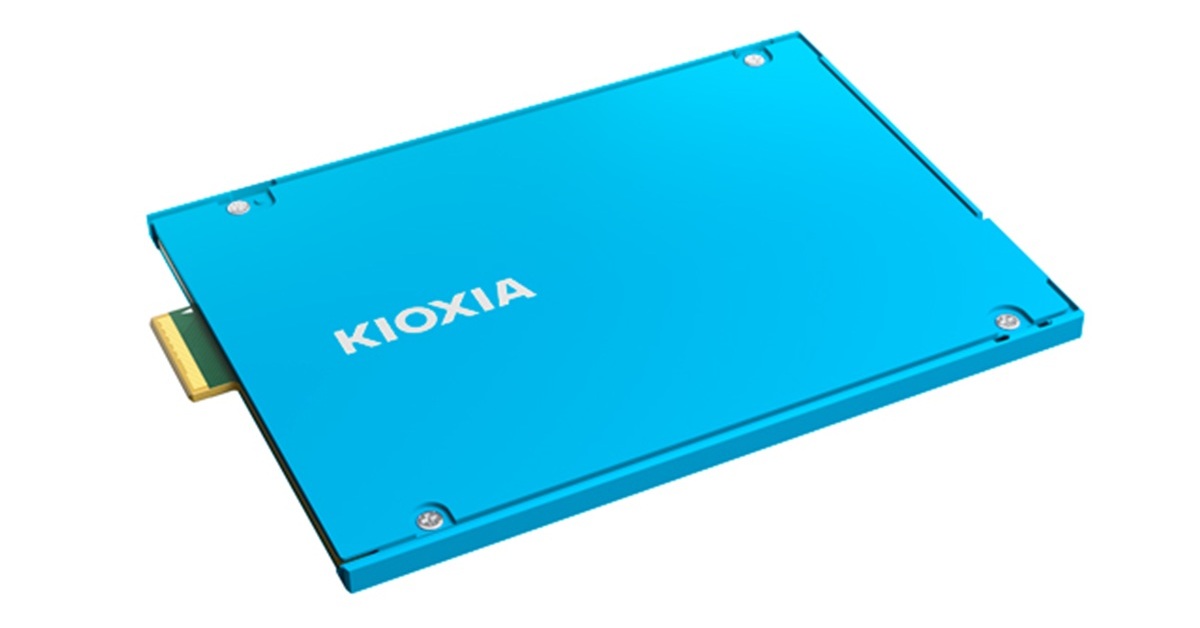
That cliff is what Kioxia is now aiming to fill. At the FMS conference in early August 2026, the Japanese memory maker unveiled its XL1 series — a CXL-attached memory expansion module built around XL-FLASH, a form of flash memory traditionally reserved for storage. The pitch is straightforward: use CXL to connect this flash-based tier into the memory fabric, push cold data out of DRAM, and squeeze more performance out of less expensive silicon.
It sounds incremental. It is not.
Why the DRAM-SSD continuum matters more than HBM
HBM gets all the headlines because it’s spectacular engineering. Three-dimensional stacking, wide memory buses, direct attachment to accelerators — it reads like a winner. But HBM is a narrow solution to a narrow problem. It solves bandwidth. It does not solve capacity, and it certainly does not solve cost.
A single HBM stack might hold tens of gigabytes. An AI training workload can require terabytes of working memory. You cannot fill that gap with HBM alone — the economics collapse. You end up mixing HBM for hot data with DRAM for the rest, and even DRAM becomes a bottleneck when prices spike and supply chains tighten.
This is the moment Kioxia’s approach lands. By positioning a CXL-attached flash tier between DRAM and SSD, it offers a path to expand working memory without buying more DRAM. The data that was sitting idle in DRAM — weights that haven’t been accessed in milliseconds, intermediate activations from earlier pipeline stages, metadata for queued work — moves to the XL1. DRAM becomes scarce real estate reserved for what genuinely needs speed. The system behaves as though it has far more memory than it physically contains.
The physics of the approach are honest. CXL operates over PCIe and provides coherent memory access, meaning the CPU and accelerators can treat the XL1 as an extension of main memory rather than as a separate storage layer. Latency will be higher than DRAM but dramatically lower than an NVMe SSD. Access patterns matter enormously here — if your workload has long tails of sequential or read-heavy access, the flash tier absorbs it cleanly. If your workload is randomly jumping across petabytes of working set, you will still feel the gap.
The supply-side angle nobody is discussing
DRAM supply has been tightening for two years. Demand from AI data centers has consumed most of the incremental capacity that TSMC and Samsung have been pushing out. Chinese memory manufacturers are scaling, but their yield rates and reliability credentials remain unproven at the enterprise level. The market is short on DRAM and short on patience.
Kioxia’s XL1 sidesteps theDRAM shortage entirely. It uses flash — technology Kioxia already manufactures at volume in Tokyo and Yokkaichi. The company does not need to compete with Samsung or SK Hynix for DRAM wafers. It is using a product it already makes, attached through a protocol — CXL — that is already being adopted by server OEMs and cloud providers.
That supply-chain independence is a strategic advantage. While Western semiconductor reporters chase HBM capacity announcements and DRAM price forecasts, Kioxia is quietly building a second channel for memory expansion that does not depend on the same constrained supply. If DRAM shortages persist — and most analysts expect them to — this becomes more than a niche product. It becomes a default tier in certain server configurations.
The timeline problem
Here is the rub. Kioxia says it will begin shipping evaluation samples to industry partners in August 2026. That is weeks away from when this article appears. A commercial product — the kind that ships in production servers — is likely quarters or even a year or more out, depending on partner adoption cycles and CXL ecosystem maturity.
AI model sizes are growing faster than memory tiers can be layered in. Every generation of language model pushes the working set larger. Every new training technique demands more active memory. The question is whether Kioxia’s XL1 reaches servers before the gap between model demand and available memory widens beyond what a single flash tier can absorb.
There is also the question of CXL itself. The standard is real and gaining traction, but it is not yet universally implemented across server platforms. AMD’s EPYC processors support CXL 2.0. Intel’s Xeon Scalable line has CXL support in later generations. Not every data center is running hardware that can expose a CXL memory pool. Until the installed base catches up, Kioxia’s addressable market is smaller than the headline implies.
Who wins, who loses
The winners are clear. Cloud providers and hyperscalers who are paying a premium for DRAM capacity will find a cheaper way to stretch their memory budgets. Server OEMs that integrate CXL memory expansion into their reference designs will have a new selling point. Kioxia itself gains a product category that leverages its flash expertise without entering the DRAM business it cannot profitably win.
The losers are less obvious but equally important. DRAM manufacturers face a potential demand drain — not catastrophic, but meaningful at the margin. Every terabyte of CXL-attached flash that replaces a terabyte of DRAM is revenue theDRAM makers do not earn. NAND manufacturers watching Kioxia’s play may reconsider their own positioning. If flash can serve as a memory-tier extension rather than purely storage, the traditionalDRAM-NAND boundary blurs in a way that benefits companies with both businesses.
Western memory competitors — Micron, Samsung, SK Hynix — have not publicly announced equivalent CXL-attached flash modules. That silence is notable. It may reflect genuine developmental gaps. It may reflect a strategic choice to bet on HBM and LPDDR rather than the continuum. Either way, Kioxia is moving into a space its rivals have not yet claimed.
What happens next
The next twelve months will determine whether this is a real shift or a laboratory curiosity. Watch for three signals.
First, which server makers adopt CXL memory expansion in their reference designs. If Dell, HPE, or Supermicro ship systems with integrated CXL memory pools, Kioxia’s module moves from research to revenue.
Second, which cloud providers test it in production. Even a limited private deployment would validate the performance model and give other customers confidence.
Third, whether Kioxia’s XL1 achieves latency numbers competitive enough to matter for AI inference workloads, which are far more sensitive to memory access patterns than training is. Inference is where memory cost per request determines profitability. A flash-tier solution that cuts DRAM requirements without adding unacceptable latency could change margin calculations across the entire AI serving stack.
The DRAM-SSD gap is not a new problem. It has existed since the first server needed more memory than it could afford in DRAM and less latency than storage could provide. Kioxia is not the first company to propose a bridge. But it may be the first with a product that arrives close to the moment the gap becomes painful enough to pay for a solution.
The AI memory crunch is real. The question is whether Kioxia’s answer arrives in time to matter — or whether the industry will have moved on to something else by the time it ships.