How Korea's AI Boom Is Buying Up Seoul — and Ending Lee's Presidency
South Korea's semiconductor windfall is flooding into Seoul real estate, turning economic success into a political time bomb for President Lee. The AI wealth gap is deepening inequality, crushing youth homeownership, and making tech-fueled growth its own undoing.
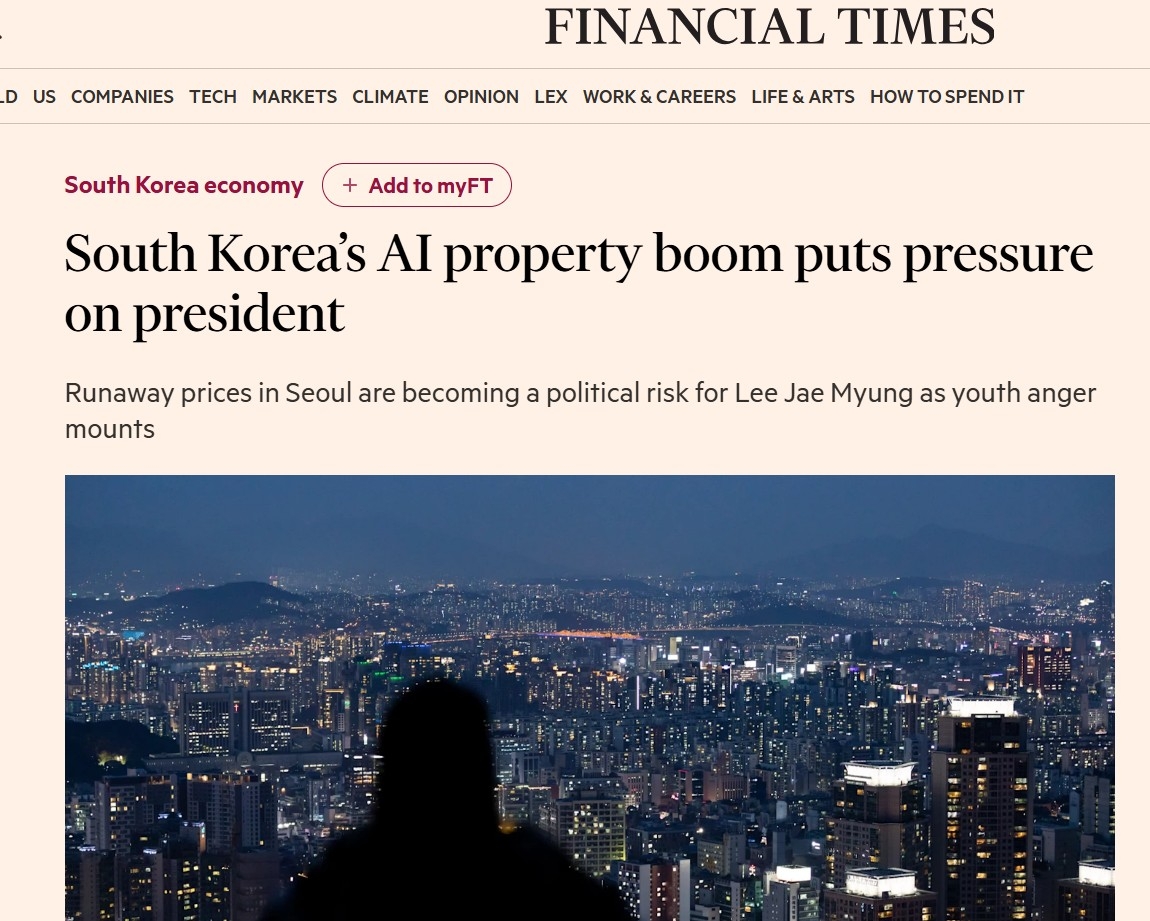
The chip money is not staying in the fabs.
It is moving into concrete.
South Korea’s AI and semiconductor boom — the single bright spot in a regionally troubled economy — is quietly rewriting the geography of wealth inside South Korea itself. The money generated by Samsung Electronics and SK Hynix, the two giants powering the global AI hardware rush, is not circulating through the economy in any even-handed way. It is flowing upward and inward, into capital-area property, and from there into a political crisis that President Lee Jae-myung cannot regulate his way out of.
That is the argument the Financial Times made in a piece published on December 8, and it is the most useful framing of a problem that has haunted Korean politics for decades. What makes this moment different from prior real estate cycles is the source of the pressure. This is not speculation driven by loose credit or overseas buyers. This is domestic, productive wealth — the kind generated by actual industrial success — concentrating into a single asset class and turning economic strength into a structural threat.
How the money moves
The mechanism is straightforward but under-appreciated. AI demand has pushed memory chip prices to multi-year highs. Samsung and SK Hynix are posting results that analysts have described as generational. Engineers, executives, and mid-level managers at those firms are seeing bonuses, stock options, and salary growth that have no historical precedent in peacetime Korea. That wealth does not sit in checking accounts. It moves into the most liquid store of value available: Seoul housing.
The result is not uniform price growth. It is a gradient. Districts close to the major semiconductor campuses, the financial core, and the elite school zones are absorbing this liquidity first and hardest. A new buyer pool has emerged — not foreign investors, not domestic speculators in the traditional sense, but technical workers whose compensation is denominated in the same global AI dollar cycle that is lifting Taiwan and the United States. They are priced into a market that was already pricing them out.
What this creates is a two-speed economy within a single city. One segment of the workforce — roughly 200,000 to 300,000 people in the semiconductor ecosystem alone — is experiencing asset inflation that outpaces wage growth for everyone else. The other segment — service workers, small-business owners, young graduates entering a market where a median apartment in Gangnam still commands a price that requires two incomes and a decade of saving — is being priced further away from ownership entirely.
Why this is different from previous Korean real estate cycles
Korea has had housing crises before. The 2000s saw repeated boom-bust cycles in Yeouido and Gangnam. The 2020 pandemic lockdown drove prices to levels that prompted emergency government intervention. But those cycles were driven by credit expansion, regulatory looseness, or demographic恐慌 buying. This one is driven by something more durable: industrial competitiveness.
When the boom is built on exports and engineering rather than leverage, the government loses its normal levers. You cannot tighten credit against a sector that is already generating excess cash. You cannot regulate speculative buyers when the buyers are salaried employees receiving legitimate compensation. You cannot print your way out of a shortage of buildable land in a peninsula where 63 percent of the territory is mountainous and zoning is controlled by a municipal system that has never solved the supply problem.
The FT piece captures this with a single phrase: Lee called the market a ticking time bomb. That is not rhetoric. It is an acknowledgment that the government’s tools are blunt and its options are adversarial. Raise interest rates and you punish the broader economy. Cut them and you pour fuel on the fire. Impose transaction taxes and you anger the very class whose technical labor is funding the national recovery. Do nothing and you watch a generation opt out of adulthood entirely.
The birth-rate multiplier
Here is where the problem stops being financial and starts being existential. South Korea’s total fertility rate is 0.72 — the lowest in the world, and well below the replacement threshold of 2.1. Housing affordability is already cited as the primary reason young Koreans are delaying marriage and childbearing. When AI-sector compensation lifts Seoul prices further, it does not just make buying harder. It makes the entire life script — degree, job, marriage, apartment, child — appear structurally unavailable to anyone outside the winner tier.
The FT note that this dynamic is dragging the birth rate lower still feels like an understatement. What is happening is a feedback loop: semiconductor success raises housing prices, which suppresses family formation, which reduces future domestic demand, which makes the economy more dependent on external semiconductor cycles, which amplifies the next round of wealth concentration. This is not a housing problem. It is a growth model problem dressed in drywall and rebar.
The political arithmetic
President Lee’s approval rating has fallen to 40 percent, according to a Gallup Korea poll conducted December 1–3 across 1,001 respondents. That is the lowest reading since he took office, and professor Shin Yul of Myongji University identifies housing as the single largest factor in the decline. The numbers tell a simple story: every month the gap between semiconductor profits and median household income widens, Lee’s political coverage shrinks.
This is not new territory for Korea’s progressive bloc. The FT correctly notes that real estate has been the consistent Achilles heel of left-leaning governments in South Korea. In the 2022 presidential election, Seoul price surges contributed to the Democratic Party’s defeat. Progressive parties campaign on egalitarian platforms and then govern in markets that reward capital over labor. The contradiction is baked into the structure.
What is new this time is the speed of the wealth transfer. The AI cycle has compressed into a timeframe that leaves no room for adaptive policy. In previous cycles, prices rose over three to five years, giving governments breathing room to introduce cooling measures, supply incentives, or tax reforms. This cycle is moving faster because the underlying demand is not speculative. It is earned income being deployed into a scarce asset, and that combination is politically untouchable.
The FOMO generation
Younger Koreans are not simply priced out. They are watching the exit strategy disappear in real time. The FT’s reference to FOMO — fear of missing out — among youth is accurate but incomplete. This is not the FOMO of social media. It is the FOMO of a cohort that sees the people doing the same jobs they are training for buying apartments at ages when their parents could not have imagined ownership. The distortion is visible and immediate, which makes it corrosive in a way that gradual inflation never is.
The result is a quiet withdrawal from the standard lifecycle. Marriage rates drop. Childbearing postpones. Homeownership aspirations shift from near-term to never. Each of these decisions is rational at the individual level and catastrophic at the aggregate level. No government propaganda campaign has ever reversed a mathematical equation, and no presidential approval rating has ever recovered while the core metric of adult formation — owning a place to live — continues to recede.
What happens next
The FT piece ends where all honest analysis of Korean housing must end: with a description of a dilemma that has no clean resolution. A sharp correction would wipe out the balance sheets of millions of existing owners and trigger a political revolt. A continued rise would complete the generational exclusion that is already underway. The government wants both stability and affordability, which is to want the market to behave in ways the market cannot.
The most likely path is not collapse or relief but Managed Stagnation — prices that creep higher in nominal terms while real purchasing power erodes through income dispersion. The semiconductor sector continues to fund the property market. The youth cohort continues to opt out. The president continues to lose approval. The policy toolbox remains empty because every tool punches upward.
This is the unusual shape of a good-news crisis. South Korea is winning at AI. It is losing at everything else that depends on that win being distributed. The FT article is valuable because it names the mechanism rather than merely observing the symptoms. The pressure on Lee is not a polling blip. It is the structural tension between industrial success and social contract, playing out in property transactions that no minister can control.