Korea's AI Manufacturing Bet Is a Supply-Chain Earthquake in Slow Motion
South Korea is nearly doubling its manufacturing-AI budget, channeling over 14 trillion won into semiconductor clusters, autonomous factories, and resource-security funds. The move could redirect global equipment demand and redraw the robotics supply chain away from Asia's second-largest economy — or toward it.
The number no one is talking about
South Korea’s Ministry of Trade, Industry and Energy has set aside 13.26 trillion won (₩40.5 billion) for next year. That sounds like a large figure until you compare it to 2025’s allocation of 9.44 trillion won. This is a 40.5 percent jump — the single largest budget the ministry has ever managed.
But the headline number hides something more dramatic. The actual spending power, when a newly created Future Response Fund is folded in, reaches 14.17 trillion won. That is a 50.2 percent real increase.
The money is not spread thinly. It is concentrated, targeted, and deliberately confrontational toward incumbents in three domains: semiconductor manufacturing equipment, industrial robotics, and resource supply chains.
M.AX is the core bet
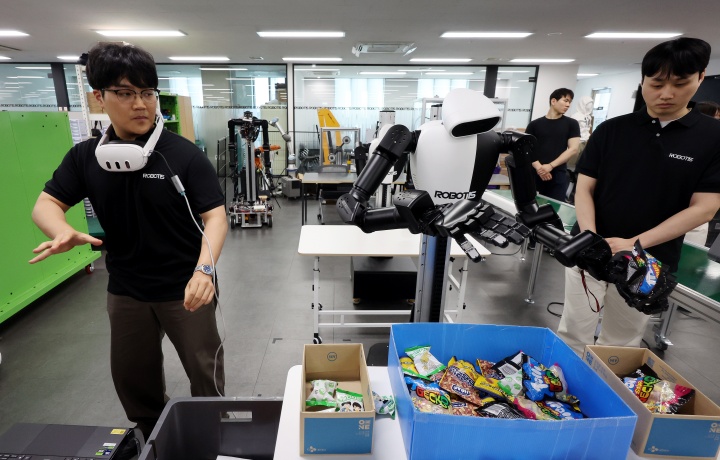
M.AX stands for Manufacturing AI Transformation. The ministry allocated 3.73 trillion won to it — a 128 percent increase over this year. Within that, seven discrete programs total 911.8 billion won drawn from the new Future Response Fund.
What exactly is M.AX spending on? Several line items are revealing:
- 120 billion won for a full-stack AI factory and a manufacturing AI foundation model. This is not a prototype exercise. It is an attempt to build a base model the way a country builds a national grid — as public infrastructure that private firms then connect to.
- 290 billion won for manufacturing tacit-knowledge AI solutions. This targets the uncodified expertise that lives in veteran operators’ heads and has never been digitized at scale in Korean factories.
- 115.8 billion won for a national manufacturing data library. Data is the bottleneck for industrial AI. Korea is trying to solve that bottleneck by treating factory data as a public good.
- 119.3 billion won to build an autonomous manufacturing ecosystem around M.AX itself.
- 37 billion won for K-robot industry ecosystem advancement and 80.7 billion won for intelligent robot diffusion.
The sum total suggests a strategy that goes beyond buying robots. It is about making Korean factories trainable, networked, and eventually self-optimizing — and exporting that capability.
The semiconductor cluster is a supply-chain pivot point
Perhaps the most consequential allocation is the 1.5 trillion won for the Southwest Region semiconductor cluster. This is the physical foundation for what Korea wants to become the world’s third major chip-making base alongside Taiwan and the United States.
A separate K-semiconductor special account of 2.6 trillion won was created this year to consolidate and accelerate support. Together, these accounts signal that Seoul no longer treats semiconductors as a sector to nurture through general incentives. They are now treated as a strategic asset requiring ring-fenced governance.
For equipment suppliers — Tokyo Electron, ASML, Applied Materials, Lam Research, and a growing cohort of Korean firms like Hanmi Sematech and Proterial Korea — the implication is straightforward. A 1.5-trillion-won cluster buildout will generate multi-year demand for deposition, etch, and lithography equipment. The question is whether Korean equipment makers can capture a larger share of that demand than they have historically.
That question is already being answered. Korea’s resource security fund, a new 1.4 trillion won vehicle, exists partly to de-risk the materials and components that semiconductor fabs consume. The budget for oil reserves jumped from 55.3 billion to 328.7 billion won — a sixfold increase driven by Middle East geopolitical instability. The Korea Mining Development Trading Corporation’s capital injection nearly doubled to 146.1 billion won. These are not abstract numbers. They are signals that Seoul is preparing for supply disruptions that could choke fab construction if critical inputs are blocked.
Why this matters beyond Korea
Japan is moving in the same direction with its own semiconductor subsidies and robotics roadmaps. China is accelerating domestic equipment substitution through its own industrial policy engines. Korea’s 50 percent budget escalation is the sharpest acceleration among the three.
The difference is scale and sequencing. Japan’s subsidies are large but fragmented across prefectures and industries. China’s approach is broader and more coercive in its market access requirements. Korea’s approach is tighter: it centralizes budget authority, creates new accounts with statutory independence, and ties spending to measurable milestones in cluster construction and AI deployment.
For global automation equipment makers, the takeaway is that Korea is no longer a passive buyer. It is becoming a builder of factory systems it intends to license. The AI foundation model program is the clearest example. If Korea produces a trainable manufacturing AI that reduces downtime and yield loss across multiple fabs, that system could be exported — with Korean software, Korean data standards, and Korean equipment integrators embedded in the stack.
The regional growth strategy is a hidden industrial policy
The 5-gugar 3-spect (five mega-regions, three special zones) allocation of 2.73 trillion won represents a 62 percent increase. This is geographically distributed investment designed to pull anchor companies out of the Seoul metropolitan area and into regions like Gwangju, Daegu, Daejeon, Busan, and Ulsan.
The mechanism is important. Previously, local investment subsidies were routed through regional governments, which slowed disbursement and introduced political friction. Next year, the central government pays companies directly. That removes a bottleneck and makes investment decisions faster.
Anchor companies that relocate will receive a new Growth Engine Special Subsidy, and equipment subsidy rates will be set at domestic top-tier levels. Consortiums of local anchor firms, suppliers, and research institutes will receive packaged support for technology development, infrastructure, and workforce training.
The strategic logic is twofold. First, it spreads risk: a concentration of semiconductor and AI capacity in one metro area is a vulnerability. Second, it creates multiple demand centers for equipment and robotics vendors across the country, not just in the existing electronics corridor around Suwon and Pyeongtaek.
Shipbuilding and autos are side bets with global teeth
Automotive R&D receives 315.8 billion won focused on three areas: EV and hydrogen core component localization, AI autonomous driving models, and software-defined vehicle platforms plus automotive semiconductors. Hyundai and Kia already dominate electric vehicle exports in several markets. The question is whether Korea can close the gap on chips and autonomy software that currently rely on external suppliers.
Shipbuilding gets 213.4 billion won for carbon-neutral vessel propulsion (ammonia, hydrogen, electric), AI autonomous navigation, and digital transformation of production lines. Hyundai Heavy Industries and Samsung Heavy Industries are already racing to commercialize ammonia-fueled vessels. Korea’s budget commitment reinforces that trajectory and locks in supply-chain advantages for propulsion-system equipment makers.
Display technology received a new 15 billion won program for high-resolution large-area OLED processes and high-efficiency emissive materials. Samsung Display and LG Display are investing heavily in this space. The budget ensures Korean fabs do not fall behind Chinese competitors who are aggressively scaling OLED and micro-LED capacity.
The resource security fund changes the game
The creation of a 1.4 trillion won resource security fund is arguably the most underreported element of this budget. It is not a subsidy. It is a strategic reserve vehicle that can finance long-term offtake agreements, equity stakes in overseas mines, and domestic stockpiling of critical minerals such as gallium, germanium, rare earths, and lithium.
Given that export controls on critical materials have become a routine geopolitical tool — most visibly in the China-Taiwan context — this fund gives Korea a financial instrument that neither Japan nor the United States currently matches in scope. Japan has commodity agencies but no comparable dedicated security fund. The United States relies more on diplomatic coordination than on direct budgetary reserves.
Who wins, who loses
Korean equipment makers win. Domestic robotics firms that can integrate AI foundation models with hardware win. Regions outside the Seoul metro area win, at least in the short term, as infrastructure spending flows inward. Global semiconductor equipment suppliers face a more competitive Korean procurement landscape as Seoul seeks to favor domestic alternatives where possible.
Foreign robotics and AI vendors lose negotiating leverage in Korea unless they partner with local firms. Companies dependent on Chinese mineral supply chains face new risk as Korea moves toward strategic diversification. Small and mid-sized Korean manufacturers that cannot absorb the complexity of AI factory adoption may fall behind faster-equipped rivals.
What happens next
The budget is allocated for next fiscal year, but the real test begins in 18 to 24 months. The Southwest semiconductor cluster needs physical construction, equipment installation, and tenant commitment before it generates demand. The AI foundation model needs training data, talent, and integration with actual fabs before it proves its value. The resource security fund needs deployed capital before it can reshape supply chains.
If Korea executes, the implication is clear: a more autonomous semiconductor ecosystem, a exportable AI manufacturing platform, and a resource supply chain insulated from geopolitical shocks. If Korea stumbles — and budget overruns, talent shortages, or regulatory friction could cause that — the money will still be spent, but the strategic returns will be smaller than projected.
Either way, the world is watching. South Korea is no longer just buying the future of manufacturing. It is budgeting to build it.