Korea Bets $1.1M a Year to Steal Its Own AI Brain Back
South Korea is offering up to 15 billion won annually to lure top Korean AI researchers home from abroad. The frontier talent program reveals how middle powers are entering the AI brain drain war — with a price tag that rivals what Xiaomi is paying for a single DeepSeek researcher.
The Price Tag on an AI Brain
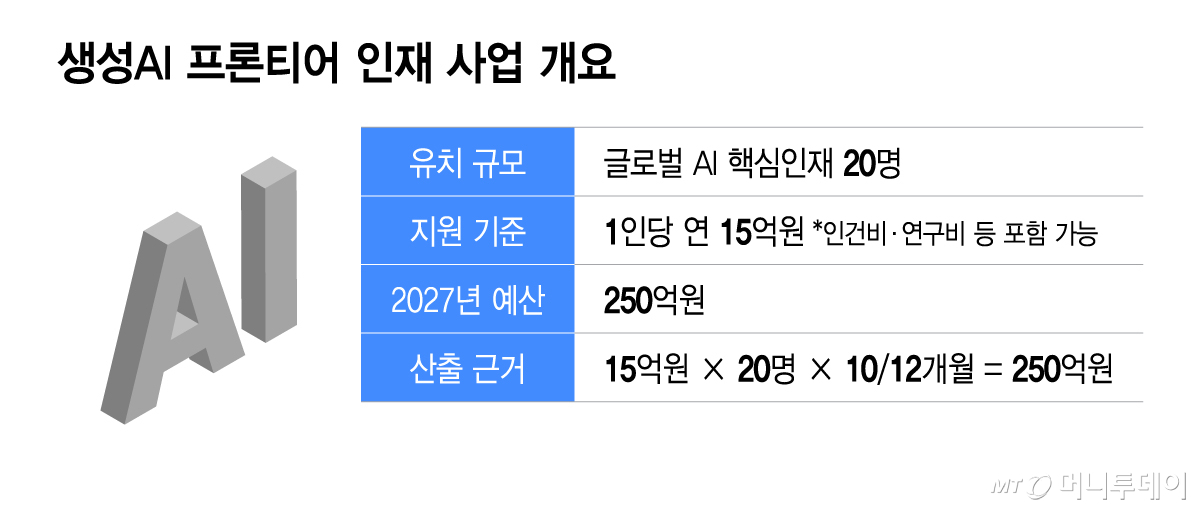
South Korea has set a number that says exactly how much it thinks a world-class AI researcher is worth: 1.5 billion won a year. Roughly $1.1 million. That is the headline figure from the government’s newly detailed “Generative AI Frontier Talent” program, a direct attempt to reverse the country’s slow bleed of its best computational minds to Silicon Valley and beyond.
The math is blunt. The ministry plans to spend 25 billion won next year alone to recruit 20 researchers for a 10-month cycle. That leaves roughly 1.25 billion won per person as a ceiling, though officials say the exact allocation will depend on individual negotiation. The 15 billion won per-capita figure is a budgetary unit that bundles salary and research expenses, not a simple paycheck. How that mix actually lands in a researcher’s bank account remains to be seen.
Who Stays, Who Leaves
The target pool is narrow by design. The government is focusing on Korean nationals already working overseas in AI research and development. These are people who went abroad for graduate training or early-career positions at top labs and never came back. The profile of a “frontier researcher” is not formally published, but the implication is clear: people working on generative foundation models at companies like Google DeepMind, OpenAI, or Meta AI. Someone at that level in Silicon Valley can command well over $1 million in total compensation when you add stock and bonuses.
South Korea is betting that the gap is close enough that the combination of a large base salary, research freedom, and domestic compute resources can tip the balance. Whether it is close enough is the real question.
The Foundation Model Race at Home
The talent program does not exist in a vacuum. It runs parallel to a frantic domestic competition to build an independent AI foundation model. The field has already compressed to three main contenders: LG’s AI Research division, SK Telecom, and Upside (업스테이지), a Seoul-based startup that has drawn outsized attention for its rapid product iteration. Together they represent the bulk of private-sector investment in sovereign model development in Korea.
The government’s program explicitly names independent AI model development as its end goal. That means the 20 recruits are likely to land at one or more of these organizations, not at universities or public research institutes. The mechanism for placing them is roundabout: the science and ICT ministry deposits the 25 billion won into Korea Development Bank, which then on-lends to the recipient companies. The companies use those funds to hire and retain the frontier talent. It is a conduit, not a direct grant.
The Global Context Nobody Talks About
Here is what this tells you about the AI talent war that most coverage misses: the United States and China are not the only players with price tags anymore. Middle powers are entering the ring with numbers that sound outrageous until you compare them to what Xiaomi paid for one researcher. Reports indicate Xiaomi offered around 10 million yuan (—roughly $1.4 million annual compensation) to recruit Luo Fuli, a core developer of DeepSeek’s V2 model. South Korea’s 1.5 billion won offer is in the same neighborhood.
The difference is scale. Xiaomi’s offer was for a single individual with a demonstrable track record. South Korea’s program is spread across 20 people, but each one is being asked to bring not just their own capability but the ability to attract and mentor others. The implicit assumption is that a frontier researcher does not arrive alone — they bring a network. If even a fraction of that network follows, the return on investment compounds fast.
That is also where the fragility sits. The program spans 2027 through 2030, with 25 billion won committed annually under the government’s medium-term fiscal plan. Over four years that is 100 billion won, or about $75 million. For context, a single top hire at a US lab often comes with a compensation package in that range for just one year. The question is whether the Korean ecosystem can hold onto someone who has spent years embedded in Stanford labs, Berkeley networks, or OpenAI’s orbit. Return migration is rarely just about money.
What Wins, What Loses
If the program succeeds, Korea gains a small but high-leverage cadre of researchers who can accelerate its foundation model timeline by years rather than months. The domestic AI industry would gain both the talent and the institutional knowledge that currently sits in foreign labs. LG, SK Telecom, and Upside each have compute and capital; what they lack in equal measure is the kind of deep research culture that takes a decade to build in the United States.
If it fails, the 25 billion won per year vanishes into recruitment costs with little to show but a handful of short-term hires who left their overseas positions at some point during the three-year window but may not have been the marginal candidate Korea needed most. There is also a reputational risk: a high-profile program that produces fewer than ten meaningful placements would signal to the global AI community that Korea can throw money at a problem but cannot solve the structural reasons talent stays abroad in the first place.
The structural reasons are real. Language, visa complexity, academic hierarchy, and the sheer density of peer networks in California all push back against repatriation. Money helps. It may not be enough.
The Next Move
The details that will matter most over the next six months are unglamorous: how many of the 20 slots actually fill, which companies receive the allocations, and what percentage of the 15 billion won per person goes to salary versus research overhead. The government has not yet named the recipient firms. That decision will effectively reveal who in Korea’s corporate sector is willing to commit to long-haul AI research rather than quick product launches.
What is already clear is that South Korea has stopped treating AI talent loss as an inevitable consequence of geography. It is now a line item in a budget. Whether that changes the trajectory of Korea’s AI capability depends on whether the people it reaches actually want to come home.