Korea's dual circuit breakers signal deeper AI-correction damage
KOSPI and KOSDAQ both triggering sell-side sidecars in one session is an unusually synchronized panic. The pattern shows how US AI valuations now move Korean portfolios — and why investors feel politics has lost its leverage over global capital flows.
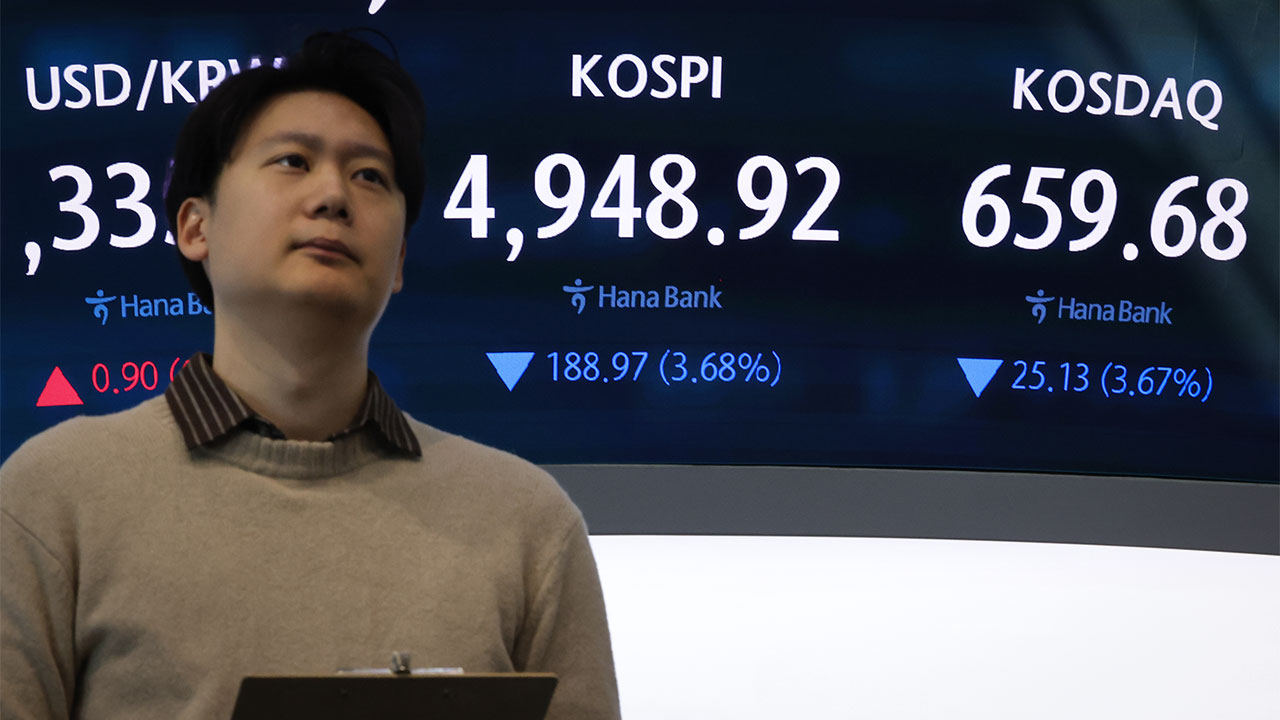
Two sidecars at once
On 20 November 2026, both South Korea’s main benchmarks — KOSPI and KOSDAQ — hit sell-side circuit breakers in the same trading session.
That rarely happens. Korea’s sidecar mechanism pauses trading when heavy selling pushes prices below predefined thresholds. It has been used on KOSPI during past drawdowns. Its appearance on KOSDAQ in tandem with the larger index is unusual enough that the financial media treated it as a breaking-systemic event rather than routine volatility. KOSDAQ, which carries a heavier weight of smaller and mid-cap growth names, tends to be more volatile on its own. When it synchronizes with KOSPI, the signal is sharper: stress is not contained within one segment of the market.
The trigger chain traced back to a sharp US-tech retreat often labelled the “Anthropic Shock” — a broad repricing of AI-exposed equities that originated in Silicon Valley and rippled through Asian supply chains within hours. American indices sold off overnight on Wednesday; by Thursday morning’s open in Seoul, Korean traders were already reacting to paper losses logged on other continents before any local fundamental news existed to justify them.
When American investors cut positions in Anthropic-linked names and semiconductor equipment makers, Korean holdings in that cluster sold off first. A share of those names are large components inside the KOSDAQ index itself; another batch of related names sit in KOSPI. When both baskets started moving south together, each hit its own sidecar threshold almost simultaneously.
Who got hit hardest
The public reaction captured the mood immediately. Online comment threads were flooded with outrage over losses estimated around 563 trillion won among retail investors since the market peaked near 9,000 on the KOSPI. Some commenters compared the present to the 2,500-point era in blunt, despairing terms.
The sharpest losses clustered in AI-relevant and chip-adjacent names. Outside a handful of defensive names, most of the indices’ gainers from earlier cycles were down sharply. Comment sections singled out Samsung-related holdings and noted broad weakness across the board, suggesting the pain was concentrated in the same sectors that had run hardest during the prior AI-driven rally. Names tied to memory-chip demand forecasts, advanced packaging capacity, and AI training infrastructure led the decline.
Retail investors took the brunt in percentage and emotional terms. Institutional money tends to hedge or rotate faster. Small accounts bought into the 2024–2025 enthusiasm without the downside protection that funds carry, so the correction arrived as pure loss. Several observers noted that a disproportionate share of recent new brokerage accounts had opened during the peak buying phase, making the current unwind feel like a betrayal rather than a normal cycle.
Why the speed surprised people
One reason the double sidecar felt jarring is the pace. In normal Korean sessions, KOSPI and KOSDAQ diverge more often than they converge on the wrong side of the tape. Here, the synchronization meant the correction wasn’t sector-specific. It was broad-based stress hitting the country’s two flagship indexes at once.
The other reason is timing. The sell-off unfolded while many participants still believed Korea had decoupled from direct US-rate risk through industrial diversification and export strength. Instead, the market showed how tightly Korean tech stocks remain threaded into American AI narratives. When the narrative sours in California, Korean order books feel it next morning.
Foreign-flow data told part of the story. International funds redeployed quickly out of Korea, chasing relative value elsewhere and unwinding hedges that had been put in place months earlier. The pace of exit compressed the timeline that normally allows for orderly repricing. Derivatives markets added another layer: implied vol skews widened as put buyers dominated, making hedging expensive for anyone trying to hold through the session.
What the “Anthropic Shock” label really means
Siding a broad Korean selloff to a single American episode may sound reductive. But the label is shorthand for a real transmission channel: US-listed AI companies that anchor sentiment for global tech are linked through supplier relationships, co-investment committees, and shared valuation multiples. A sudden reassessment of those multiples propagates fast across borders that trade in dollars and rely on American demand forecasts.
That propagation path is why the event matters beyond Seoul. It isn’t simply a domestic correction. It’s evidence that Korea’s equity sensitivity to Silicon Valley sentiment has increased materially over recent years.
What made this episode distinctive was the velocity of the feedback loop. Algorithmic risk models flagged drawdowns in US AI names and automatically reduced exposure in correlated Korean securities. Those sells then showed up as price pressure in Seoul, which triggered further model-driven exits. By the time human discretionary traders could assess fundamentals, much of the directional move had already occurred. This is a structural feature of modern markets, not an anomaly unique to this day.
Political temperature rose alongside the losses
Comment sections directed frustration toward President Lee Jae-myung, the Financial Services Commission chief Yi Eui-won, and the wider political class. Several voices framed state responses as insufficient and criticized prioritization of stock-index targets over investor protection.
Not every response was punitive toward government. Some commentators pushed back, arguing that market declines aren’t unique to Korea and that personal responsibility should temper blame. The split reveals a deeper tension: voters increasingly expect political stability to buffer them against external market shocks, yet those shocks arrive on timelines politics can’t control.
Pension-fund behaviour compounded the anxiety. Domestic institutional investors, including key retirement-savings vehicles, held meaningful positions in the same AI-adjacent clusters that retail had piled into. Their rebalancing away from high-multiple names created additional selling gravity that amplified the downside move.
Four consequences to watch
1. Retail credibility. If small investors lose another round without visible safeguards, participation in Korean equities may contract further. That changes liquidity profiles for the long term. A thinner pool of domestic retail sellers makes future moves more prone to overshoot in either direction, raising execution risk for everyone.
2. Index composition pressure. Repeated correlated hits could force regulators and index providers to revisit weighting caps on AI-adjacent clusters. The current structure amplifies both the gains and the drawdowns. Broadening index constituents away from a narrow set of technology-heavy names would reduce the mechanical impact of a single narrative shift.
3. Circuit-breaker design. Sidecars pause trading but don’t stop selling pressure. Future sessions may prompt discussion about how these mechanisms interact with algorithmic execution and foreign fund redemption windows. There is also a question of whether the current thresholds account for faster cross-border spillover than when they were originally calibrated.
4. Policy framing. The debate over whether this episode constitutes a “healthy adjustment” or a structural problem will shape legislative and regulatory attention for months. Expect scrutiny on whether stimulus tools target market depth rather than headline levels. Temporary liquidity injections address panic; they do not recalibrate the underlying valuation assumptions driving the repricing.
Bottom line
Double sidecars on KOSPI and KOSDAQ are a stress signal, not a one-day anomaly. The event proves that Korea’s largest public market now moves in lockstep with Silicon Valley’s mood swings through deepening supply-chain and narrative ties. Investors who misread that linkage over the past two years paid the price in this correction. Policymakers who assume political tools can offset global risk miscalculation will face the same lesson again unless they address the underlying exposure.
For outsiders tracking the region, the takeaway is straightforward: when US AI valuations wobble, Korean portfolios bounce first. The synchronization of Thursday’s sidecars was not a glitch. It was the clearest indicator yet that Asia’s most liquid retail-driven market has become an amplifier of American tech sentiment — and that this cycle is only going to accelerate as AI capex commitments deepen across the regional supply chain.