Korean President's Tax Loophole Shows Elite Impunity Problem
South Korea's president sold his apartment through a financing arrangement that dodged gift tax scrutiny. The case exposes how even democratic nations struggle to hold their most powerful figures accountable.
The President’s $2.2 Million Apartment Sale
South Korea’s National Tax Service confirmed last week that President Lee Jae-myung’s apartment transaction will face no gift tax assessment, a ruling that has reignited long-standing anxieties about whether the country’s most powerful officeholder is truly subject to the same laws as everyone else. The service reviewed publicly available documents and determined the deal fell below the 10 million won ($7,300) taxable threshold under current inheritance and gift tax law.
Here’s what happened. In July, Lee sold a jointly owned apartment in Bundang, Seongnam for 2.9 billion won ($2.1 million). The buyer assumed a 1.777 billion won mortgage. Lee provided the difference between the sale price and the mortgage as an interest-free loan, a structure that effectively transferred equity value without triggering gift tax reporting requirements. The tax service calculated the benefit to the buyer from this interest-free arrangement and found it came to less than 10 million won — the statutory minimum for gift tax liability.
The opposition immediately framed this as a loophole exploit. Lawmaker Park Soo-young argued that the president had strengthened residential loan regulations while simultaneously using private lending to circumvent those same restrictions. “This is exactly the kind of scheme our tightened loan policies were designed to prevent,” Park said during a parliamentary session, noting that the transaction raised questions about whether current thresholds were fit for purpose when applied to assets owned by sitting presidents.
Why This Matters Beyond Tax Law
The technical question — whether a 10 million won threshold was breached — obscures the more important one. South Korea has spent decades building institutions meant to investigate powerful figures. The National Tax Service maintains dedicated investigation divisions. Courts have ruled against presidents before. And yet here we are: a sitting president selling a luxury apartment through a financing structure that critics call a transparent evasion, and the tax service concluding no violation occurred.
The psychological dimension of this case should not be underestimated. When citizens observe that the legal thresholds governing high-level officials function as practical exemptions rather than genuine limits, it erodes the foundational premise of equal treatment under law. This is not merely a Korean phenomenon — it is a structural tension inherent in every democracy where wealth and political power intersect.
Across Asia’s democracies, similar patterns emerge. In the Philippines, former President Duterte walked away from graft investigations. In India, several state-level scandals involve ruling family members with no prosecutions. In Taiwan, despite a more robust independent anti-corruption apparatus, political families still accumulate wealth through ambiguous transactions that escape scrutiny. What binds these cases is not the absence of laws but the presence of thresholds, loopholes, and interpretive discretion that disproportionately benefit those with resources to structure transactions within legal boundaries.
The Threshold Problem
South Korea’s 10 million won gift tax threshold exists on paper as a minor administrative provision. In practice, it creates a gap large enough for well-advised taxpayers to move substantial value without triggering tax liability. For ordinary citizens, 10 million won represents years of savings — perhaps two or three years of disposable income for a middle-class household in Seoul. For a president selling a multi-million dollar property, it is a rounding error that functions as a de facto exemption.
The threshold was designed for administrative convenience, not as a substantive policy boundary. Tax authorities need a minimum liability floor to avoid expending investigative resources on trivial transfers. But when that floor remains unchanged for decades while asset values inflate and political offices attract extraordinary wealth, the gap between legislative intent and practical effect widens considerably.
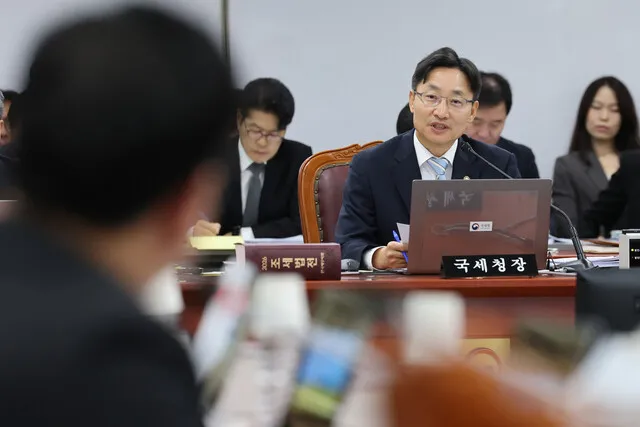
The tax service itself acknowledged the oddity. When pressed about whether Lee’s transaction should receive the same scrutiny as other high-value private debt cases, Commissioner Im Gwang-hyun offered a deflection rather than a principle. He suggested that investigations of similar transactions typically involve younger buyers or unusual circumstances — implying that the president’s case was structurally different, though he offered no evidence to support that distinction. The absence of a clear principled framework is itself revealing: when the most powerful figure in the country operates within the letter of the law, there is no institutional incentive to articulate why that should matter.
Meanwhile, an internet post circulated during the parliamentary hearing claimed that another individual had been investigated by the same tax division for a comparable transaction. If true, it would suggest uneven enforcement — a pattern consistent with elite impunity in any democracy, and one that raises the question of whether the law is being applied or merely invoked selectively.
The Irony of Regulatory Positioning
Lee’s political profile adds another layer of complexity. He campaigned on tightening residential loan regulations, particularly targeting speculative transactions and excessive leverage — measures explicitly designed to curb the kind of private financing arrangements that facilitated the Bundang sale. Whether this constitutes a deliberate circumvention depends on whether one believes the law’s letter and the law’s purpose should align, a question that goes to the heart of democratic governance.
The regulatory irony extends beyond symbolism. When policymakers exploit the very loopholes they sought to close, it generates a second-order effect: diminished public trust in the regulatory architecture itself. Citizens begin to view laws not as shared commitments but as instruments that can be navigated by those with sufficient knowledge and resources. This erosion of normative authority is far more costly than any single transaction’s tax revenue, because it undermines the voluntary compliance that makes tax systems functional.
For Korean taxpayers, the contrast between public rhetoric and private action is jarring. For international observers, it is familiar. Every democracy struggles with the gap between how leaders govern and how they live. The difference in Korea’s case is that the country takes its anti-corruption norms seriously enough to expect better — which makes the failure to deliver all the more damaging.
What Happens Next
The tax service’s conclusion does not end political pressure. Opposition lawmakers have signaled intent to pursue legislative changes that could close the threshold loophole or apply stricter standards to transactions involving public officials. Whether such proposals gain traction depends on the balance of power in the National Assembly, where governing coalition allies may resist reforms that invite scrutiny of their own financial arrangements.
A more consequential second-order effect may already be unfolding: the case has introduced a new variable into Korea’s ongoing debate over presidential accountability. South Korea’s modern democratic history is marked by multiple impeachment crises and prosecutorial investigations of former leaders. The Bundang transaction adds a fresh dimension to that narrative — one in which the president is not accused of criminal corruption but of exploiting a technical gap that the system itself created.
More fundamentally, the case raises a question that will recur in every Asian democracy: what institutions exist to ensure that those who write the rules also obey them? South Korea’s answer has historically been independent prosecutors and investigative bodies. But independence alone does not guarantee equal application. When the most powerful figure in the country operates within the letter of the law, the law itself becomes the shield — and the institutions designed to check power find themselves constrained by the very statutes they are meant to enforce.
The Broader Pattern and the Closing Question
Across the region, the lesson is consistent. Legal technicalities protect the connected. Thresholds designed for administrative convenience become escape routes for the wealthy. And public outrage, while immediate, rarely translates into structural change because the same legal frameworks that enable evasion also control reform. Legislators who benefit from loopholes are unlikely to dismantle them, and independent agencies缺乏the mandate to rewrite the statutes that define their investigative scope.
South Korea’s democracy has survived worse scandals. The country has weathered military dictatorship, financial collapse, and repeated presidential impeachments. The question is not whether the institution will hold but whether a president’s apartment sale should have required any investigation at all. If the answer is yes — if even technically compliant transactions by the most powerful officeholder deserve scrutiny — then the real failure lies not in Lee’s choices but in a system that allows those choices to go unexamined.
The Bundang apartment sale will likely become a footnote in tax policy debates. Its real significance lies in what it reveals about accountability in democracies where power concentrates faster than institutional guardrails can adapt — a pattern that repeats itself, with minor variations, in every political system on earth.