Korea's Property Tax Pivot Signals Who Really Holds Power in Housing
South Korea's ruling party is pressuring the government to soft-pedal a key property tax hike aimed at non-resident single homeowners — a retreat that could undermine years of reform efforts and signal to markets that holding property wins.
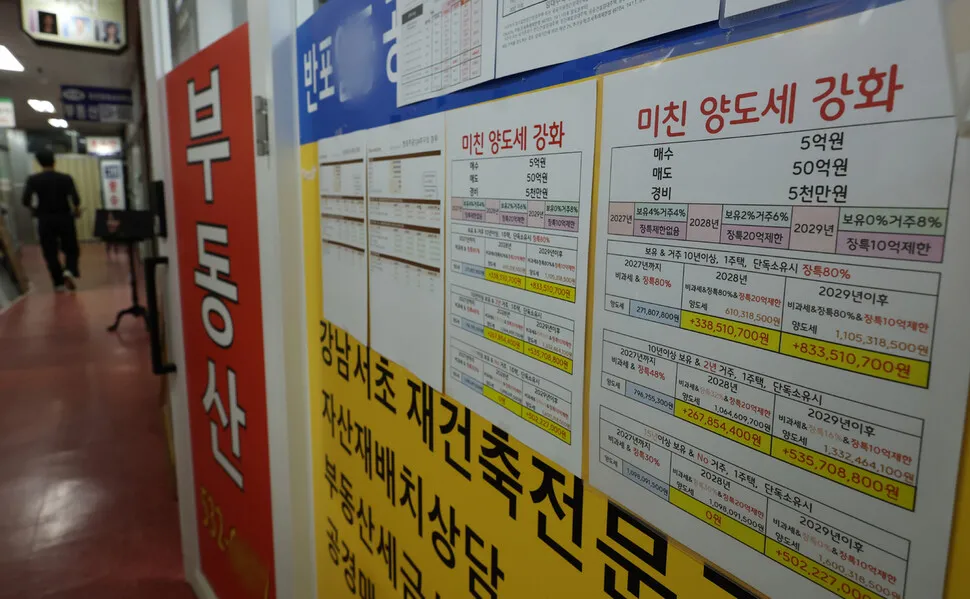
The retreat before the battle has even begun
South Korea’s government drafted one of the most consequential property tax reforms in decades. Then its own ruling party asked it to water down the centerpiece — and the Ministry of Economy and Finance is now quietly considering a compromise that would strip the reform of its bite.
The original plan, unveiled in late May, was elegantly simple: single homeowners who actually lived in their properties would get a larger tax exemption (14 billion won instead of the current 12 billion), while non-resident single homeowners — people who own a home but live elsewhere — would see their exemption slashed to 9 billion won. The logic was transparent. You pay more if your property sits empty or rental, less if you live in it. The president has repeated the “actual residence principle” (실거주 원칙) so often it became a campaign mantra.
Now the Democratic Party is asking the government to remove the distinction entirely. A compromise being floated would simply restore the non-resident exemption back to 12 billion won — meaning no penalty at all for owning a home you don’t live in. The existing system already had a 12 billion won threshold for everyone. The reform was supposed to change that. Going back to zero change would be a surrender disguised as flexibility.
Who wins, who loses, and what the numbers say
Take a specific case the finance ministry itself cited: a single homeowner in a property valued at 30 billion won (with an official assessed value of 20 billion won), qualifying for a standard 20 percent tax credit. Under the reform, this person would pay about 4.25 million won annually in comprehensive real estate tax. Under the compromise, that drops to roughly 2.66 million won — a savings of nearly 1.6 million won per year.
That may sound modest. But the psychological signal is enormous. A policy explicitly designed to penalize non-occupation ownership would effectively have been abandoned. The market hears this clearly.
Agents in Gangnam’s luxury condominium markets are already reacting. Low-priced listings are being pulled from the market. Asking prices are moving higher. The very behavior the tax was meant to discourage — hoarding property as an investment vehicle rather than a home — is being rewarded by the retreat.
The deeper problem: policy credibility
What the finance ministry is most afraid of isn’t lost revenue. It’s policy credibility.
“We’re monitoring how the supplementary measures affect the market,” a ministry official told the press. “Especially the risk of sending the signal that ‘if you hold property long enough, the government will back down.’”
That fear is not abstract. South Korea has cycled through property curbs for over a decade — purchase restrictions, loan limits, transaction taxes — each one eroding public trust when they were eventually relaxed. The comprehensive real estate tax was supposed to be different. It was the structural reform, the one that would shift reliance from transaction taxes to holding taxes, from stopping purchases to making ownership costly unless you actually lived there.
Rolling back the non-resident penalty now would be the clearest possible message: this was never serious. The next government — or even the same government under different political pressure — could reverse it again. The tax becomes another cyclical instrument rather than a permanent feature of Korea’s housing architecture.
The backlash is already forming
Civil society groups are not waiting quietly. The Citizen’s Coalition for Economic Justice released a statement on May 24 calling the Democratic Party’s move a step toward becoming a “party of tax cuts for the wealthy.” They argued the government should also reconsider raising the exemption for resident homeowners from 12 billion to 14 billion won — essentially saying the entire reform needs a ground-up rethink, not a selective rollback.
Academic voices are echoing the same concern. Professor Jeong Se-eun of Chungnam National University, a member of the government’s own Tax System Development Committee, warned that single-homeowner tax payers represent only the top 1 percent. If the government retreats now, he said, expecting a rational, property-tax-based housing system in the future would be naive.
These aren’t fringe complaints. They’re signals from the people who designed the policy that the policy is being undone before it even lands.
What this means for East Asia
South Korea’s housing market is one of the most closely watched in the world. Its price-to-income ratios rank among the highest in developed economies. Its property tax system has historically been one of the weakest — a structural feature that has amplified boom-bust cycles across the region.
The 2024 reform was Korea’s best chance in decades to change that. A differentiated exemption structure that penalizes non-occupation ownership would have sent a clear signal across East Asia: holding empty property is expensive, living in your home is rewarded. That kind of policy architecture exists nowhere else in the region at this scale.
China’s property tax pilots have stalled. Japan’s fixed asset tax remains shallow and uniform. Hong Kong’s stamp duties punish transactions but not ownership. Korea was building something different.
If the non-resident distinction disappears, the region loses its most ambitious experiment in using taxation to reshape housing behavior. The lesson for investors and policymakers alike would be that even the most-watched reform in Asia yields to political pressure within weeks of announcement.
What happens next
The compromise hasn’t been finalized. The finance ministry is still “carefully reviewing” the scope of any adjustments. But the direction of travel is visible: the ruling party has the leverage, and it is using it.
The question is not whether the distinction will survive — it is whether anything will. If the non-resident penalty goes, the resident bonus may follow under the same political logic. The entire reform could collapse into a marginal adjustment that changes nothing about who profits from Korea’s housing market.
For the millions of Koreans who cannot afford a home, this is not an abstract tax debate. It is a signal that the system will continue to reward those who already own. For the government, it is a test of whether a policy born from presidential priority can survive contact with its own party. For the region, it is a moment that will be studied by anyone trying to understand why housing reform keeps failing in East Asia.
The principle was clear. The politics are clearer.