Korea's Quiet Defense Push Into Europe Has NATO Thinking Differently
After proving the FA-50 in Poland, KAI is now pitching a KF-21-UAV teaming system at MSPO 2026 — and building local infrastructure in Europe to support it. Seoul is becoming a defense exporter Europe can't ignore.
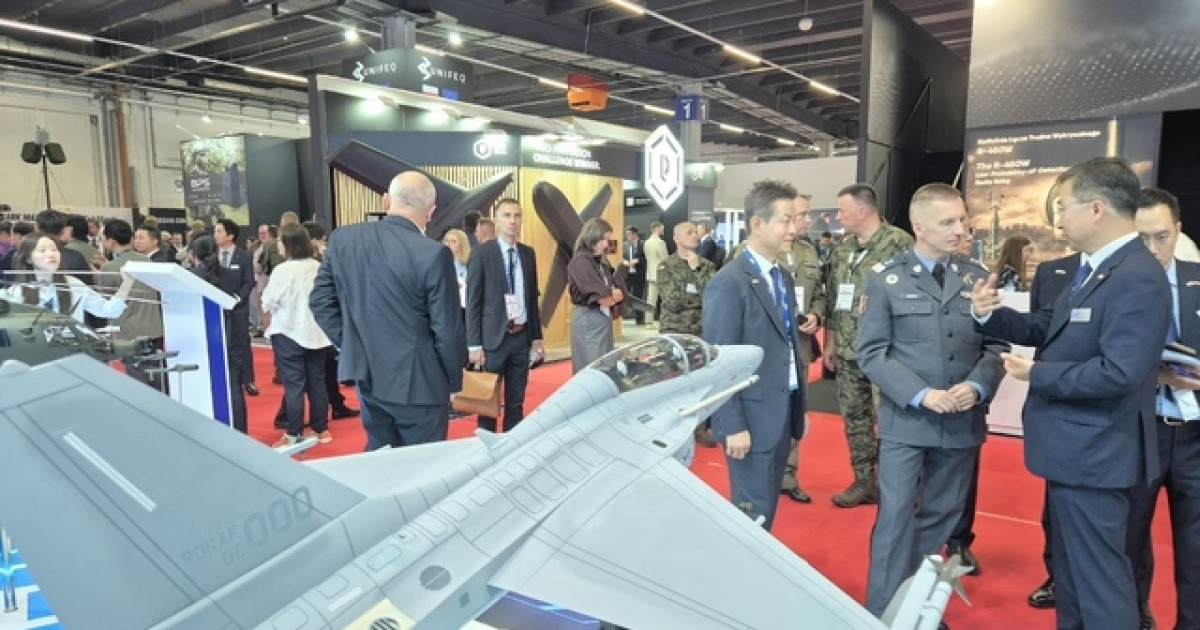
The Real Story Behind KAI’s MSPO 2026 Stand
Korea Aerospace Industries walked into the MSPO exhibition in Kielce, Poland, in early September not to announce a single deal but to lay out an entire future combat architecture. The centerpiece was NACS — the Next-generation Air Combat System — linking the KF-21 fighter, aUCAV (unmanned combat air vehicle), AAP (multi-role unmanned aircraft), and low-orbit communications satellites into one networked killing chain. What made it notable was not just the technology on display but the strategy behind it: Poland, where the FA-50 has already proven itself, is now serving as KAI’s European staging ground for something far bigger.
This is not business as usual for Korean defense exports. It is a deliberate pivot from selling individual airframes to selling systemic combat capability — and it targets a market that European traditional players have largely ignored in favor of legacy procurement cycles. The NACS demo showed live data-link feeds between a simulated KF-21 cockpit and an AAP drone executing coordinated strike patterns. That demonstration was filmed, circulated internally among prospective buyers, and has already prompted at least three additional NATO air forces to request briefings.
Why Poland Matters More Than You Think
The FA-50 story in Poland is well-documented. Seoul signed a 48-aircraft contract in 2022, and the jets are now flying with the Polish Air Force. What the public narrative missed is what happened after delivery: KAI opened a base operations office at Mińsk Mazowiecki Air Base in 2023 and incorporated a European subsidiary in Warsaw in mid-2024. These are not ceremonial moves. They are infrastructure investments that signal long-term commitment — the kind that makes future buyers in neighboring countries take notice.
Poland is now the only country in Europe with Korean fighter aircraft operating under Korean logistical support. That gives KAI something no competitor can easily replicate: live operational data from a real combat-capable platform in a NATO theater, fielded by a customer that is actively expanding its defense industrial base. Polish technicians have logged over 2,000 flight hours on the FA-50 as of mid-2026, and KAI has used that dataset to refine maintenance schedules and spare-parts forecasting — information that can now be offered to prospective customers as proof of concept.
Beyond the data, there is a political dimension. Poland’s government has staked its reputation on diversifying defense suppliers away from sole reliance on traditional Western partners. That creates a receptive environment for Korean exporters in a way that Romania or Bulgaria, where governments have been more cautious about signaling distance from established alliances, simply cannot match.
The MUM-T Play Is the Game Changer
What European buyers at MSPO were most interested in was not the KF-21 itself but the manned-unmanned teaming (MUM-T) architecture around it. KAI showcased the FA-50 paired with an AAP drone, demonstrating how a piloted platform can control unmanned assets in real time. The same concept was extended to the MAH (medium lift attack helicopter) and LAH (light attack helicopter), both integrated with ALE (air-launched effectors).
This is strategically significant. The entire NATO eastern flank is weighing how to counter potential saturation attacks — swarms of cheap drones overwhelming expensive air defenses. Most European defense companies are still answering with point-defense systems. KAI is answering with a system that turns every manned platform into a drone commander. That is a fundamentally different value proposition, and it lands differently with air forces facing budget constraints.
The second-order effect is worth tracking: if MUM-T becomes the default posture for mid-tier NATO air forces, it reshapes procurement entirely. Spare-parts ecosystems, pilot training pipelines, and even military doctrine will all pivot around the concept of the piloted platform as a battle management node rather than the primary strike asset. Korea is positioning itself at the center of that shift before European competitors have even defined the problem space.
The Customers KAI Is Targeting
KAI’s marketing push from Poland is aimed at Romania, Bulgaria, and Slovenia — all NATO members with aging fighter fleets and no domestic production capacity. These are countries where the F-16 and Mirage 2000 are past their prime, and where the Eurofighter and Rafale carry price tags and political strings that make some capitals uncomfortable.
The KF-21, currently entering service with the Republic of Korea Air Force in late 2026, sits in a market niche that is underserved: a fourth-generation-plus fighter with fifth-generation networking capability, priced below Western equivalents, and available without the export control complexities that come with American or European platforms. That is not a theoretical positioning — it is exactly where Poland’s initial FA-50 buy made sense.
Romania stands out as the most likely near-term conversion. It already operates Korean-made K2 Black Panther tanks and has been looking for a complementary air platform. A KF-21 acquisition would deepen the interoperability dividend while giving Bucharest a credible deterrent posture without requiring American or French political negotiation.
Who Wins, Who Loses
The winners are clear: KAI gains a beachhead in a market that has been closed to non-European suppliers for decades. Poland consolidates its role as the security anchor of Central Europe, with a defense partner that does not come with the diplomatic complications some buyers associate with Washington or Brussels. European UAV and fighter contractors face a new competitor that is not European but is treating Europe as its most important export market.
The losers are less obvious but real. French and Swedish exporters who have relied on first-mover advantage in Eastern Europe now face a rival with superior unmanned integration and a pricing model built for mid-tier buyers. American defense firms are not directly displaced — the KF-21 competes in a different category — but the symbolic weight of Korea exporting advanced combat systems to NATO territory without American design involvement is not lost in Washington.
There is also a supplier-layer consequence. Korean component makers — including radar and avionics firms that have previously sold exclusively to Korean military programs — are now being pulled into international supply chains. That creates a nascent Korean defense ecosystem in Europe that could outlive any single contract and deepen the strategic footprint beyond what KAI alone can sustain.
What This Means for US Alliance Dynamics
This is the quiet undercurrent of the story. Korea is building a defense export footprint in Europe that operates independently of the US industrial base. That is not anti-American — it is a natural consequence of Korea’s own strategic autonomy ambitions. But it does create a subtle tension within NATO supply chains. The US has invested heavily in keeping European defense procurement aligned with American platforms. A successful Korean foothold in Central Europe introduces an alternative that American policymakers will find harder to dismiss.
The FA-50 in Poland proved the concept. The KF-21 and NACS at MSPO 2026 prove the trajectory. What happens next depends on whether any of KAI’s target customers convert interest into contracts — but the infrastructure, the political signaling, and the technological narrative are already in place.
Korea is no longer just a buyer in the European defense equation. It is becoming a seller with a strategy — and the fact that the strategy is being executed from a NATO base in Poland makes it impossible for alliance planners to treat as a peripheral development.