Korea's Rate Hike Could Reshape Asia's Monetary Chessboard
South Korea's back-to-back rate hike to 3% signals a tightening bias that could cascade across emerging Asia — but it also exposes the limits of a dollar-anchored strategy when domestic overheating runs in the opposite direction.
The spread is at its tightest in nearly four years, and it is not just a bilateral story.
The Bank of Korea raised its benchmark rate to 3% on August 27, marking a second consecutive increase — a move that has only happened three times in the central bank’s history. The last back-to-back cycle ran from April 2022 through July 2023, when the BOK hiked seven straight times to combat a post-pandemic inflation surge.
This time, the motivation looks different, and the regional implications could be larger than the single quarter-point move suggests.
Why Korea is moving now
The numbers behind the decision tell a story of an economy that simply refuses to slow down.
Real GDP grew 0.6% in the second quarter, building on a 1.8% expansion in the first. On a year-over-year basis, Q2 growth hit 3.7% — well above the 3.0% consensus forecast. The cumulative current account surplus reached approximately $200 billion by June, the largest half-year figure on record since 2000. Semiconductor exports are driving the rebound, and the domestic recovery they spawn is feeding demand-side price pressures.
Consumer inflation followed a steady upward slope: 2.0% in January–February, 2.2% in March, 2.6% in April, and then 3.1% in May and 3.2% in June. Core inflation, the BOK’s preferred gauge, climbed to 2.6% in July — the highest reading since December 2023, when it last peaked at 2.8%.
Household debt continues to accumulate, and Seoul apartment prices are climbing again. The BOK upgraded its 2025 growth forecast to 3.3% from 2.6%, the widest upward revision since May 2021, and lifted next year’s estimate to 2.9% from 2.1%.
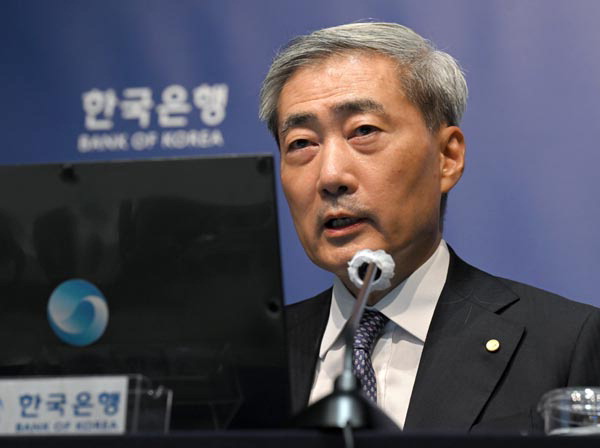
Governor Shin Hyun-soon framed the hike as preemptive — a bet that keeping policy restrictive now prevents a sharper adjustment later.
The US-Korea spread narrows to 0.75 percentage points
The most immediate market signal is the shrinking gap between Korean and American policy rates. With the US federal funds rate sitting at 3.50–3.75%, the differential has contracted from 1.0 percentage point to 0.75 — the narrowest margin since December 2022, a full three years and eight months ago.
A narrower spread reduces theyen incentive for carry trades that park capital in Korean won-denominated assets. It also removes some of the downward pressure on the KRW that typically accompanies wider US-Korea gaps. For importers and borrowers carrying dollar debt, even a small correction in the differential matters — Korea’s external debt is substantial, and every basis point of currency appreciation shifts the repayment calculus.
What this means for the rest of Asia
Here is where the story leaves Seoul.
Several Asian central banks sit at similar crossroads. Indonesia, Thailand, the Philippines, and India have all navigated inflation surprises and currency volatility while trying to protect growth. Korea’s decision to keep tightening — even as the US Federal Reserve signals a potential pivot — sends a signal that the region’s largest economy is unwilling to wait for dollar weakness to solve its inflation problem.
That creates a coordination puzzle. If Korea leads further tightening while the Fed turns dovish, other central banks face a harder choice. Moving with Korea means borrowing costs rise faster; holding back risks capital outflows as the yield advantage erodes.
The Philippines’ Bangko Sentral and Indonesia’s Bank Indonesia, both of which have smaller FX reserves relative to their dollar-denominated liabilities, feel this squeeze most acutely. A further narrowing of the US-Korea spread without a corresponding shift in US policy could accelerate capital rotation away from the region’s smaller economies and toward higher-yielding corners of the emerging market complex.
The semiconductor variable
Korea’s rate hike is, in part, a bet on the cyclical nature of chip demand. The current growth spike is semiconductor-driven — and semiconductors are cyclical by definition. If AI-related capex slows or memory pricing corrects, the growth upgrade the BOK is now pricing in could reverse faster than expected.
That risk cuts both ways. If the upgrade holds, the BOK has more room to keep rates higher for longer, reinforcing the tightening bias across the region. If the semiconductor cycle peaks sooner than projected, the BOK faces a steeper tradeoff: rein in an overheating economy or risk a harsh correction.
Either outcome matters for regional peers. A prolonged high-rate environment in Korea pulls liquidity from neighboring markets. A premature pivot — cutting rates while inflation is still rising — would undermine the credibility the BOK has worked hard to rebuild since the 2022–23 cycle.
Who wins, who loses
Exporters win if the won stabilizes or appreciates modestly against the dollar, as the narrower spread should encourage. Domestic borrowers lose immediately — mortgage rates and corporate loan costs tick higher, compounding the pressure from already-elevated household debt.
Regional policymakers face the hardest calculation. Korea’s move raises the cost of coordinating a regional response. If other EMs follow, they risk throttling growth in economies that were barely growing before the pandemic. If they do not, they absorb capital outflows and currency depreciation.
The BOK may be buying time — but it is spending regional credibility to do it.
What happens next
The next two meetings will be decisive. If inflation continues its quiet climb and GDP holds above 3% annually, a third consecutive hike is plausible. If semiconductor revenues falter or household debt stress intensifies, the BOK could pause — and that pause itself would reshape expectations across Asian markets.
The 0.75 percentage point spread between Korea and the US is not an endpoint. It is a threshold. How Korea’s central bank navigates the path from here will determine whether Asia’s monetary policy trajectory converges toward the Fed or moves in a direction its own economies can sustain.