Korea Just Sold Its First Reactor to America — and It Changes Everything
South Korea has secured permission to build its APR1400 reactor on US soil for the first time, flipping a 46-year-old technology-transfer relationship upside down and creating new leverage in US-Korea trade disputes.
The Reversal No One Saw Coming
In 1978, South Korea received its first generation of nuclear-reactor technology from the United States. For decades, the relationship followed a simple script: America designed, Korea built. Westinghouse licensed its designs, Korean engineers adapted them, and the output went to countries from the Middle East to Europe.
That script broke on November 1, 2026.
Seoul and Washington announced a strategic investment framework called Project Power that includes building eight large reactors on US soil. Sixty percent of the $200 billion deployment target — roughly $120 billion — is earmarked for nuclear. And for the first time, the reactors at the front of the lineup will be Korean-designed: the APR1400, a 1.4-gigawatt model developed by Korea Electric Power Corporation (KEPCO) and its affiliates.
The APR1400 has never been built in the United States. No foreign reactor design has. The deal marks the first time a US-based nuclear program will rely on a non-American reactor model for new construction.
Who Gets What
The agreement lays out a specific sequence. Westinghouse will begin construction on two AP1000 reactors (1.1 GW each) first. Within six months, contracts will be signed for two Korean APR1400 units and two additional American-built units. Then, two more AP1000s follow.
The order was not accidental. Industry Minister Kim Jung-kwan said he spent considerable time negotiating the sequence. “The Korean-type reactors will come first,” he stated.
Westinghouse had demanded intellectual-property compensation for the technology originally licensed to Korea in 1978. In 2025, Washington and Seoul reached an agreement that barred Korea from independently entering North American markets and required technology-use royalties estimated at over 1 trillion won per exported reactor.
This deal revises both restrictions. Korea gains an “exceptional” entry into the US market, limited to projects funded through Project Power. Royalty terms are being renegotiated, though details remain vague.
Howard Lutnick, the US Commerce Secretary, confirmed the reactors will be sited in Ohio, Tennessee, South Carolina, and Kentucky.
The Cost Gap That Makes This Possible
The economics are stark. Building nuclear reactors in the United States costs roughly three times what it costs in Korea, according to both governments. American construction faces a depleted workforce of qualified welders and engineers, fragmented supply chains, and permitting delays that routinely add years to schedules.
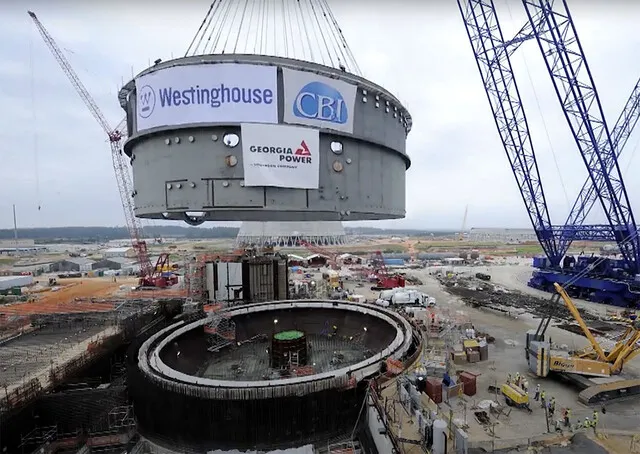
South Korea understands this terrain better than most. It learned American construction costs the hard way when the Vogtle project in Georgia ballooned far beyond initial estimates.
To buffer the risk, the two sides allocated $200 billion in contingency funds out of the $1,200 billion total nuclear investment. Each pair of reactors — Korean or American — is budgeted at $300 billion: $250 billion for construction plus $50 billion in reserves.
Kim Jung-kwan clarified that the contingency reserve counts toward investment commitments regardless of whether it is actually spent. “If the money is not used, it still qualifies as fulfilled investment,” he said. But with inflation and the likelihood of delays, most of that reserve will almost certainly be drawn down.
The Advance Payment That Signals Confidence
Perhaps the most consequential detail is the timing of the money. South Korea has proposed an advance payment of up to $100 billion before the end of 2026.
The official rationale is practical. Nuclear components take years to manufacture. Reactor pressure vessels require 54 months from design to delivery. Steam generators take 57 months. Coolant pumps and motors need 65 months. These are called long-lead items, and securing their production slots is essential to any reactor schedule.
Daewoo E&C holds a dominant position in manufacturing these components. The advance payment effectively pre-commits capital to lock in manufacturing capacity before anyone else can bid for it.
This is strategically significant because commercial viability reviews have not been completed. Investing at scale before a formal go/no-go decision is unusual, and it has drawn some criticism domestically. The Ministry of Trade, Industry and Energy defended the move, arguing that waiting for full approval would mean missing the production window entirely.
What This Means for US-Korea Trade
The nuclear deal does not exist in isolation. It intersects with one of the most sensitive threads in the US-Korea relationship: South Korea’s $25 billion investment commitment in exchange for American concessions on LNG import rules.
The Biden administration placed restrictions on Korean LNG imports to protect domestic shale producers. Seoul promised $200 billion in investment to Washington as part of a broader strategic dialogue. Nuclear construction is the largest single component of that investment pledge.
By moving fast on the advance payment and securing a Korean reactor on American soil, Seoul is extracting tangible value from a deal that otherwise gave Washington significant leverage over Korean energy imports. The APR1400 is proof of concept — if two units perform on schedule, Korea can claim the design is competitive even in the most demanding regulatory environment in the world.
The Bigger Picture
Eight reactors across four states would represent the largest single deployment of nuclear technology in American history. If the Korean units are delivered on time and under budget, the APR1400 becomes the first non-US reactor design validated in the American market. That changes everything about how nuclear technology flows globally.
India, Vietnam, Saudi Arabia, and Egypt are all exploring nuclear programs. Right now, they look to France (EDF’s EPR), Russia (Rosatom), China (Hualong One), or the United States (Westinghouse). A successful American demonstration would add a fourth credible option and shift bargaining power away from the traditional suppliers.
For Westinghouse, the deal is complicated. Its AP1000 still leads the initial phase, but the APR1400’s position ahead of the second round of American units signals that Korean technology may outcompete it on cost. The company’s original IP demands were an attempt to monetize that history. This deal reduces that leverage.
What Happens Next
The Commercial Viability Review remains the single biggest uncertainty. If it concludes the economics do not work, the entire project stalls regardless of political commitment. If it clears, the $100 billion advance payment begins flowing in the coming months.
Domestically, the deal will face scrutiny in the National Assembly. Critics will ask why $100 billion is being transferred before full commercial assessment. Supporters will point to the geopolitical and industrial returns.
On both sides of the Pacific, the APR1400’s American debut will be watched closely. A success rewrites the map of nuclear exports. A failure damages South Korea’s reputation in a market it already dominates in the Middle East and could undermine its broader strategic investment credibility with Washington.
Neither country can afford for this to fail.