Korea's 1.6 Trillion Won Space Bet Is About More Than Just Reaching the Moon
South Korea is nearly doubling its space agency's budget to chase lunar landing ambitions by 2030 — but the real story is how it's reshaping the regional balance of space power.
A Budget That Changes the Question
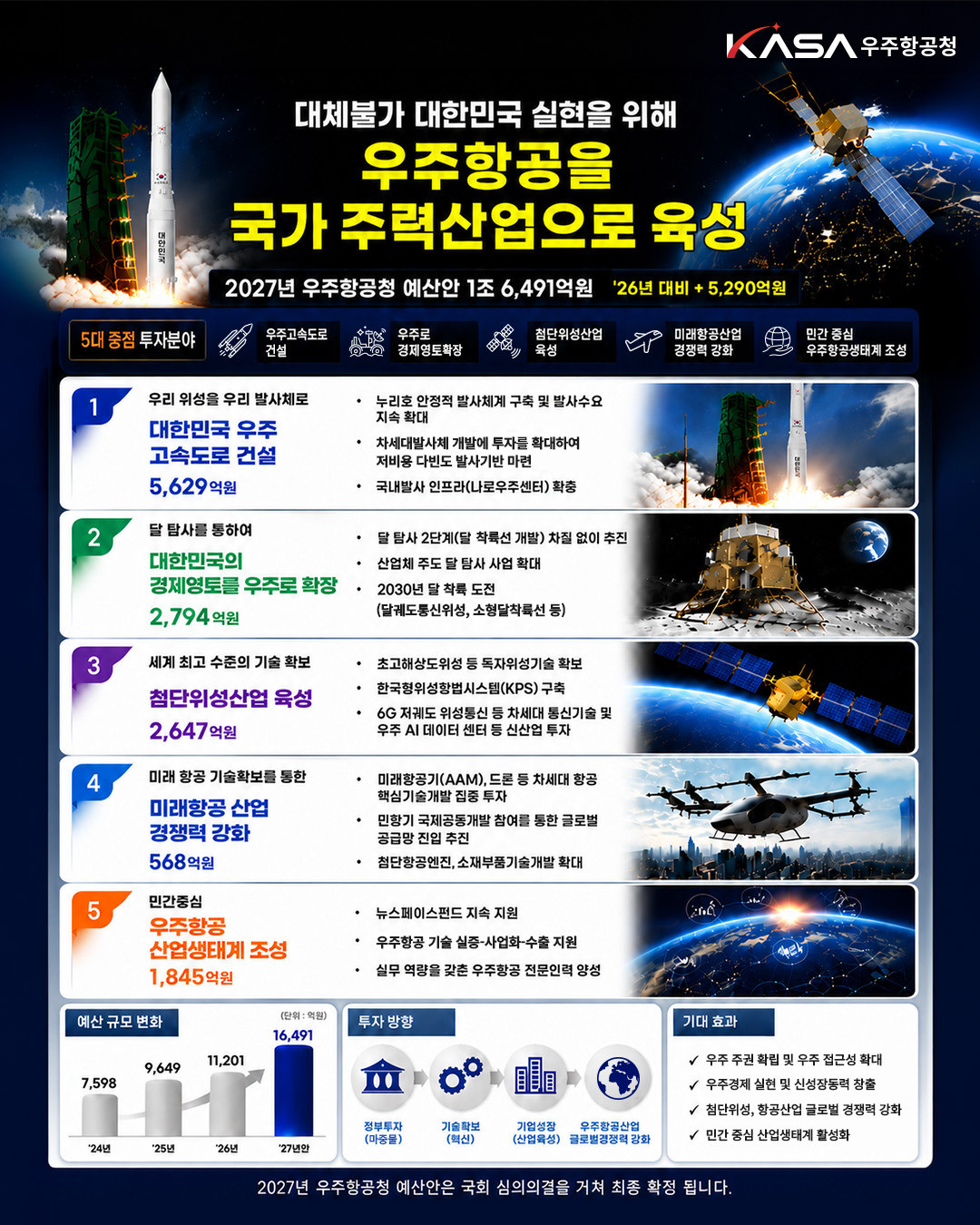
South Korea’s Space Agency is asking for 1.65 trillion won in next year’s budget — a 47.2 percent jump from this year. On the surface, that’s just another government line item. But the allocation tells a different story. This isn’t money being poured into keeping South Korea a reliable launch service provider for foreign payloads. It’s money being spent to build something self-contained: a domestic launch cadence, a lunar landing capability, and a private-sector ecosystem that doesn’t depend on government contracts alone.
The most striking line is in lunar exploration. Funding jumps 180 percent — from roughly 100 billion won to nearly 280 billion won. Within that, 106.3 billion won is ring-fenced for a small lunar lander, targeting a 2030 touchdown. South Korea isn’t just trying to orbit the moon this time. It’s aiming to put hardware on the surface.
What makes this allocation notable isn’t merely the percentage increase. It’s the specificity. The government has carved out dedicated funding for a communication and navigation satellite system to support the lander — something the previous lunar mission, Danuri, did not require since it was purely an orbiter. That distinction matters. A lander needs a return path: telemetry, tracking, and command links that orbiters never demand. The budget treats that infrastructure as a prerequisite, not an afterthought.
The Launch Vehicle Foundation
Before you can land on the moon, you need to get there reliably and affordably. That’s where the “space highway” concept comes in. The budget for this category more than doubles — from 263 billion won to 563 billion won.
Three projects sit inside it. The Korean-type launch vehicle enhancement gets 155 billion won. The next-generation launch vehicle development — the one that could eventually replace Nuriro — gets 291.6 billion won. And a new 25.3 billion won project upgrades the Naro Space Center’s Phase 3, specifically to support first-stage reusability and larger payload capacity.
Seventy-five billion won in fresh funding goes to stabilizing annual Nuriro launches. After three successful flights between 2021 and 2023, South Korea has proven it can build a rocket. What it hasn’t proven is that it can do so repeatedly. Annual launches require ground infrastructure, flight-proven hardware, and a supply chain that runs faster than government procurement cycles allow. The budget signals that the agency sees this gap and is trying to close it — but the timeline is aggressive.
The reusable first-stage investment deserves closer attention. South Korea is committing resources to reusibility before Nuriro has even established a rhythm of commercial launches. That’s a strategic bet: if the next vehicle enters development already designed for recovery, the cost curve drops sharply. But it also means the agency is running two parallel innovation tracks — stabilizing the current rocket while building the next one. Either track slipping drags both timelines with it.
The Private Sector Pivot
Perhaps the most consequential allocation is the 1.845 trillion won reserved for cultivating a private space industry ecosystem — with 1 trillion won committed to NewSpace investment support. This is not seed funding. This is structural capital meant to shift the center of gravity from government labs to commercial companies.
South Korea has a strong manufacturing base and world-leading electronics firms. The question has always been whether that industrial capacity translates into space competitiveness. The budget is designed to force the answer yes.
The logic is clear: if Seoul wants to land on the moon by 2030 and sustain orbital operations, it cannot rely on the Korea Aerospace Research Institute alone. It needs companies like Hyundai Heavy Industries, Samsung ThALES, and a growing startup scene to absorb technology, drive down costs, and scale production. The 1 trillion won NewSpace fund is the lever.
The second-order effect of this pivot is worth tracking. Government-led space programs tend to produce well-engineered but expensive hardware with long development cycles. Private participation introduces competitive pressure on cost and speed. But it also introduces fragmentation — multiple companies building to different standards, competing for the same contracts, and potentially duplicating effort. The agency’s challenge will be orchestrating that competition without letting it fray into inefficiency. The budget includes provisions for a space technology cluster and a commercial spaceport study, suggesting Seoul is aware of the coordination problem and intends to manage it.
Japan Is Watching
Japan’s space ambitions have historically overshadowed South Korea’s. JAXA has deep expertise in lunar landers, asteroid missions, and orbital mechanics. Japan has also been investing heavily in its own lunar program and in commercial launch capabilities. South Korea’s budget increase arrives at a moment when the two countries’ space strategies are starting to overlap in ways that didn’t exist five years ago.
Japan’s lunar landing target — currently set for the mid-2020s with private-sector partners — would give it a head start. But South Korea’s approach is different. Instead of chasing Japan’s milestones directly, Seoul is building the underlying architecture: reusable launch vehicles, a dedicated lunar communication satellite, and a domestic satellite manufacturing base. If those foundations hold, South Korea could reach competitive capability faster than its trajectory alone would suggest.
The real competition may not be who lands first. It may be who builds the industry that makes landing routine. Japan has the advantage of earlier investment and deeper institutional knowledge. South Korea has the advantage of a newer industrial strategy that isn’t burdened by legacy procurement patterns. That tension will define the region’s space landscape over the next decade.
What Could Go Wrong
The budget must still clear the National Assembly’s standing committee and the Budget Committee before becoming law. That process can trim ambitious allocations. A 47 percent budget increase in any ministry is politically conspicuous.
Even if approved, the timeline is tight. A 2030 lunar landing requires successful Nuriro flights, next-generation launch vehicle development, lander construction, and orbital verification — all in roughly four years. Reusable first-stage technology adds another variable. If reusability trials delay the next-generation rocket, the lunar timeline compresses further.
And there is a funding risk inherent in the model. The 1 trillion won NewSpace investment assumes private companies will match public capital. If market conditions shift or returns lag, the ecosystem may not expand fast enough to justify the spending. A downturn in global launch demand could leave South Korea’s private space companies undercapitalized precisely when they need to scale.
The Bigger Picture
South Korea’s space budget is no longer about catching up. It is about defining a role in a region where space capability is increasingly strategic — tied to communications, navigation, Earth observation, and eventually, economic advantage. The 1.65 trillion won allocation says Seoul sees space as a future pillar industry, not a prestige project.
The numbers are concrete. The ambition is clear. Whether the execution matches the budget is the question that will determine if South Korea becomes a space power or just another country that tried. One thing is certain: the era of watching from the sidelines is over.