Korea's Steel Pivot: Why the Cleanest Steel Is Now Being Forged in Louisiana
Hyundai and POSCO are breaking ground on an $5.8 billion electric arc furnace steel plant in Louisiana, marking a decisive shift in Korean industrial strategy. The project targets carbon reduction and US tariff avoidance as Korea's steel giants pivot from domestic competition to overseas integration.
The Iron Crossroads in the Bayou
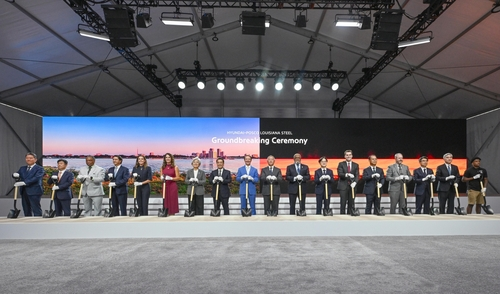
When Chairman Chung Eui-sun of Hyundai Motor Group and Chairman Jang In-hwa of POSCO stepped onto a construction site in Ascension Parish, Louisiana, last week, they weren’t just breaking ground on a steel plant. They were drawing a line under an era.
Hyundai Heavy Industries Steel and POSCO — Korea’s steel rivals for decades — are jointly investing $5.8 billion in what will be the first integrated electric arc furnace steel plant in the United States dedicated to auto-grade steel. The facility, which Hyundai and POSCO are calling HPLS, will produce 2.7 million tons of automotive steel sheets annually by 2029. It will sit on roughly 223 hectares of land, with a production line that stretches from steelmaking through hot rolling, cold rolling, and coating.
But the story behind the headline numbers matters more than the numbers themselves. This is Korea’s oldest heavy-industry duopoly — built on the backbone of Incheon and Pohang — now choosing to invest its future across an ocean rather than at home.
Who Actually Owns the Earth Beneath Those Boots
The equity split reveals the real architecture of the deal, and it is not what you might assume from reading the press release.
Hyundai Heavy Industries Steel holds 50 percent. POSCO, the country’s No. 1 steelmaker by revenue, holds just 20 percent. The remaining 30 percent is split between Hyundai Motor and Kia, 15 percent each. That means Hyundai Motor Group — through its two auto arms and its steel subsidiary — controls 80 percent of the venture. POSCO is the technology contributor, not the controlling shareholder.
This is a striking reversal. For years, POSCO’s domestic market leadership and its reputation for high-grade auto steel made it the natural leader of any Korean steel consortium. Here, it is the junior partner in a Hyundai-branded project. Chairman Jang acknowledged the asymmetry directly, telling reporters afterward that while his companies compete in Korea, they are all Korean companies on the global stage.
That framing may soften the strategic reality: POSCO is effectively licensing its most valuable competitive advantage — auto-grade steel expertise and hydrogen-reduction ironmaking technology — into a plant it does not control.
The Carbon Math (and the Caveat)
The electric arc furnace route, which melts scrap steel and direct-reduced iron using electricity rather than coking coal, is presented as the plant’s green credential. Hyundai claims the process will cut carbon emissions by approximately 70 percent compared to the blast furnace method that dominates Korean steel production.
There is one critical caveat buried in the source material: that 70 percent reduction is a target, not a verified result. It has not been production-tested. Electric arc furnaces can indeed be cleaner than blast furnaces — but only if the electricity powering them comes from low-carbon sources. Louisiana’s grid, historically coal- and gas-heavy, will determine whether HPLS delivers on its climate promise or merely rebrands dirty steel with a cleaner acronym.
The distinction matters because the plant’s entire commercial logic leans on the growing market premium for green steel. European automakers and increasingly American buyers are willing to pay more for lower-carbon inputs. If HPLS cannot substantiate its emissions claims at scale, the margin advantage evaporates.
The Tariff Shield That Made This Necessary
The United States raised its tariff on imported steel to 25 percent last year, then to 50 percent. For Korean steelmakers exporting to America, those numbers are existential. The math is brutal: your product arrives at half again the price it had the day it left Busan or Incheon.
Domestic production on American soil sidesteps that penalty entirely. But more importantly, it repositions Hyundai Motor Group’s supply chain. The steel produced at HPLS will flow primarily to Hyundai’s Alabama plant and Kia’s Georgia facility, with sales to other global automakers as a secondary stream. This closes a loop that previously ran from Korean steel mills to American assembly lines through a customs barrier.
Chairman Chung framed the vision broadly — the plant would serve not just automakers but “the foundation of America’s core industries,” including AI data centers and power generation. That is a commercial pitch dressed as nationalism. The real driver is supply chain sovereignty.
What Leaves Korea Behind
The $5.8 billion figure is only part of Hyundai Motor Group’s planned $26 billion investment in the United States through 2028. HPLS is a centerpiece, but it carries an opportunity cost that domestic observers should not overlook.
Capital that flows to Louisiana is not flowing to Ulsan or Pohang. Korea’s steel belt, already grappling with overcapacity and slowing domestic demand, faces a further drain of investment and expertise. POSCO’s contribution of its hydrogen-reduction ironmaking technology — a process it has spent years refining as part of its own decarbonization roadmap — means that know-how now lives partly in an American facility rather than reinforcing Korea’s industrial base.
The employment implications are mixed. The plant will create American jobs, certainly. But it also risks accelerating the hollowing-out of Korea’s heavy-industry anchor regions, where steel employment has been declining for years anyway.
The Questions That Will Define the Project
Three uncertainties will determine whether HPLS becomes a model or a cautionary tale.
First, the yield rate. Electric arc furnace production of auto-grade steel — steel that must meet exacting specifications for strength, formability, and surface quality — is technically harder than producing structural steel. Hyundai and POSCO have not yet demonstrated that they can sustain high yields at commercial scale. A single bad quarter of off-spec production could crater margins.
Second, the tariff landscape itself. The 50 percent tariff is a policy choice, not a geological fact. A different American administration could reduce or eliminate it, undermining the economic rationale for building a $5.8 billion plant in the first place. Both Korean chairs implicitly acknowledged this risk by accelerating the ground-breaking ceremony — timing their commitment to lock in political goodwill while the current administration remains receptive.
Third, POSCO’s return on a minority stake. Twenty percent of a venture that requires POSCO to contribute its crown-jewel technology carries questions about intellectual property protection and profit distribution that have not been publicly addressed. If HPLS succeeds, POSCO gains access to the North American auto market through a partner it does not control. If it stumbles, POSCO absorbs technology leakage without proportional reward.
The Bigger Picture
This plant is not just a steel mill. It is a signal that Korea’s industrial champions are no longer betting on domestic scale as their competitive moat. The home market is maturing. The cost advantages of Korean labor and infrastructure are narrowing globally. The real growth now lies in proximity to demand — and in adapting that demand’s new rules around carbon and trade.
Hyundai and POSCO are trying to do two things simultaneously: capture the American market before tariffs make it inaccessible, and prove that Korean steel can be clean enough to command a premium in a world increasingly indifferent to the cost of carbon.
Whether they succeed depends less on American soil than on their ability to execute — at speed, at scale, and with discipline — in an environment where every ton of off-spec steel is a competitive disadvantage.
The first shovel of dirt has been turned. The next three years will tell whether this is the beginning of a new chapter for Korean industry or simply the most expensive way to avoid a tariff.