Korea's Tokenized-Securities Roadmap Is a Quiet Regulatory Play
South Korea's phased rollout of tokenized stocks, bonds, and funds starting in February 2027 could reposition the country as an early Asian hub for regulated digital securities — and force the US and EU to reconsider their first-mover advantage.
The real story behind Seoul’s tokenized-securities decision
South Korea’s Financial Services Commission didn’t just approve a pilot program. On November 4, it released a formal policy framework that will let tokenized versions of stocks, bonds, and mutual funds enter the market starting February 2027 — and it did so through a three-phase roadmap that is deliberately designed to scale from private institutions to public retail participation.
What English-language desks will likely miss is how unusual this timeline is. Most jurisdictions are still debating whether tokenized securities should exist at all. Korea is publishing its rulebook, setting investor caps, defining capital requirements for new intermediary roles, and scheduling phased legal amendments before the summer. The Electronic Securities Act amendment takes effect February 4, 2027, and the FSC plans to finalize subordinate regulations by the end of this month for public comment. That is not a sandbox. That is a construction schedule.
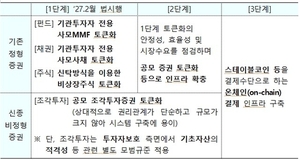
The three phases, in order
Phase one begins on day one of the new law. It allows tokenized private money market funds, privately placed bonds, and unlisted shares issued through a trust structure. Retail participation in this phase is limited. The key move is letting institutional players test the rails without exposing the broader market to untested settlement risk.
Phase two widens the scope. Once the FSC judges that Phase One has stabilized, it will permit public offerings of tokenized equities and bonds. The threshold for this expansion is not fixed in the current document — the commission explicitly said it will monitor safety and market demand before opening the floodgates. That restraint is intentional. It signals that Korea is willing to pause rather than rush.
Phase three is the longest horizon. The FSC envisions a stablecoin-backed on-chain payment and settlement infrastructure that would let tokenized securities clear and settle in near real time, without the traditional T+2 bridge. This is the phase that would meaningfully change the cost curve for cross-border issuance.
Who wins, who loses
The biggest winner is the Korean market infrastructure industry. The rulemaking creates entirely new licensed roles — issuer account management institutions, for example, require a minimum paid-in capital of 40 billion won (roughly $28 million USD), specialized IT staff, internal controls, and compliance with Korea Depository & Settlement’s blockchain security standards. That is not a barrier designed to exclude. It is a barrier designed to ensure that only well-capitalized players operate at the issuer level, reducing the risk of a collapse that could sour the entire regime.
Existing securities firms and OTC exchanges win by operating under their current licenses. No additional authorization is required to handle tokenized securities within their approved scope. That removes a major implementation friction that has slowed progress in other markets.
Retail investors are protected but capped. The annual net purchase limit at OTC exchanges is set at 100 million won per person — about $70,000 USD — measured as total purchases minus total sales. For non-monetary trust certificate offerings, the per-investor subscription ceiling is the lesser of 30 million won or 5 percent of the total issuance amount. Both numbers are low enough to contain systemic risk from a single retail blow-up, but high enough to make the market economically interesting.
The loser in the short term is anyone betting that Korea will move faster than this. The phased approach means that broad public access to tokenized equities and bonds is at least a year away from Phase One’s start, and the stablecoin settlement layer could take years longer. This is not a sprint.
Why the global context matters
The United States and the European Union have both taken the lead in framing how tokenized securities should be regulated. The US has relied on a case-by-case enforcement approach through the SEC, while the EU’s Markets in Crypto-Assets regulation created a unified framework for digital tokens — but neither has produced a clear, phased path to full-tokenized-equity issuance at scale.
Korea’s approach bypasses that debate by treating the problem as an infrastructure buildout rather than a legal classification exercise. The FSC is not asking whether a token is a security. It is assuming it is, and then building the licensing, custody, and settlement layers around that assumption. That is a different kind of regulatory confidence — one that comes from having a comprehensive securities law already in place rather than trying to retrofit crypto rules onto traditional markets.
For cross-border issuers, the implication is straightforward. A Japanese pension fund or a Singaporean family office looking to tokenize a bond issuance could face ambiguous guidance in Washington or Brussels, but by early 2027 Seoul will have a published rulebook with known capital requirements, known investor caps, and known settlement timelines. That predictability is a competitive advantage in a space where most participants are still waiting for clarity.
What happens next
The FSC will publish its subordinate regulation revisions for public comment later this month. Industry feedback will shape the final text before the February 2027 deadline. The commission’s deputy director, Kwon Dae-young, made it clear that the goal is not to confine tokenized securities to fractional investment products — the explicit intent is to tokenize existing financial instruments, not create parallel ones.
The most significant signal in the document is the conditional approval of asset pooling. Allowing the aggregation of similar small-ticket assets into a single tokenized pool could unlock liquidity for asset classes that have historically been too illiquid to securitize at reasonable cost — think regional real estate, small-ticket receivables, or fragmented private credit. That is the move that could make this roadmap genuinely transformative rather than incremental.
If Korea executes on all three phases, the country could become the first major Asian market with a complete, regulated tokenized-securities pipeline. The question is no longer whether tokenized securities will trade on public markets in Asia. It is whether Seoul will be the jurisdiction where the first large-scale cross-border issuance lands.