Korea Treats Film as National Security Asset in France Push
President Lee Jae-myung used France's Lumière Summit to announce a €500M joint investment with Paris and pledge deep state support for co-productions. South Korea is no longer just exporting K-dramas — it's building a soft-power industrial policy.
The Lumière Summit Was Not Just a Photo Op
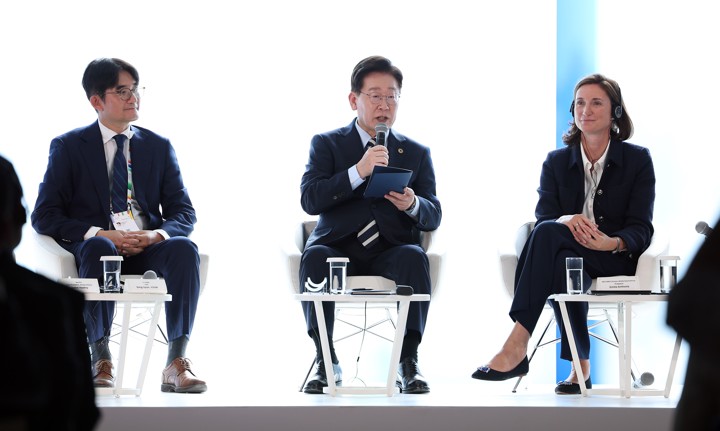
President Lee Jae-myung did not fly to Saint-Paul-de-Vence to give a speech about art. He went to stake a claim. At the Lumière Summit, France’s answer to Cannes’s red-carpet theater, Lee stood between Yoon Sang-hyun of CJ ENM and Emily Anthes of the Motion Picture Association and told the assembled filmmakers that South Korea’s moment had arrived — not despite its local specificity, but because of it.
“The most local uniqueness becomes the most global competitiveness,” Lee said. It sounded like a slogan. It was actually a policy directive.
What made the moment distinctive was the lineup behind him: Choi Soo-yeon, CEO of Naver, the tech-giant-turned-content-investor; Lee Mi-kyung, vice chairman of the CJ conglomerate that controls Korea’s largest media empire; Kim Yun-ji of the Korea Creative Content Agency; Han Sang-jun of the Korean Film Council; and Pierre-Antoine Capton, CEO of Canal+, France’s answer to HBO. A French television executive sitting at the same table as a Korean tech-platform CEO is not a coincidence. It is the architecture of a new deal.
The choice of venue carried its own weight. Saint-Paul-de-Vence, the hilltop Provençal village where the Lumière Summit convenes, is deliberately removed from the commercial turbulence of Cannes. It is a place where deals are whispered rather than shouted, where governments and studios converge under the assumption that culture is worth the effort of serious negotiation. That Lee chose this setting over a flashier counterpart underscored the administration’s intent: this was not a marketing tour. It was statecraft conducted through content.
The €500 Million Signal
Reports confirm a €500 million joint investment framework between Korea and France, announced in conjunction with the roundtable. The number itself is secondary to what it represents: Korea is no longer merely shipping serialized dramas across borders. It is co-financing the infrastructure that produces them.
The French angle is deliberate. France sits at the rare intersection of three worlds that matter for content strategy — it is Hollywood’s most protective European market, the home of global festival politics, and one of the few countries where state subsidies and private studio investment still function as a single ecosystem. By anchoring a major co-production agreement in Paris rather than London or Berlin, Seoul is positioning itself inside the continental European cultural-finance apparatus. That is a calculation you do not make unless you are thinking in decades, not quarters.
The €500 million figure should also be read against Korea’s existing cultural expenditure. The Korean Creative Content Agency (KOCCA) operates on an annual budget that, while significant, has historically focused on market expansion and talent development. A bilateral commitment of this magnitude signals a qualitative shift — from promoting Korean content abroad to embedding Korean creative capacity within foreign production ecosystems. This is investment in co-creation, not just distribution.
The Players Behind the Deal
CJ ENM deserves attention here. Under Yoon Sang-hyun, the company has been quietly converting its traditional broadcasting and exhibition dominance into a content-development engine. The investment in The White Lotus Season 3 — shot in Okinawa with a multinational cast and American producers — signaled that CJ was playing a longer game than domestic ratings. The Lumière Summit announcement confirms the strategy: Korea is moving from content exporter to co-producer of prestige projects that travel globally by design, not accident.
Naver’s presence under Choi Soo-yeon is equally revealing. Naver has been accumulating creative IP through its publishing and webtoon divisions, and its streaming platform Watcha has been building audience data that could rival what Netflix already knows about Korean viewers. A Korean platform company and a French pay-TV operator discussing co-production at a summit is a quiet acknowledgment that the next battleground for Korean content may not be North America — it may be the regulatory and subsidy landscape of continental Europe.
Capton’s Canal+ is not a small player in this calculation. The French premium network has spent years building a reputation as the home of ambitious local-series production, from The Bureau to Paralyzed. A partnership that channels Korean storytelling infrastructure into Canal+’s development pipeline could produce something the industry does not yet have a name for: a transcontinental prestige series ecosystem that does not run through Los Angeles. The implications extend beyond entertainment. European audiences have long viewed Korean content through the lens of streaming algorithms. A co-production framed as a French-Korean institutional partnership reframes that narrative entirely.
The Policy Framework
Lee’s remarks contained more than rhetoric. He explicitly pledged “policy and institutional support” for global co-productions, international investment, and distribution development. For a president to use a summit speech to signal government backing for an industry is unusual in a country where ministers typically handle such announcements. The fact that Lee positioned himself as a “reliable partner” — a phrase that carried unmistakable bureaucratic weight — suggests this will translate into concrete measures: tax incentives, co-production treaty expansion, possibly a dedicated fund modeled on France’s own CNC system.
This is what analysts should watch for next: whether Seoul moves beyond the generic “support K-content” language of previous administrations and into specific fiscal and regulatory mechanisms. The Lumière Summit was the declaration. The finance ministry and the Ministry of Culture will write the implementation.
Second-order effects are already visible. Korean film crews and post-production facilities that have long operated on thin margins are now positioning themselves to bid on European co-productions that qualify for French subsidy programs. Production service companies in Goyang and Jeonju have begun hiring French-language coordinators and updating their compliance documentation to meet EU co-production thresholds. The ripple effects will reach into hospitality, logistics, and local government — sectors that did not previously consider themselves part of the cultural economy.
Why This Matters Beyond Korea
The global conversation about Korean cultural dominance tends to frame it as organic — Parasite won because it was good; Squid Game succeeded because it was addictive. That narrative is incomplete. What is happening in Saint-Paul-de-Vence is the state-level industrialization of soft power, executed with the same discipline that built Korea’s semiconductor and automotive sectors. The question is no longer whether Korean content can compete globally. It is whether Korea can build the institutional scaffolding that makes sustained global competition routine rather than accidental.
The French partnership adds a dimension that neither Hollywood nor other Asian content producers currently match at this scale. It gives Korea access to European co-production financing rules, festival pathways, and distribution channels that are otherwise difficult to penetrate from outside the Anglo-American axis. Japan has invested in animation and character IP. China has invested in theatrical infrastructure and home-market scale. Neither has constructed a bilateral co-production architecture with a major European cultural power that explicitly treats content as strategic infrastructure.
The broader lesson for other nations is worth noting. Korea’s approach demonstrates that soft power is no longer a ministerial afterthought or a tourism-adjacent branding exercise. It is now discussed at the presidential level, financed through bilateral investment frameworks, and integrated into industrial policy the way defense procurement or energy transition plans are. Countries that continue to treat culture as peripheral will find themselves competing against nations that have made it central.
The Close
The Lumière Summit announcement will be read by some as another celebrity-backed cultural initiative, the kind that proliferates in an era of summit diplomacy. But the presence of a tech CEO beside a film council chair, a streaming-platform executive beside a pay-TV operator, and a president willing to anchor policy language around co-production infrastructure suggests something more durable. Korea is not asking the world to like its content. It is building the systems that ensure the world has no choice but to engage with it.
Whether this industrialized soft power model scales beyond the France corridor remains an open question. The next two years will determine whether the €500 million commitment translates into completed productions, substantive tax mechanisms, and measurable audience growth in European markets. But the direction is clear. Korea has decided that culture is not a byproduct of economic success. It is infrastructure. And it will be treated accordingly.