Far-Right Attacks Backfire, Boosting Korean Film 'Assassins' to Box
A far-right campaign accusing the South Korean film 'Assassins' of historical distortion inadvertently drove record audiences to theaters. The backlash reveals how deep political polarization in Korea is reshaping cultural production.
When Hate Drives Tickets
A far-right campaign accusing a Korean film of historical distortion ended up doing something its attackers never intended: it sold out movie theaters.
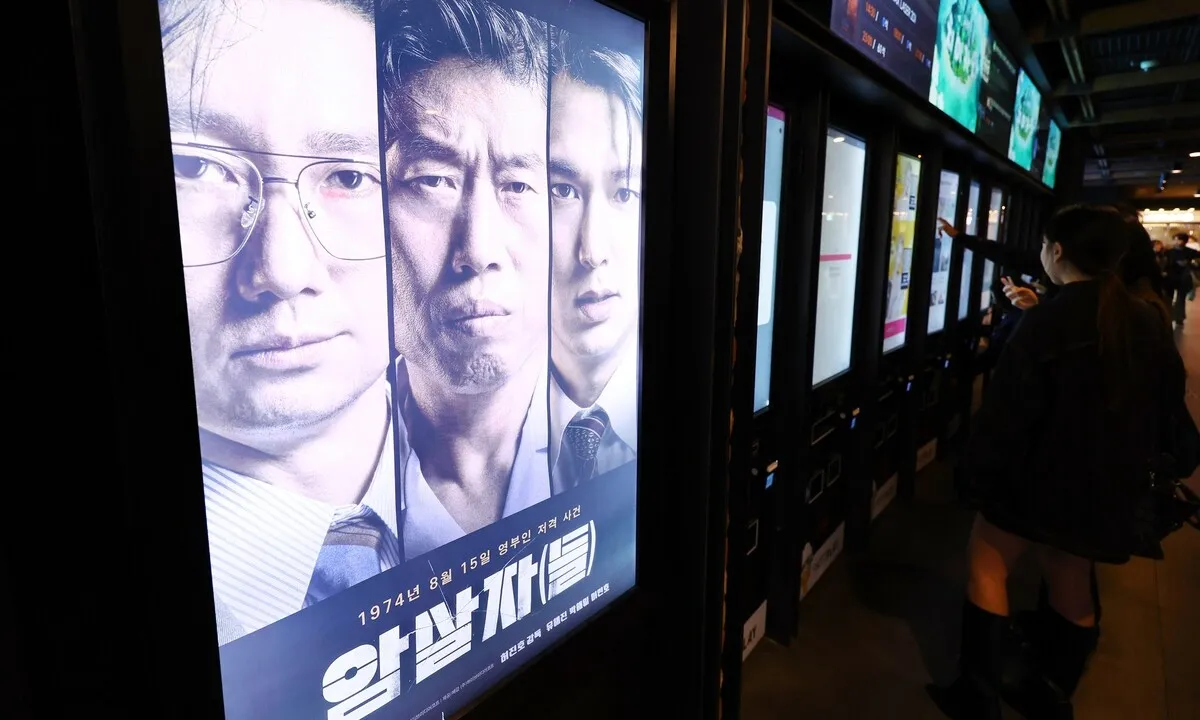
“Assassins” (암살자(들)), which opened on the 23rd of last month, fell to second place in its first weekend behind the Japanese animated film “Gekijōban Chiikawa: Mermaid Island no Himitsu.” But by April 4th, the film had pulled in roughly 188,000 admissions and reclaimed the top spot. Its cumulative audience has now reached 2,235,000 — a remarkable number for a film entangled in a national firestorm over whether it distorts history.
The counterintuitive result offers a rare data point in an era where culture wars increasingly shape market behavior. In South Korea, opposition to a film can function as invitation.
The Controversy That Couldn’t Be Ignored
The debate centers on how “Assassins” depicts the era of former dictator Park Chung-hee, whose 1961 coup d’état and subsequent 18-year rule remain among the most contested chapters in modern Korean history. Conservative groups and members of the ruling People’s Power Party have labeled the film historical revisionism. Protesters gathered outside the home of lead actor Ryu Hae-sung on April 4th, demanding he appear in “pro-right-wing films.” Party lawmaker Kim Jin-woo publicly mocked Ryu’s appearance.
But many who sought out the film found the accusations difficult to reconcile with what they saw. Kim Eun-joo, a 64-year-old viewer who visited a theater near her home in Incheon, said she was drawn in precisely because she couldn’t find specifics about what was allegedly wrong. “There are barely any scenes with President Park Chung-hee appearing,” she said. “Specific references to him don’t really come up. I couldn’t understand why it was a problem.”
That gap between the scale of the attack and the content of the film is itself telling. When the substance of a critique is opaque but the volume is deafening, curiosity fills the vacuum.
International Eyes on a Domestic Fight
The story spilled beyond Korea’s borders. Hong Kong’s South China Morning Post published an analysis on April 3rd asking why a single film about a dictator had pushed Korean society into conflict. The outlet noted that the backlash reignited long-suppressed debates about how Korea should remember the Park era and whether unresolved political fractures are shaping public interpretation of history.
Japanese pop culture scholar Tashiro Chiyo, who runs a Hallyu community and has authored several books on Korean Wave culture, posted his thoughts on social media after watching the film. He acknowledged that viewers should distinguish fact from fiction, but argued that cinema’s pleasure lies precisely in exploring “what if?” scenarios within history’s gaps.
The international attention underscores what many Korean observers have long noted: debates over Park Chung-hee are never just about the past. They are proxies for arguments about democracy, economic development, and national identity that Korea has never fully settled.
The Industry Pushes Back
As the harassment intensified, Korean film professionals mobilized. The Korea Producers Association and the Korean Film Producers Guild released statements on April 1st and 2nd urging an end to personal attacks, threats, and the spread of unverified claims against those involved in the film. On April 4th, the Directors Guild of Korea (DGK) issued its own statement, saying it stands in solidarity with filmmakers who deserve to create freely and safely.
By April 5th, 19 on-set film worker organizations had united under the banner “Film Workers Solidarity” to release a joint declaration: “Judgment of a work belongs to audiences and society. No one should have their daily life and safety threatened simply for participating in a project or expressing an opinion.”
The government weighed in as well. Culture Minister Choi Hwi-yong posted on social media that asking the state to preemptively censor a work people simply disagree with would be a return to the era of “prior restraint” — a term with particularly heavy resonance in Korea, where censorship was a defining instrument of authoritarian rule. He said he had urgently requested police action against the illegal activities surrounding the film’s cast and crew.
Ryu Hae-sung’s agency, VAST Entertainment, confirmed that false and defamatory information about the actor was being widely circulated on online communities and social media, and said it would take all available measures to protect his rights and safety.
Who Wins, Who Loses
The immediate winner is “Assassins” and its distributors, which converted hostility into admissions. The longer-term dynamics are messier.
Critics of the film gained visibility but lost narrative control. By framing the controversy as a threat to individual actors rather than a substantive engagement with the film’s historical claims, the campaign revealed more about the fragility of its own position than about the film itself. The more protesters screamed about historical distortion, the more audiences wondered what exactly the distortion might be — and went to see for themselves.
Actors and filmmakers face a new category of professional risk. When political opponents can track down private residences, the boundary between artistic criticism and personal threat dissolves. This is not abstract: the DGK and producer guilds framed their statements specifically around safety, not merely creative freedom.
For Korean cinema broadly, the episode is a stress test. South Korea’s film industry has long been a barometer of social tension — from the pro-democracy cinema of the 1980s and 1990s to the globally celebrated wave of the 2000s and 2010s. Each cycle has been accompanied by conservative backlash. What distinguishes this moment is the speed and digital infrastructure of the attacks, and the degree to which they target individuals rather than engaging with content.
The Bigger Pattern
“Assassins” did not become number one despite the controversy. It became number one in part because of it. The film’s trajectory mirrors a pattern seen in other polarized societies: culture war Mobilization often generates more attention for the targeted work than any marketing campaign could buy.
But the cost of that dynamic is measured in the chilling effect on the next project. When filmmakers know that depicting certain historical figures can trigger doxxing and harassment, the question is not whether they will self-censor, but when.
Korea’s unresolved debate over Park Chung-hee — a man credited with rapid industrialization and condemned for dictatorship — will not be settled by a box office tally. But the way a society argues about a film about him says everything about where that society stands today.