Korean Scientists Re-Rebut Nobel Laureates Over Cosmic Acceleration
A Yonsei University team has published its second rebuttal to a paper by Nobel laureates defending cosmic acceleration — a rare public dispute that could reshape how we understand dark energy.
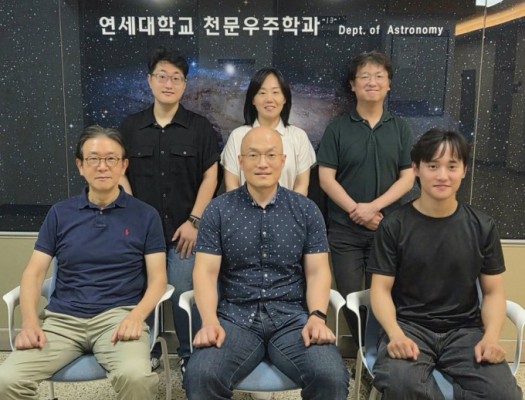
A Second Shot at the Cosmos
Two months after a team led by Nobel Prize-winning physicists pushed back hard on a Korean challenge to the standard model of cosmology, the Yonsei University researchers have fired back again. Their latest paper, published July 27 in the Monthly Notices of the Royal Astronomical Society, doesn’t just defend their earlier claim — it argues that the rebuttal itself contains two analytical errors, both subtle and both consequential enough to shift the inferred strength of cosmic acceleration by an amount the authors call “non-negligible.”
What makes this noteworthy isn’t just the science. It’s the rarity of a non-Western research group engaging a group of Nobel laureates head-on in the same journal, twice, within months. The standard model of cosmology — which holds that the universe is expanding at an accelerating rate driven by dark energy — is as close to settled doctrine as physics gets. And the people who won the 2011 Nobel Prize for that discovery are now defending it in print against researchers based in Seoul.
For Lee Young-wook, the dispute is not about ego. It is about what he describes as a “systematic blind spot” in how supernova samples are constructed. If that blind spot is real, the implications reach far beyond a single paper. If it isn’t, the Yonsei team has still forced a conversation that the cosmology community might have preferred to leave dormant.
The Dispute in Plain Terms
At stake is the interpretation of Type Ia supernovae — exploding stars whose brightness is used as a standard candle to measure cosmic distances. For decades, astronomers have assumed their peak luminosity doesn’t vary significantly with age. The Yonsei team, led by Professor Lee Young-wook of the Center for Galaxy Evolution Research, argued last year that this assumption is flawed. When you account for the subtle brightness differences that come with supernova age, they found, the data no longer requires cosmic acceleration. The universe may already be decelerating. Dark energy, in their view, weakens over time.
That paper landed in MNRAS. So did a rebuttal in June from a Southampton University team that included Nobel laureates Adam Riess and Brian Schmidt. Their counterargument was straightforward: the correlation between supernova brightness and age is weaker than the Yonsei team claimed, and the correction needed is too small to overturn the acceleration conclusion. The universe keeps speeding up. Dark energy holds.
What followed was unusually visible. In cosmology, disagreements typically play out in closed peer review or get absorbed into larger meta-analyses. This one was public, pointed, and fast. Within weeks, the South Korean astronomy community rallied around the Yonsei paper, and several independent groups published short communications questioning aspects of the Southampton rebuttal without necessarily endorsing every claim made by Lee’s team.
Two Errors, According to Yonsei
In their re-rebuttal, the Yonsei team identified two specific issues in the Southampton analysis. The first involves the redshift range. The UK team bundled supernovae across an excessively wide range of redshifts into a single sample. Because redshift correlates with both distance and lookback time, this aggregation diluted the apparent strength of the age-brightness relationship. The Yonsei team argues the correction should be larger, not smaller, once that blending is corrected for.
The second error is more technical but equally consequential. The researchers note that when the age variation in a sample is narrow, the measured slope of the brightness-age relationship actually steepens — an inverse relationship the Southampton analysis failed to account for. By treating these two effects independently rather than jointly, the UK team’s correction was systematically underestimated.
Put together, the Yonsei team argues, their original conclusion stands: the observational evidence for accelerating expansion is not as robust as the standard model assumes. Lee told reporters after the paper’s release that the two errors partially cancel in one regime but amplify each other in another, and that the net effect depends heavily on how the supernova sample is weighted. “The standard analysis is not wrong,” he said. “But it’s incomplete, and incompleteness in this case looks a lot like bias.”
Why This Matters Beyond the Journal
The stakes here are cosmological, but they’re also institutional. Korean astronomy has been building serious capability over the past two decades, yet it rarely finds itself in direct contention with the architects of the standard model. This isn’t a case of a marginal paper buried in an obscure journal. MNRAS is a leading peer-reviewed outlet, and the authors — Lee and his team — are affiliated with one of Korea’s most prominent research universities.
There’s also an independent signal that lends credence to the skeptics. Professor Lee points to baryon acoustic oscillation measurements from the Dark Energy Spectroscopic Instrument (DESI), which have shown hints of evolving dark energy — a result that would be inconsistent with the cosmological constant but consistent with the Yonsei team’s framework. Whether those DESI results hold under further scrutiny is still unresolved, but they add weight to the argument that the standard model needs re-examination. Several cosmologists outside the immediate dispute have noted that the DESI hint, if confirmed, would represent the first clear departure from the Lambda-CDM model in decades.
The institutional dimension matters because scientific consensus is not self-correcting at the speed of truth. Funding flows toward established paradigms. Graduate students choose thesis topics that are likely to produce results within standard frameworks. A challenge to dark energy as a cosmological constant doesn’t just ask for a calculation — it asks an entire field to reconsider what it thought it knew. That kind of friction is slow, messy, and often uncomfortable for everyone involved.
What Comes Next
The Yonsei team is already running additional tests, comparing only supernovae of similar ages across the full redshift range to eliminate the very confounding factors they’ve accused the Southampton team of introducing. Early results, presented at a virtual seminar in August, suggest that when age is held constant, the age-brightness correction becomes harder to detect — lending some support to the Southamption critique but also reinforcing Lee’s argument about sample selection.
The real payoff, however, will come from the Vera C. Rubin Observatory, which began its ten-year Synoptic Survey last June. With its massive digital camera capturing the sky repeatedly, Rubin will produce an order-of-magnitude larger sample of Type Ia supernovae than is currently available — young supernovae and old ones, across unprecedented redshift coverage. Rubin’s data will allow astronomers to separate the age effect from the redshift effect cleanly, something no existing dataset can do. That single capability could resolve the current impasse, or deepen it.
If the Yonsei team’s corrections hold up under that data, the implications are serious. Dark energy wouldn’t be a simple cosmological constant. The acceleration we think we’ve measured could be partly an artifact of how we calibrate our distance ladder. A revision of that magnitude would ripple through every model of cosmic evolution, from the early universe to the far future. It would force a reckoning with the dark energy equation of state — currently pinned at negative one — and reopen questions that the 2011 Nobel Prize was meant to close.
If the rebuttals hold, the standard model persists with only minor adjustments — and the debate ends where it began, in a footnote rather than a textbook change.
The Wider Context
This dispute doesn’t exist in isolation. The Hubble tension — the persistent mismatch between early-universe and late-universe measurements of the expansion rate — has already cracked the foundation of Lambda-CDM. The DESI results on evolving dark energy add another crack. The Yonsei-Southampton exchange adds a third. None of these alone is fatal to the standard model. Together, they suggest the model may be approaching the limits of its explanatory power, much as the ether did before relativity, or as planetary epicycles did before Kepler.
That analogy is provocative and imperfect, but it captures the mood among some cosmologists who prefer not to say so publicly. The field is large, well-funded, and generally confident. Confidence is healthy. But confidence without challenge becomes dogma, and dogma without data is just religion with equations.
What Comes After
For now, the manuscript trail tells the story: three papers in MNRAS, two teams, one unresolved question about whether the universe is really doing what we thought it was doing. That’s unusual. It’s also exactly how science works when the data isn’t as clean as the theory would like it to be.
What comes after depends on Rubin. It depends on whether the DESI hints solidify or fade. It depends on whether the Yonsei team’s methodological arguments hold up under independent replication — which is already underway at several institutions, including groups in Japan and Germany. It depends on whether the cosmology community can absorb a meaningful challenge to its central narrative without either dismissing it reflexively or inflating it beyond what the evidence supports.
And it depends on whether scientists in Seoul, Southampton, and everywhere in between can keep doing the work without letting the drama eclipse the data.
The universe will keep expanding regardless of who wins this argument. The question is whether we’re measuring it correctly.