Why the Pentagon Needs Korean Shipyards
The Wall Street Journal has concluded something Washington insiders have long suspected: America cannot rebuild its navy without Korean shipbuilding know-how. Hanwha's acquisition of the Philadelphia Naval Shipyard and a sweeping legislative push signal a dramatic shift in how the US plans to counter Chinese maritime dominance.
The Impossible Math of American Naval Revival
The numbers are brutal and rarely quoted in Washington policy circles. The United States builds less than one percent of the world’s ships by tonnage. China builds more than 230 times that amount. By year’s end, according to Clarksons Research, Chinese yards will capture more than three-quarters of all new commercial vessel orders. Korea sits second at roughly sixteen percent.
This is not a statistic with academic interest. It is the single most consequential gap in American strategic posture, and for months it has been treated as unsolvable. The Wall Street Journal changed that conversation this week with a blunt assessment: the US cannot rebuild its navy without Korean shipbuilding capability.
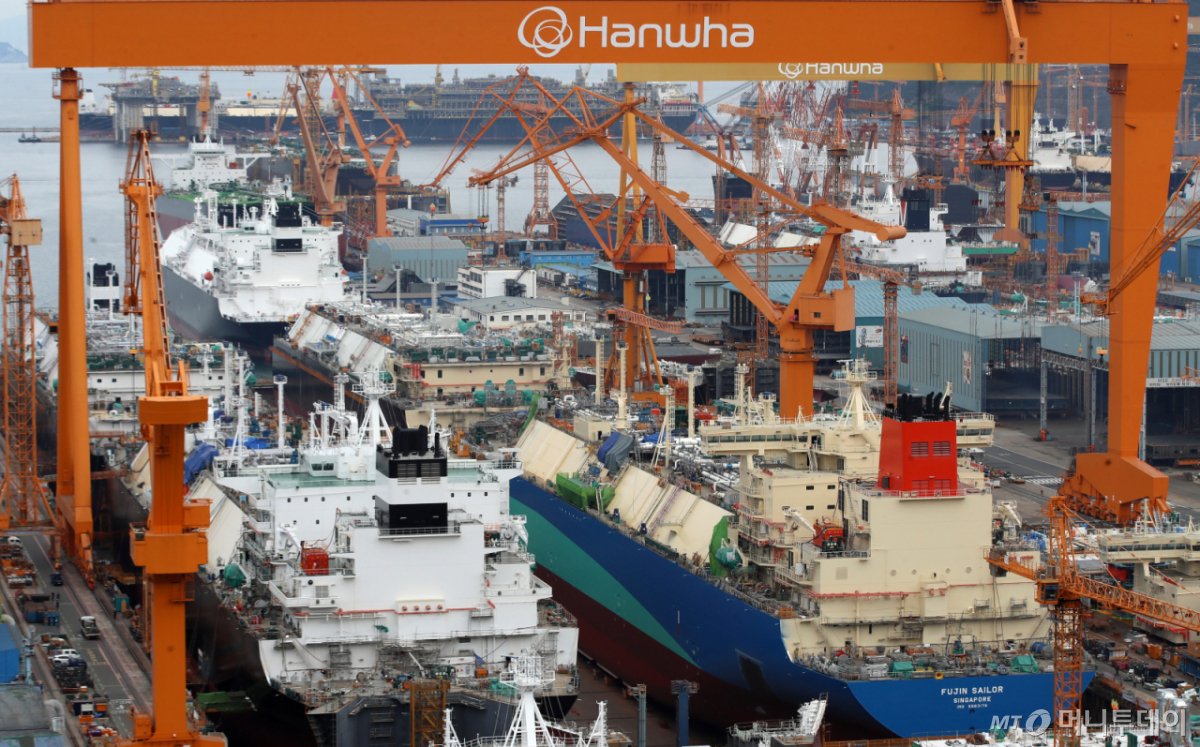
The reporting traces a path from Donald Trump’s announcement approving Seoul’s first nuclear-powered submarine program to a sprawling legislative and investment effort that now bears the unlikely name “MASC” — Making America Shipbuilding Cool Again. At its center stands Hanwha Ocean, the former Hyundai Heavy Industries-owned yard in Geoje, South Korea, which also completed its acquisition of the historic Philadelphia Naval Shipyard for $100 million two years ago.
What makes this story harder to parse than a typical trade arrangement is that it exposes a structural vulnerability few in either government want to discuss publicly. The US Navy needs hulls faster than its domestic yards can produce them. Congress has tried every lever — Buy American mandates, cost-plus contracts, domestic incentive programs. None have moved the needle materially because shipbuilding is not a problem of will. It is a problem of industrial capacity, and the United States lost that capacity decades ago.
The Philadelphia Play
Hanwha’s investment at the Philadelphia site tells the story in dollars. The company has spent approximately $350 million on facility upgrades since the 2024 acquisition and has outlined plans for several billion more. The timeline calls for the yard to hold certifications capable of building navy support ships immediately, with combatant-grade qualification targeted by 2028.
That schedule is aggressive by any standard. The Philadelphia yard has been dormant for years, its infrastructure designed for Cold War-era construction methods. Upgrading it to modern standards — especially those required for nuclear-capable projects — is a multi-year undertaking even with deep pockets.
Meanwhile, in the home market, Hanwha Ocean is simultaneously fulfilling one of the most sensitive agreements in the region. Trump posted on Truth Social that Korea would build nuclear submarines, replacing its aging diesel fleet, but then apparently reconsidered the geography of production, noting on a separate post that the work would happen at Philadelphia. The contradiction suggests internal negotiations were still underway, though the direction is clear: Seoul retains the design and engineering lead while Philadelphia becomes the physical assembly point.
Whether Philadelphia can absorb that work without compromising quality or schedule is the open question.
The Legislative Bait
Congress is trying to close the gap between ambition and reality through legislation. Representative Dave McCormick, a Pennsylvania Republican whose district includes the Philadelphia site, co-sponsored the Ships for America Act, which would formally encourage allied shipbuilders to invest US capital and transfer technology in exchange for access to military contracts.
The White House has gone further, recommending that foreign yards making “meaningful and sustained” investment in US facilities be permitted to build up to two Navy vessels per year on American soil. That threshold may seem modest — two ships annually from any single foreign yard is hardly a fleet-building strategy — but it represents a fundamental break with decades of restrictive policy. The Jones Act and the statutory requirement that nearly all Navy vessels be built domestically have been treated as sacred ground. This recommendation treats them as adjustable variables.
McDonough himself visited Hanwha’s main Geoje facility recently, a gesture loaded with political meaning. He told reporters that entering shipbuilding seriously requires long-term commitment, signaling that Washington is willing to negotiate on timelines and oversight in exchange for results.
The Real Blocker
Here is where the Wall Street Journal found the soft underbelly of the entire project. Japanese and other allied shipbuilders have watched the Philadelphia experiment with interest, but they have not committed significant capital. The reason, according to WSJ reporting, is simple: no one trusts that the Department of Defense will deliver predictable future orders.
This is the core risk. Investment in shipyard infrastructure runs in decades, not election cycles. A yard like Philadelphia requires billions in upgrades before it produces a single warship. If the Navy changes procurement strategy after one administration — as it has repeatedly done — that capital evaporates. Hanwha is betting that the alliance structure between Washington and Seoul provides enough insulation against that volatility. Other potential partners, particularly Japan, remain unconvinced.
HD Hyundai’s recently announced joint venture with a US construction firm to build a new advanced yard by 2029 adds another data point. Seoul’s major conglomerates are preparing multiple insurance policies against demand uncertainty rather than pinning everything on Philadelphia alone.
What Changes
The geopolitical arithmetic here is straightforward but profound. China is building ships faster than any nation in history. The US Navy’s current force structure depends on maintaining qualitative advantages that assume American yards can replace losses within reasonable timeframes. Those assumptions are collapsing.
Korea’s entry into US naval construction does not solve the capacity gap overnight. It acknowledges it. The implicit concession is that America’s industrial base can no longer sustain itself in heavy manufacturing domains where rivals have accumulated decade-long advantages.
For Hanwha, the opportunity is asymmetric. The company gains access to American military contracts worth potentially tens of billions — revenue streams insulated from the cyclical downturns that have periodically battered commercial shipbuilding. For the United States, it gains a credible path toward restoring some domestic hull production, provided Congress funds the upgrade cycle and the Pentagon commits to multi-year procurement signals that make the capital expenditure rational.
The harder lesson is this: the Trump administration’s protectionist instinct has collided with industrial reality, and the compromise came in Korean. Whether Washington can sustain the political coalition needed to keep this trajectory intact beyond the next budget cycle remains the unanswered question.