Korean Studios Are Taking Over Gamescom
Krafton, NC, and Pearl Abyss unveiled nine new titles at Gamescom Online, signaling a coordinated push into global console and PC markets. The strategy reveals a seismic shift in how Korean game companies compete worldwide.
Korean studios stopped playing defense at Gamescom
Nine new titles. That is not a coincidence. It is a statement.
Krafton, NC Entertainment, and Pearl Abyss marched into Cologne with a portfolio wide enough to suggest they are no longer trying to crack the Western market—they are trying to own it. The three companies, each a heavyweight in its own right, used the Gamescom Online opening night event to unveil a combined lineup of nine new games spanning shooters, tactical arenas, narrative-driven RPGs, and co-op adventures. All targeting PC and console players outside Korea.
This is a pivot that did not happen overnight. For years, Korean publishers outsourced mobile revenue streams while conserving their big-budget PC and console IPs for domestic release. That era is ending. What happened at the Gamescom Online pre-show is proof enough.
Krafton went beyond PUBG
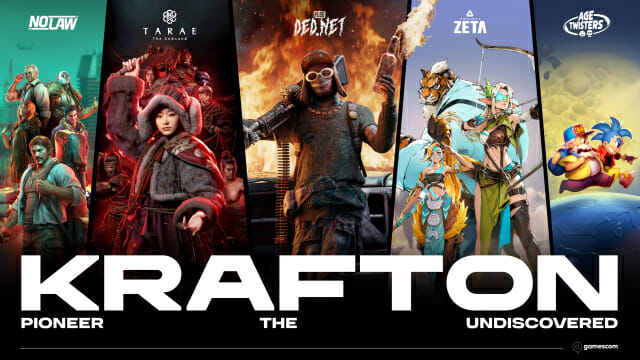
Krafton arrived with five titles—more than any other Korean publisher at the event. The portfolio reads like a playbook for diversification away from a single franchise dependency.
PUBG: Deadnet stands out as the most ambitious departure. Set in a fictionalized 1996 Pacific Northwest region called Cascadia, it blends the battle royale DNA Krafton built its brand on with roguelite progression and supernatural abilities that change every match. It is a deliberate attempt to make the formula feel fresh without abandoning what made PlayerUnknown’s Battlegrounds a phenomenon.
Then there is NO LAW, a first-person shooter-RPG hybrid that centers on a protagonist named Gray Harker. The pitch emphasizes player choice and multiple approaches to conflict—stealth infiltration, hacking, hardcore gunplay—all within a single immersive open world. If the game delivers even half of what the trailer suggests, it positions Krafton directly in competition with titles like Cyberpunk 2077 and Deus Ex, two worlds where Korean developers have historically struggled to gain traction.
The remaining three titles—Project Zeta, a team-based tactical arena game; Tall: Unbound, an Eastern dark fantasy action RPG; and Age Twister, a two-player co-op adventure featuring age-shifting mechanics and train-combat sequences—round out a lineup that covers shooter, RPG, and co-op genres simultaneously. This is not a one-hit studio scrambling for its next win. It is a company investing across its entire portfolio.
NC is going full global with Aion 2
NC Entertainment brought three titles, and the most consequential one is already calendar-ready.
Aion 2 confirmed a September launch window with a full global release on Steam and Perple on October 5th, targeting North America, South America, Europe, and Asia. Before that, NC will run a large-scale launch scale test on September 17–18 to validate server infrastructure—a move that signals the company expects simultaneous worldwide demand, not staggered regional rollouts.
This is significant. Until recently, most Korean MMOs released domestically first and expanded internationally months or even years later. NC’s willingness to synchronize a global launch reflects both confidence in its multiplayer infrastructure and an understanding that today’s players expect parity. There is no patience for a Korea-first strategy in the PC MMO space anymore.
Also on deck: Cinder City, a dystopian Seoul-set narrative experience, and Like or Die, a team-based survival FPS where streamers compete in real time while building viewership through in-game mechanics. Both carry strong international appeal—one leans into Korean cultural specificity as a unique selling point, the other taps into streaming culture as a core mechanic. Together they show a publisher comfortable experimenting with genre and tone.
Pearl Abyss is betting on the existing base
Pearl Abyss took a more conservative approach with Blade & Soul: Revolution Enhanced, an expanded edition of its long-running action MMORPG. The enhanced version adds new cutscenes, additional dialogue, voiceover support for five languages, and Arabic subtitles. Existing owners receive a free update. A 20 percent discount runs across all platforms until September 9th.
It is a smart retention play. The Blade & Soul franchise has maintained a dedicated player base for over a decade, and an enhanced edition gives Pearl Abyss a low-risk way to re-engage lapsed players and attract new ones without the developmental risk of a greenfield title. The inclusion of Arabic language support is notable—it signals that the company is paying attention to regions outside the traditional Western European and North American markets.
What this means for the industry
The coordinated nature of these announcements is the real story. Three major Korean publishers, appearing on the same stage, with complementary but non-overlapping portfolios, all calibrated for Western and global audiences. This is not a series of independent decisions. It is the output of a strategy that has been building for several years: invest in high-quality PC and console titles, release them globally, and treat Korea as one market among many rather than the home base.
The implications are real. European and American publishers have watched Korean mobile developers dominate the app store charts for a decade. Now they face Korean teams competing directly with AAA-level narratives, shooters, and co-op experiences on platforms those publishers consider their own.
The timing matters, too. Gamescom is the largest gaming event in the world, and showing up with nine new titles is a clear message. Korean studios are no longer content to be suppliers of mobile games to the West. They are building games for the West, with Western expectations baked into every design decision.
Who wins here? Players with access to diverse, high-quality Korean-made games. Publishers who still treat Korea as peripheral risk falling further behind. And Korean investors watching their portfolio companies compete on equal footing with the biggest names in Western gaming.
The next 12 months will tell whether these titles live up to the hype. But the direction is clear.