Korea's EV-Hybrid Split Exposes the Infrastructure Crack
At EV Trend Korea 2026, manufacturers split into two camps: BYD and KGM are betting on hybrids to bridge the charging gap, while Kia, Volvo, and BMW are all-in on pure EV platforms. The divide reveals a deeper infrastructure problem that could stall electrification globally.
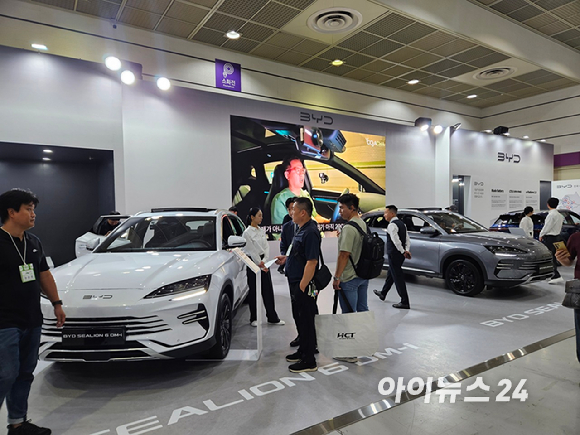
The Show Floor Tells Two Stories
At EV Trend Korea 2026 in Seoul’s COEX center, the exhibition layout itself mapped a fracture in the global automotive transition. On one side of the hall, BYD Korea and KGM Mobility displayed showrooms explicitly branded around dual-track electrification — battery electric vehicles paired with plug-in and conventional hybrids. On the other, Kia, Volvo, and BMW presented exclusively BEV lineups built on dedicated platforms and high-voltage architectures.
Twelve new electrified vehicles were unveiled across the five companies. The split in their lineup composition was not accidental. It reflected a fundamental disagreement about what is blocking EV adoption in Korea today: is it range anxiety rooted in sparse charging infrastructure, or is it a technology problem that can be solved by building better EVs?
BYD and KGM: Betting on the Bridge
BYD Korea’s booth ran under the concept “Power of Duality.” In the PHEV corner sat the Sealion 6 DM-i, a mid-size SUV powered by BYD’s self-developed DM-i hybrid system. A cutaway model of the powertrain was displayed prominently. In the BEV corner, the Atto 3 Plus rode on BYD’s e-Platform 3.0 with its blade battery.
A BYD representative told reporters the dual display was designed to let consumers experience both electrification paths and choose according to their lifestyle. The subtext was clearer than the marketing copy: Korea’s charging infrastructure remains uneven, and a growing number of buyers are not yet willing or able to commit to a pure EV.
KGM took a similar dual approach. Its Acteon Hybrid, built on what the company calls a Dual Tech system, can operate in electric mode for up to 94 percent of urban driving cycles before the internal combustion engine engages. Alongside it were the Torres EVX, an SUV fitted with an LFP blade battery, and the Musso EV, a battery-electric pickup truck.
KGM’s own explanation was direct. A company representative said hybrid and PHEV models serve as practical alternatives for consumers in regions with weak charging infrastructure or those still transitioning away from internal combustion engines. In other words, KGM sees hybrids not as a compromise but as a market-creation tool — a way to pull reluctant buyers into the electrified ecosystem without demanding they solve the charging puzzle first.
Kia, Volvo, BMW: The All-In Bet
The BEV-only camp made no such concession. Kia showcased the EV3 and EV5, both built on its E-GMP dedicated EV platform, alongside the PV5 Passenger, which rides on a variant of that platform designed for purpose-built mobility applications. The message was about platform depth and product breadth, not about hedging.
Volvo went further into infrastructure territory with its 800-volt architecture. The EX90 flagship SUV and ES90 flagship sedan, both displayed at the show, can charge from 10 to 80 percent in roughly 20 to 22 minutes. That is a deliberate answer to the charging gap: if you cannot build enough chargers fast enough, make the chargers you do have dramatically faster.
BMW joined the high-voltage camp with its fifth-generation eDrive technology in the i5 sedan and the new iX3 SAV, the latter also using an 800-volt architecture and BMW’s sixth-generation eDrive system. The emphasis across both brands was on performance and charging speed, not on offering a hybrid fallback.
The Hidden Argument Is About Who Bears the Burden
Here is what the headline coverage at the show missed. The BYD-KGM strategy and the Kia-Volvo-BMW strategy are not just different marketing approaches. They represent two different assignments of responsibility for solving the electrification transition.
The hybrid camp is effectively saying: the infrastructure gap is a real constraint, and automakers should provide a product that works within that constraint rather than waiting for it to be fixed. Consumers pay a modest premium for a dual powertrain, and the transition happens incrementally.
The BEV-only camp is saying: the infrastructure gap is a solvable engineering and investment problem, and the priority is to accelerate that solution by making EVs so capable that consumers skip hybrids entirely. The risk is that the infrastructure investment lags the product launch, leaving buyers with range anxiety and empty chargers.
This is not a Korea-specific debate. It is playing out across every major automotive market. But Korea is a useful laboratory because the infrastructure reality is especially visible — dense urban parking limits home charging, fast-charger deployment has stalled in many regions, and consumer confidence in long-distance EV travel remains fragile.
What Happens Next
The academic commentary at the show pointed in one direction. Lee Ho-geun, a professor of future automotive engineering at Daeok National University, noted that Hyundai Motor Group avoided hybrid displays in favor of showcasing cutting-edge EV technology, while BYD deliberately emphasized hybrids because they sell well in Korea and can move the market immediately.
That framing misses the longer game. ByD’s dual strategy is not purely defensive. China’s EV exporter is building a consumer base across both powertrain types, gathering data on battery usage, charging behavior, and hybrid system optimization simultaneously. The company is not waiting for infrastructure to mature before pushing BEVs — it is using hybrids to fund and inform that push.
KGM’s approach carries a different risk. The Acteon Hybrid’s 94-percent urban electric mode is a compelling specification, but it depends on consumers plugging in daily. If charging access remains sporadic, the hybrid becomes a conventional car with a battery that mostly runs on gasoline, and the emissions benefit narrows significantly.
For Kia, Volvo, and BMW, the risk is timing. Ultra-fast 800-volt charging is only useful if the public network can support it. A 20-minute charge means little if the nearest compatible stall is three kilometers away or occupied. Both Volvo and BMW are counting on infrastructure investment outpacing their vehicle launches — a bet that could pay off in coastal and urban corridors but leave buyers stranded in rural areas.
The exhibition itself was stable manufacturing posture for established brands. But the strategic divergence on the show floor will likely determine which companies capture the next wave of buyers who are neither ready to go fully electric nor willing to stay in combustion engines. The infrastructure gap is not going away soon. How each automaker chooses to bridge it — or ignore it — will shape the market for years.