The KRAS G12D Paradox: Why Pancreatic Cancer's Deadliest Mutation
A new KRAS vaccine enters human trials for pancreatic cancer interception, but hits a stubborn paradox: the most common KRAS mutation is also the hardest for the immune system to recognize. The finding may reshape how oncologists approach targeted therapy across GI cancers.
The trial that flips the script on pancreatic cancer vaccines
A first-in-human study published in Cancer Discovery by Haldar and colleagues tested a pooled mutant KRAS peptide vaccine — mKRAS-VAX — in 20 individuals at high risk of pancreatic ductal adenocarcinoma. The results were straightforward: 18 of 20 participants mounted measurable, KRAS-specific T-cell responses, with a median 18.2-fold increase in reactivity. Adverse events were limited to grades 1–2. Longitudinal sampling in a subset showed vaccine-induced T-cell clonotypes persisting for up to two years.
Those numbers sound promising for any novel cancer vaccine. But the real story hides in the subtype breakdown — and it upends a comfortable assumption about how oncology vaccines should work.
Why the most common mutation is the hardest to target
Pancreatic cancer is driven almost universally by mutated KRAS. Among those mutations, G12D reigns supreme, accounting for roughly 41% of KRAS-mutant cases in contemporary clinicogenomic series, compared with 32% for G12V and 16% for G12R. When you design a therapeutic vaccine, your instinct is to aim at the biggest target.
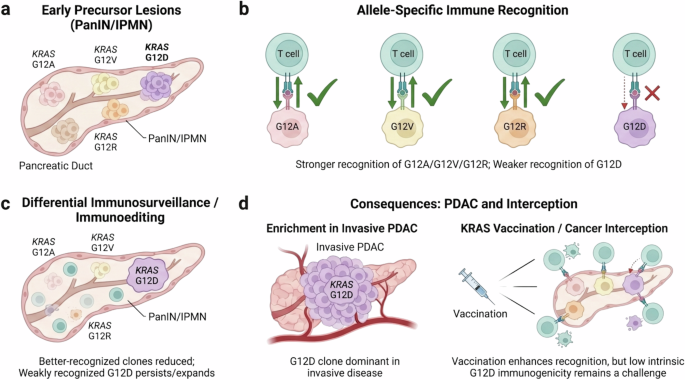
mKRAS-VAX did exactly that — and G12D delivered the weakest response by far. At only an 8.3-fold median increase, G12D lagged well behind G12A (43.9-fold), G12V (33.7-fold), and G12R (21.8-fold). In plain terms: the variant most responsible for driving pancreatic cancer was also the worst seen by the immune system after vaccination.
This is not a trivial pharmacokinetic quirk. It is a signal about immune biology that cuts deeper than one trial.
The hidden arm of immune selection
The authors propose an elegant explanatory model, and unpublished observations from their group support it. They detected pre-existing T-cell reactivity against common KRAS mutants in both PDAC patients and healthy donors — with strikingly limited recognition of G12D specifically. Several G12D-mutant patients responded robustly to other KRAS peptides while barely responding to G12D itself. This argues against a generalized immune exhaustion hypothesis; the immune system is clearly capable of recognizing KRAS mutants. It simply does not see G12D very well.
If G12D is poorly visible to T cells, then natural immunosurveillance would exert weak negative selection pressure on G12D-mutant clones during early carcinogenesis. Populations of cells carrying that mutation could accumulate unchecked. Better-recognized variants — G12A, G12V — would face stronger immune-mediated淘汰. Over time, that asymmetric visibility reshapes the mutational landscape in favor of G12D.
Population-scale genomic data provides an indirect line of support. Preferential loss of the restricting HLA allele has been observed for G12V but not for G12D in the context of HLA-A*11:01, consistent with differential immune pressure across KRAS variants.
In this reading, G12D’s epidemiological dominance and its therapeutic invisibility are not coincidence — they are the outcome of the same process. The variant became common because it escaped immune detection. And that escape route is exactly why a vaccine struggles to reverse it.
Interception versus treatment: a fundamental shift in timing
Even a modest vaccine that generates detectable T cells is theoretically meaningful if deployed at the right moment. The key innovation of the Haldar study is not simply that it targets KRAS — it is that it targets KRAS before invasive cancer takes hold.
PDAC evolves slowly from precursor lesions: pancreatic intraepithelial neoplasia (PanIN) and intraductal papillary mucinous neoplasms (IPMNs). Mutant KRAS is present in many of those early lesions. By the time frank carcinoma develops, the tumor microenvironment has become profoundly immunosuppressive and genomically heterogeneous. A vaccine administered at that stage fights an uphill battle against exhausted T cells, regulatory T cells, and myeloid-derived suppressor cells — all shielded by dense stroma.
Vaccinating high-risk individuals with radiographic abnormalities moves the intervention upstream, into an era when residual tumor burden is minimal and the local immune architecture is still permissive.
Melanoma studies illustrate the broader principle. In untreated advanced melanoma, combining an immune-modulatory peptide vaccine with pembrolizumab numerically prolonged progression-free survival without reaching prespecified significance. Among anti-PD-1 naïve patients, median progression-free survival was 24.8 months versus 11.0 months. More relevant to interception, individualized neoantigen vaccination combined with pembrolizumab after resection produced durable improvements in recurrence-free and distant metastasis-free survival at five years — benefits pronounced even among ctDNA-negative patients, pointing squarely at minimal residual disease as the ideal window.
The phase III INTerpath-001 trial has since reported positive endpoints for both recurrence-free and distant metastasis-free survival, reinforcing the pattern: cancer vaccines work best when tumor burden is low and the immune system has not yet been reprogrammed by the microenvironment.
Haldar and colleagues simply moved the needle one step earlier still.
Why the paradox matters beyond one vaccine candidate
The G12D immunogenicity gap has practical consequences for vaccine design. A pooled peptide construct must balance breadth against potency. Targeting G12D exclusively risks suboptimal responses. Targeting only the more immunogenic variants risks missing the largest share of precursor lesions in the population.
The pooled approach taken here attempts to navigate that tension. But it also reveals a deeper strategic question for precision oncology: should we continue chasing the most prevalent driver, or should we prioritize the variants the immune system can most easily recognize?
That tension extends well beyond pancreatic cancer. Other gastrointestinal malignancies carry distinct KRAS altetypes with different prevalence and immunogenicity profiles. Understanding which mutations are biologically dominant versus immunologically dominant will shape the menu of antigens included in future preventive and therapeutic vaccines across the GI tract.
What remains unresolved
The study is small — 20 participants, median follow-up of 16.5 months — and was not designed or powered to demonstrate cancer-preventive efficacy. No participant developed PDAC during the observation period, but that is expected. Without a control group, longer follow-up, and direct evidence that vaccine-induced T cells actually traffic into and eliminate precursor lesions, claims of interception remain grounded in theory rather than proof.
An ongoing window-of-opportunity cohort in patients undergoing resection of high-risk pancreatic lesions will test a critical mechanistic link: do circulating, vaccine-induced KRAS-specific T cells reach the pancreas and engage mutant cells in situ? Answers from that arm could bridge the gap between immunogenicity and clinical benefit.
Additionally, the G12D paradox introduces uncertainty about whether boosting G12D-specific T cells requires unconventional strategies — altered-peptide ligands,neoepitope optimization, or combination with agents that temporarily relieve immune suppression in the precursor microenvironment.
The longer arc
The most consequential implication of this work may not be a single vaccine regimen. It is the suggestion that allelic differences in immune visibility actively sculpt which KRAS mutant populations dominate in pancreatic cancer. If correct, that framework forces a reexamination of how driver mutations are studied and targeted: prevalence alone does not equal vulnerability.
It also reframes the therapeutic imperative. For pancreatic cancer — one of the most lethal solid tumors with few effective prevention strategies — demonstrating that the immune system can be instructed to recognize a somatically acquired driver mutation before invasive disease emerges would represent a genuine paradigm shift. The G12D paradox is a reminder that the path from biological insight to clinical protection runs through immunology, not just genomics.