Lake Ontario Renamed Lake America: Trump's Toponymic Power Play Exposes the Real Game
Donald Trump has signed an executive order renaming Lake Ontario to Lake America amid a collapsing US-Canada trade dispute. The move is theatrical on its face — but it follows a playbook established with the Gulf of Mexico, and its real purpose is diplomatic coercion disguised as symbolism.
The Name Is the Weapon
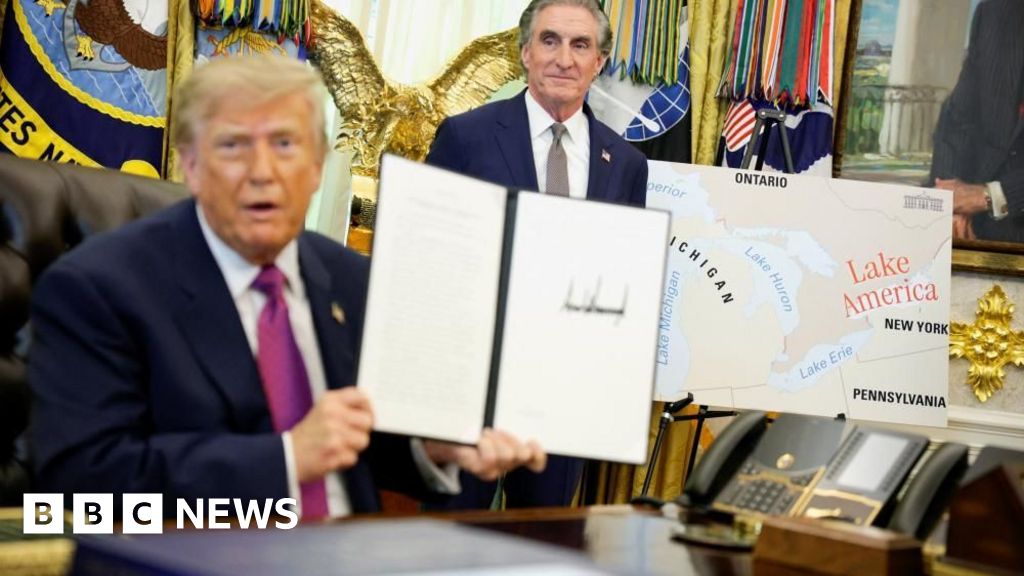
Donald Trump signed an executive order on Thursday renaming Lake Ontario to Lake America. He did it in the Oval Office, with the press watching, and said it was not a message to Canada — just something he had been thinking about for a long time. The US has imposed new 50% tariffs on $20 billion in Canadian goods. Canada will hit back with dollar-for-dollar counter tariffs next month. Trade talks collapsed late Friday night after both sides accused each other of last-minute demand changes.
The timing is the story. This is not a toponymic initiative. It is trade policy dressed in geography.
The order directs the Department of the Interior to update the Geographic Names Information Service, the federal database that maintains domestic US place names. That database covers American territory. It does not cover Canada. The lake sits on the border between New York state and the Canadian province of Ontario. Both countries use the name. Neither country is obligated to follow what the other writes in a federal register.
No internationally recognized body sets the names of shared waters. The International Hydrographic Organization deals with ocean naming conventions, not continental lakes that have carried the same name for four centuries. That vacuum is exactly where Trump operates — in the space between what is legally binding and what is politically costly.
The Gulf Precedent
Trump signed a similar order in his first term renaming the Gulf of Mexico to the Gulf of America. Mexico rejected it. Google Maps quietly split the difference: US users see one name, Mexican users see another, everyone else sees both with a parenthetical footnote. It was the kind of technical compromise that makes diplomats look like problem solvers and the public look like they got nothing.
Then the White House blocked Associated Press reporters from presidential events over the news agency’s refusal to adopt the new name in its coverage. The AP sued. The case is still ongoing.
What the Gulf episode proved is that Trump does not need other countries to accept a renamed feature. He needs them to care that he renamed it. The point is not cartographic accuracy. The point is the expenditure of political attention on every single map, dataset, shipping chart, textbook, and news article that has to decide how to handle the new name. That is the real currency.
Canada is now being asked to perform the same calculus on a lake.
The Canadian Response
Prime Minister Mark Carney posted a social media message on Thursday noting that Lake Ontario’s name predates both the Canadian Confederation and the US Declaration of Independence by centuries. “We know that the United States is changing,” he wrote. “Their trade relations, their foreign policy, their national monuments, their hydronyms.” The joke lands because it is not entirely false.
Industry Minister Melanie Joly called the move foolish on Tuesday. Nova Scotia Premier Tim Houston added, in a post before the order was signed, that it would always be Lake Ontario. The language was informal — “buddy” — which is itself a diplomatic signal. You do not speak that casually to someone you fear.
Canada’s response is coordinated, dismissive, and calibrated to avoid escalation. That is the correct instinct. The moment Canada reacts with equal theatrics, Trump wins the news cycle a second time. The harder choice is what happens after the headlines fade.
What This Changes
Nothing legally. Everything commercially.
Shipping manifests, international waterway designations, environmental treaties, and cross-border infrastructure projects all reference Great Lakes names. A US federal database update forces every multinational logistics company, insurance underwriter, and regulatory filer to decide which name to use in official correspondence. That decision is not neutral. Choosing the new name signals recognition. Refusing it signals sovereignty. Both have costs.
Travel advisories, border documentation, and customs filings already carry geographic labels. Any future disruption at the border — and there are hints Trump is considering them — gives American officials a convenient new vocabulary for enforcement. A ship arriving from Montreal carrying goods that previously referenced Lake Ontario routes now has a paperwork question that did not exist yesterday. That is not an accident.
The tariff dispute provides the leverage. The renaming provides the pressure. The two are not separate strategies.
Who Gains, Who Loses
The Trump administration gains three things. First, it keeps the Canada trade fight on the front page without issuing a single new policy statement. Second, it creates a testing ground for what happens when a fourth North American water feature gets the same treatment — Trump already floated renaming the Atlantic and Pacific during the signing ceremony. Third, it splits the American media along the same fault line as the AP dispute: outlets that adopt the name become complicit in the strategy, those that refuse become targets.
Canada loses credibility it does not need to spend. Every statement about the lake’s four-century history is accurate but politically thin. History does not stop a 50% tariff. It only makes the counter-narrative cleaner.
The real losers are the people and businesses on both sides of the lake whose livelihoods depend on predictable commercial relationships. Cross-border freight, fishing, tourism, and environmental management all require stable frameworks. Arbitrary name changes destabilize those frameworks without changing any physical reality. That instability is the product.
What Comes Next
Canadian trade minister Dominic LeBlanc signaled on Thursday that the US withdrew some demands around French-language labeling requirements and confirmed that measures promoting French language and Canadian culture would not face future US trade actions. He said Canada looks forward to further clarifications that could reopen negotiations.
The door is slightly open. But the naming dispute is not going away. Trump has demonstrated that he treats geography as a bargaining chip. The Gulf of Mexico case shows he is willing to weaponize it through commercial intermediaries like Google. The Lake Ontario order extends that playbook to a new feature.
Mexico’s legal position against renaming shared waters remains unresolved and could set a precedent if tested. Canada has not yet filed anything comparable. That is the next question: whether Ottawa treats this as symbolic noise or as a legal claim worth pursuing internationally.
The lake itself does not care what it is called. It remains the smallest of the Great Lakes, bordering New York and Ontario, its name rooted in indigenous words long before either country existed. The water will continue to flow. The negotiations will continue to stall. And both sides will keep using geography as leverage until one of them decides the cost is too high.
The question is no longer whether Trump can rename a lake. He already signed the order. The question is what he plans to do with the rest of the continent.