Lee Jun-seok's Exit Fragments South Korea's Conservative Bloc
Lee Jun-seok's resignation as Reform Party leader after a devastating local election collapse has thrown South Korean conservatism into uncertainty. With the party's entire leadership gone, the question of whether it merges with the ruling PPP or fragments entirely now hangs in the balance.
The Man Who Built It Is Walking Away
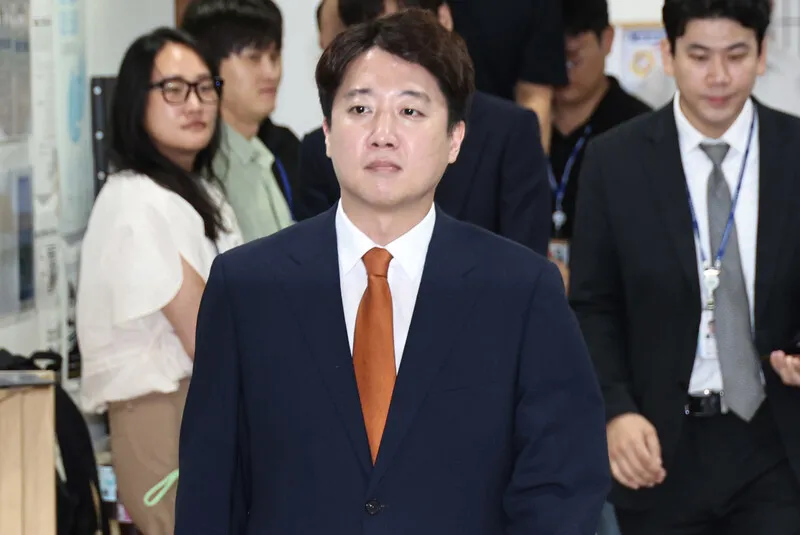
Lee Jun-seok resigned as leader of the Reform Party on June 26, officially taking responsibility for the party’s catastrophic showing in the June 3 local elections. But reading the numbers makes his departure look less like an act of accountability and more like a surrender.
The Reform Party, founded only two years and seven months ago, had staked its existence on a simple proposition: it would be the modern, youthful alternative to the established conservative camp. It ran 192 candidates across the June local and by-election cycle, brandishing campaign-finance innovation — the much-publicized 990,000 won candidacy-cost fund — as proof that it could disrupt a system saturated with old-money machine politics.
It elected one person.
Kim Ki-hyun, a candidate for the Gyeonggi provincial assembly in Hwaseong, was the party’s sole victor. In the Seoul mayoral race, top committee member Kim Jeong-cheol finished with 0.82 percent of the vote — behind the Justice Party’s Kwon Young-guk at 1.03 percent and the Women’s Party candidate Yoo Ji-hye at 0.84 percent. In Busan, the party’s fate took a darker turn: its mayoral candidate Jung Yi-han was arrested and indicted on suspicion of staging a self-inflicted attack, a scandal that further eroded whatever credibility the Reform Party had assembled.
Lee announced his exit at a press conference in the National Assembly’s communication hall, telling reporters that over the past three months he had proposed a series of reforms aimed at revitalizing the party, but found no traction inside its ranks. “I take full responsibility as leader for failing to persuade them,” he said. He added that he would return to his seat as a lawmaker representing the Dongtan 2 New City constituency — a reminder that his electoral base remains intact even as his institutional power evaporates.
The entire leadership stepped down with him. Policy Committee Chair Lee Ju-young and top committee members Kim Jeong-cheol and Kim Sung-yeol resigned simultaneously. Parliamentary leader Cho Cheol-ram has been installed as acting leader, with a nationwide party convention scheduled to choose permanent leadership.
What Nobody Is Talking About: The Merger Gambit Is Dead
The more consequential dimension of this collapse is not the election result itself but what it does to the question that has quietly structured South Korean conservative politics for the past two years: will the Reform Party merge into the ruling People Power Party (PPP)?
That question was never idle speculation. Lee Jun-seok had repeatedly floated the possibility of consolidation, and the PPP leadership — particularly its establishment wing — had tolerated the Reform Party’s existence precisely because a smaller conservative partner could absorb younger voters and progressive-leaning discontents without diluting the PPP’s core base. The merger talks were always conditional, always stalled, always dependent on Lee’s personal authority as the party’s figurehead.
Now that authority is gone.
Cho Cheol-ram, the acting leader, issued a statement to CBS Radio saying there had been “some differences of opinion” on the party’s direction but insisted they did not amount to open conflict. The implication was that Lee had simply concluded the party lacked the will to follow his reform agenda. Either way, the center of gravity has shifted. The Reform Party no longer has a single leader who can negotiate a merger deal or hold the factional pieces together. It has an interim administrator and a convention calendar.
For the PPP, this is both a relief and a complication. A merger would have given the ruling party a cleaner path to conservative consolidation heading toward the 2028 general election. Without Lee, that path is obscured. The PPP can no longer assume the Reform Party will fold into it gracefully; the question is whether the Reform Party folds at all.
The Real Loser Is the Consensus That Conservatism Has a Future
South Korea’s right wing has spent the past decade cycling through variations on the same theme: a breakaway faction rises, promises renewal, and then either collapses under its own contradictions or gets absorbed by the mainstream. The Reform Party was supposed to be the latest iteration — a clean, young, digitally native conservative force that could finally modernize the right after the scandals and stagnation that defined the previous PPP administration.
It failed before it really began.
What makes this particularly significant is the timing. The June 3 local elections were widely read as a referendum on President Yoon Suk-yeol’s administration and its governing coalition. The Reform Party’s near-total elimination from the results suggests that the conservative coalition is not merely unpopular — it is structurally hollow. Voters did not reject one faction; they rejected the premise that conservatism, in any of its current forms, has a coherent project.
Lee’s resignation letter framed the defeat as a personal failure of persuasion. But the data points elsewhere. The Reform Party’s 0.82 percent in Seoul was not a margin of error — it was a measurement of irrelevance. Its sole provincial win came in a district where local dynamics, not national conservatism, determined the outcome. The Busan scandal discredited the party before voters even had a chance to evaluate its platform.
Who Wins, Who Loses, What Happens Next
The PPP establishment wins, at least in the short term. A merged Reform Party would have complicated the ruling party’s legislative math and created a competing conservative voice inside parliament. An orphaned Reform Party does neither. The PPP can now consolidate its narrative without sharing the stage.
Lee Jun-seok loses his institutional base. He returns to the National Assembly as a backbencher from Dongtan 2 — a seat he holds, but one that does not come with the leverage of party leadership. His political relevance depends on whether he can reinvent himself outside the Reform Party apparatus. History suggests this is difficult.
The Reform Party loses its reason for being. A party founded on anti-establishment conservatism cannot easily survive when the establishment conservatives have no incentive to keep it alive and its own base has vanished. The nationwide convention called by Cho Cheol-ram may produce new leadership, but the fundamental question — what is this party for? — remains unanswered.
Young conservative voters lose a vehicle. The Reform Party’s appeal was precisely that it offered an alternative to the PPP’s worn-out machinery. With the party’s collapse, those voters face a choice: absorb into the PPP, drift toward centrism, or remain politically unmoored.
The convention to select new Reform Party leadership will proceed in the coming weeks. Whether it produces a viable party or simply a formal wound-down remains an open question. What is clear is that the two-and-three-quarter-year experiment in conservative renewal has ended not with a negotiation table but with an empty podium.