Leipzig drone attack exposes Europe's widening vulnerability
A failed drone strike at a German airport carrying suspected military explosives has exposed a growing threat to European critical infrastructure — and is forcing a hard rethink of how NATO protects civilian airfields.
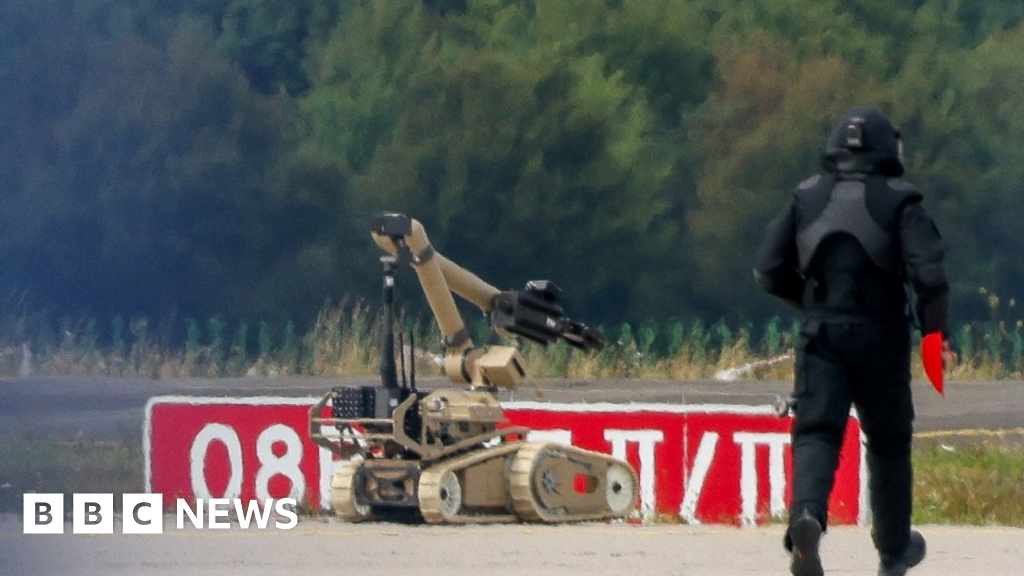
A bomb that never detonated, and what it reveals
A drone carrying military-grade explosives landed at Leipzig/Halle Airport on 4 August and did nothing. The detonator was faulty. Police used a robot to defuse the device. No one was hurt. No plane was damaged.
That the device failed is a relief. The fact that it was there at all should be disturbing.
German Chancellor Friedrich Merz did not mince words in the aftermath. Attackers, he said, are becoming increasingly ruthless and accepting severe property damage, injuries, and even fatalities. The government, he stressed, was facing a real threat — and increasingly becoming a target. The wording is deliberate. This is no longer a hypothetical about drone proliferation. It is an assessment of a threat that has already reached German soil.
Behind the scenes, however, the response was far less choreographed. Airport operations ground to a halt for hours. Emergency services swept the area. Flight paths were rerouted. DHL, the airport’s anchor tenant, suspended operations temporarily, sending shockwaves through a logistics network that processes millions of packages daily. The financial ripple was immediate — supply chain delays that reverberate across European e-commerce and freight corridors.
Who is using the airport, and why that matters
Leipzig/Halle is not a typical passenger terminal. It is a logistics giant — home to DHL, one of the world’s largest cargo operators — and a designated NATO and German military transport hub. Since Russia’s full-scale invasion of Ukraine began, the airport has handled substantial volumes of military aid bound for Kyiv. Ukrainian carrier Antonov Airlines operates out of it. Troop transport and equipment transits through it regularly.
Proximity to active military cargo operations makes this airport a sensitive node. A bomb at a commercial arrivals hall is alarming. A bomb near Ukrainian cargo planes parked at a base where allied military supplies are staged is a strategic provocation.
Security experts have speculated about Russian involvement. Moscow has denied it. Berlin has not directly accused anyone. But the pattern of unauthorised drone flights over sensitive sites in Germany — military bases, airports, energy terminals, seaports, logistics companies — has been building for months. Police have suggested some may have been organised by Russian agents. The third drone found after the Leipzig incident, and traces of hexogen — a military explosive — discovered nearby, suggest this was not a lone hobbyist mistake.
The hexogen detail is particularly telling. Hexogen, also known as RDX, is not a compound readily available on civilian markets. It requires industrial synthesis and is primarily used in military ordnance. Its presence at the scene indicates either state-level sophistication or at least access to channels beyond amateur hobbyists. This raises the stakes from nuisance to credible attack planning.
What is new about this threat
Europe has discussed drone threats before. What is different now is the shift from surveillance to sabotage.
Small civilian drones can fly under radar, cost relatively little, and be adapted with simple payloads. They do not require state-level capabilities to launch. But when the payload is hexogen and the target is critical infrastructure, the barrier between harassment and attack collapses. And when a second drone appears to have collided with a cargo aircraft nearby — as police suggest — the intent looks less like spying and more like disruption or destruction.
This is a two-layer threat. The first layer is the physical one: cheap drones, modified or purpose-built, carrying enough explosive to damage or disable aircraft, cargo, or infrastructure. The second layer is psychological and operational: every incident forces airports to slow down, to inspect, to reclassify zones that were previously considered low-risk. The cumulative effect is a system gradually grinding against its own resilience limits.
Merz’s government is responding. Plans include stronger drone defences and a policy shift allowing security services to strike back — including through cyber operations such as hacking attacker servers. That second point is notable. It signals a willingness to go beyond defensive countermeasures and project power offensively against whoever is launching these devices, even from within Germany. It is a departure from a postwar tradition of restraint.
But the policy pivot also raises uncomfortable questions. Cyber counterstrikes inside another country’s territory — even against non-state actors — set precedents that will be examined closely by allies and adversaries alike. Where does retaliation end? Who decides? These are not theoretical concerns for a continent already navigating an ambiguous conflict zone.
Who wins, who loses
The attackers — whoever they are — gain something simply by appearing. A single drone incident at an airport handling military cargo creates operational friction: inspections increase, schedules slow, insurance premiums rise. If the goal is to disrupt the flow of aid to Ukraine, even a failed device accomplishes that by raising the cost of doing business at nodes like Leipzig.
There is a second-order effect worth noting. Insurers and freight operators begin pricing risk differently. Routes diversify away from vulnerable hubs. Smaller airports — less equipped for layered defence — become either harder to service or, paradoxically, easier targets because they lack sophisticated counter-drone systems. The weakest links in the supply chain bear disproportionate risk.
Merz gains politically. His rhetoric on being Germany’s strongest supporter of Ukraine is reinforced by a concrete threat that lands on German ground. The incident gives him cover to push through tougher security measures that might otherwise face public resistance. He is also using the episode to signal resolve both domestically and to allies — particularly the United States, where questions about continued support for Ukraine have surfaced periodically.
Europe loses in a quieter way. The incident confirms a worsening reality: NATO’s eastern flank is no longer just a frontline for conventional military confrontation. It is also a zone of asymmetric pressure — where drones, cyber intrusions, and sabotage test civilian infrastructure that was never designed to be hardened against such attacks. Airports, ports, and logistics hubs were never treated as military targets under European norms. Now they are.
The erosion is incremental rather than dramatic, which makes it easy to underestimate. Each new incident normalises a threat that previous generations of Europeans would have considered belonging to a different era of conflict.
What happens next
Germany is not the only country seeing this pattern. The Netherlands, Poland, and the Baltics have reported similar incidents. A coordinated response is unlikely to come quickly. Drone defences are expensive, and there is no single architecture that fits every airport or seaport. Cyber operations, too, raise legal and diplomatic questions — especially when attribution is uncertain and retaliation could escalate.
NATO has begun discussions on collective drone defence, but institutional coordination across thirty-two member states is slow by design. The alliance’s existing frameworks were built for state-on-state scenarios, not for a mosaic of small-scale attacks that collectively undermine critical infrastructure without crossing any formal threshold of war.
Air traffic controllers will need retraining. Airport security protocols will need updating. And governments will have to decide whether the default posture should be prevention, interception, or deterrence — each approach carrying different political and practical costs.
What is clear is that the posture of European airspace has changed. The assumption that large civilian infrastructure was beyond the reach of cheap, improvised weapons is gone. The question now is not whether another incident will occur, but when, where, and whether the next detonator will actually fire.
Merz’s warning that attackers will pay a price is a promise of response. How Germany defines that response — and whether it extends beyond its borders — will shape Europe’s approach to an increasingly blurred line between war and everything else. The Leipzig drone did not explode, but it detonated something far more consequential: the long-held assumption that European airports are safe from the kind of asymmetric warfare once reserved for distant battlefields.