Lunar Potato Farming: What Moon Soil Crops Reveal About Space Colonies
Oregon State University found potatoes grow in simulated lunar soil with fertilizer — but with lower biomass, elevated metal absorption, and nutritional gaps that complicate every assumption about extraterrestrial self-sufficiency.
The Martian Was Right About One Thing
The fictional Mark Watney survived on potatoes grown in Martian dirt. A new study from Oregon State University suggests that if humanity ever plants itself on the Moon, potatoes might actually work there too — but the optimism needs a serious reality check.
Published in npj Microgravity, the research grows potatoes in simulated lunar regolith and finds they can produce viable crops with supplemental fertilizer. That sounds like a win for space colonial ambitions. It isn’t quite that simple.
What Actually Happened
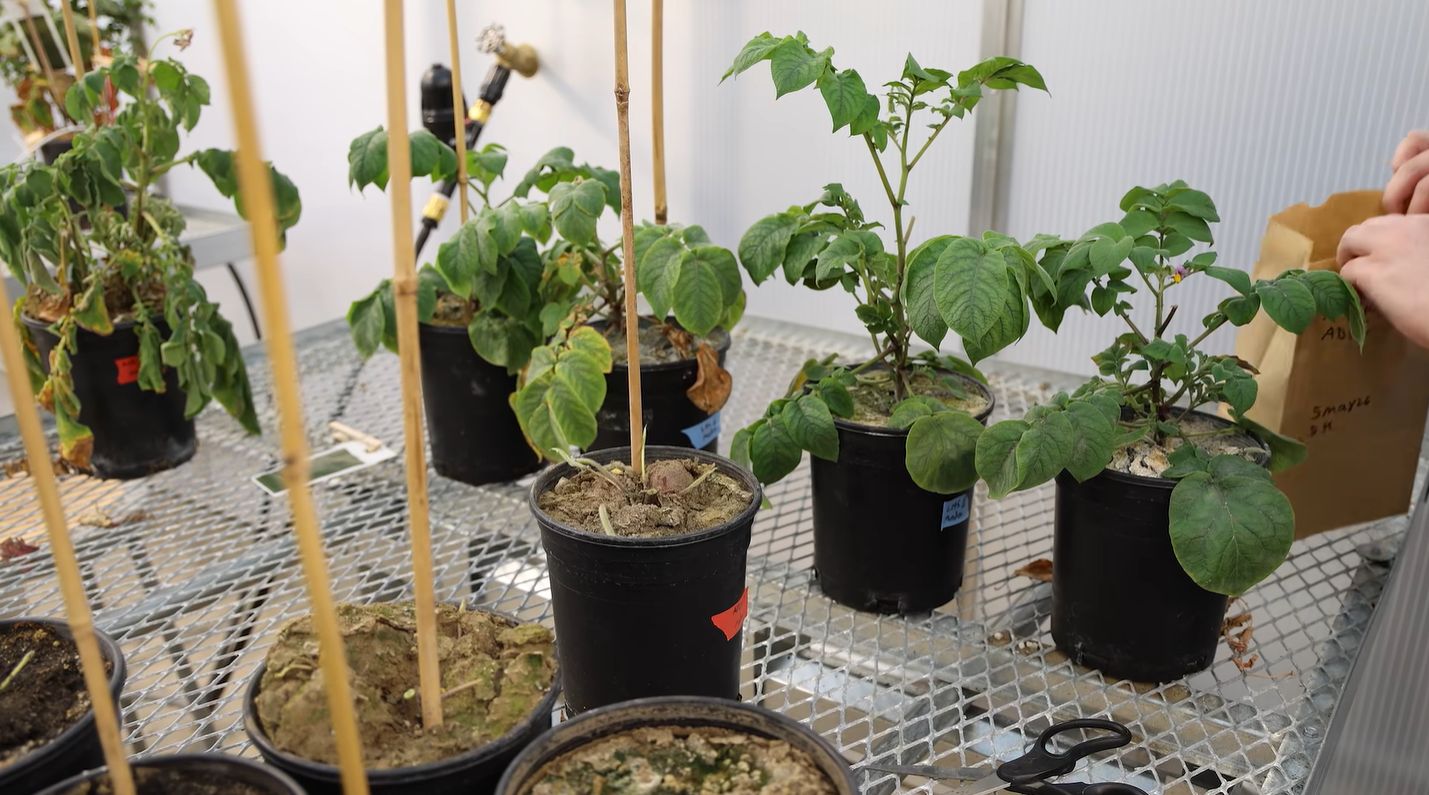
The team compared potato growth in three conditions: standard Earth soil (the Adkins control), simulated lunar regolith with fertilizer, and simulated lunar regolith without fertilizer. The results followed a predictable pattern but carry implications that reach far beyond agriculture.
Without fertilizer, the potatoes struggled visibly — stunted shoots, pale leaves, minimal tuber development. With it, they grew substantially. Yields approached Earth-grown benchmarks under ideal fertilization. The control group told the more interesting story. Potatoes grown in lunar simulant produced measurably less biomass overall and showed signs of reduced cellular health compared to their terrestrial counterparts, even when fertilized to comparable nutrient levels.
Researchers attributed much of this damage to the physical nature of regolith itself. Lunar soil is fundamentally different from Earth soil at the microscopic level — its particles are sharp, jagged, and glassy, shaped by eons of micrometeorite bombardment without the weathering processes that round terrestrial grains. These edges cause constant micro-damage to roots and other plant structures, a form of chronic mechanical stress that no amount of added nutrients fully resolves. The effect is cumulative. Roots exposed to regolith simulant developed thicker cell walls as a defensive response, a sign of sustained physiological effort rather than normal growth patterns.
The Fertilizer Problem
Fertilizer solved the yield gap but introduced another dependency. Any lunar base growing food this way must either manufacture or import substantial quantities of agricultural amendments. That creates a supply chain liability that redefines what self-sufficiency means.
Current thinking about lunar bases envisions sustained human presence through the 2030s and beyond, supported by the Artemis program infrastructure. Self-sufficiency remains the stated goal. But if every hectare of regolith farm requires imported nitrogen, phosphorus, potassium, and trace elements, then agricultural independence is conditional on industrial independence — which is itself conditional on reliable resupply or in-situ resource extraction capabilities that don’t yet exist at scale.
There is a second-order problem most discussions overlook. Fertilizer composition matters for how crops interact with the regolith substrate. The study used standard NPK formulations designed for terrestrial soils. Their effectiveness in lunar simulant may not translate directly when scaling up, because the baseline chemistry of the growing medium changes how nutrients become available to plant roots. Different ratios, chelation methods, or slow-release formulations could alter outcomes significantly — but those variables remain largely untested in regolith environments.
The question isn’t whether you can grow potatoes on the Moon. It’s whether you can do it without turning the Moon into a second Earth, complete with the same fragile input chains.
Nutritional Tradeoffs Matter More Than Yields
Here is where the study gets uncomfortable for colonial planners. The potatoes didn’t just weigh less — they were nutritionally inferior and carried higher metal concentrations. Copper absorption was notable enough to flag explicitly. For a small crew living in a closed environment, accumulated heavy metal exposure over months or years could shift from agricultural footnote to medical emergency.
This matters because space medicine operates on tight margins. Astronauts already deal with bone density loss, immune suppression, and radiological risk. Adding low-level dietary contamination from otherwise “safe” food sources compounds rather than solves health risks in ways that are difficult to detect in short-duration missions. The effects would likely surface only after repeated cycles of consumption, making them easy to dismiss as noise during brief flights.
The Earth control group didn’t show these issues. The difference wasn’t fertilizer quality. It was the substrate itself.
Beyond metals, the nutritional profile shifts in ways that compound each other. Lower biomass means fewer total calories per plant. Reduced micronutrient density in the tubers means crew members would need to consume larger quantities to meet dietary requirements — which strains storage capacity and increases waste from unsold or spoiled produce. In a closed loop system, nothing is wasted and everything is accounted for. The math becomes unforgiving.
Who Wins, Who Loses
The winners here are straightforward: NASA and international space agencies gain confidence that basic caloric production in extraterrestrial environments is achievable. Private space companies benefit from reduced perceived risk in mission planning. Agricultural researchers working on closed ecological life support systems have another data point to refine their models.
The losers aren’t people — they’re assumptions. The assumption that regolith farming scales linearly with fertilizer input. The assumption that “growable” means “nutritious.” The assumption that biological processes behave similarly in novel substrates when they clearly don’t.
Most importantly, the study undermines the easiest version of the Mars-like narrative that has dominated public imagination around space settlement. Watney didn’t worry about copper toxicity or cellular degradation. He worried about running out of potatoes. Real lunar agriculture would face both problems simultaneously.
Second-Order Effects No One Is Discussing
There are ripple effects from this research that extend well past planting schedules. Water recycling systems in lunar habitats would need adjustment. Plant transpiration rates differ in regolith-grown crops, which shifts humidity profiles inside enclosed growing chambers. Humidity management affects condensation collectors, which feed back into drinking water supplies. A deviation in one subsystem propagates through others.
Waste processing takes on added complexity. Human and organic waste that currently loops back into terrestrial agriculture as fertilizer would need redesign for lunar contexts. Composting organisms evolved for Earth soils don’t function identically in confined extraterrestrial environments. The microbial communities supporting nutrient cycling would require deliberate inoculation and monitoring.
Crew psychology deserves attention too. Watney’s story worked because potatoes were a symbol of mastery over an alien environment. Growing actual crops on the Moon carries similar symbolic weight — but when the crops underperform expectations repeatedly, the psychological toll adds to isolation, confinement stress, and mission fatigue in ways that are hard to quantify but impossible to ignore.
What Comes Next
The immediate path forward involves two parallel tracks. First, genetic selection and breeding for regolith-resistant potato varieties — strains with tougher root systems and reduced metal uptake. This is incremental but potentially transformative over multiple growing cycles. Commercial agriculture already selects for soil-specific traits; the same approach applies here with added urgency.
Second, engineered regolith processing. If the sharp-edged particles are the primary source of root damage, then sintering, grinding, or chemical treatment of lunar soil could make it significantly more hospitable before planting begins. This adds process steps that complicate everything from equipment design to crew workload. Every additional step is another failure point in an environment where spare parts don’t arrive on schedule.
Neither track eliminates the fundamental tension: extraterrestrial agriculture will always be harder than terrestrial agriculture, even with the best technology available. The potatoes prove it works. They also prove it works worse.
That distinction will determine how fast lunar bases become self-sustaining, and whether they ever do. The Oregon State study doesn’t end the conversation about moon farming — it reframes it. The question is no longer whether humans can grow food off-world. It’s what price we accept for doing so, and whether that price fits within the narrow margins that define survival beyond Earth.