The LZ Anomaly Could Redraw Global Physics Funding
A single unexplained event at the LZ dark matter detector sits at 2.6 sigma — intriguing but far from discovery. Whether it holds up will reshape detector funding, redirect a field that has chased WIMPs for decades, and test the economics of big science in an era of tightening budgets.
The Signal That Isn’t a Signal (Yet)
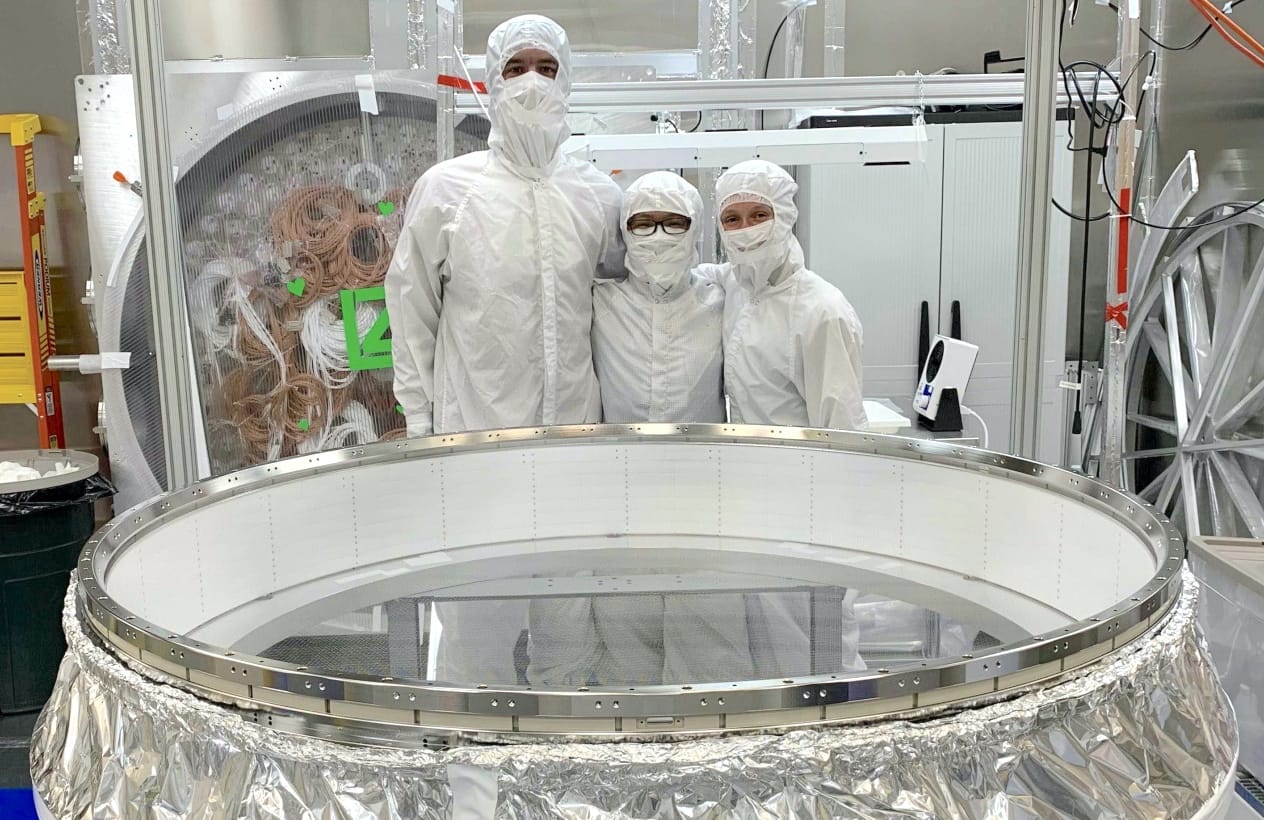
A single event. That is all the Large Zenith experiment has to show after 220 days of listening to ten metric tons of liquid xenon buried a mile underground in a South Dakota gold mine. The hit — a xenon nucleus recoiling, producing the flash of light and electrons that dark matter theorists have chased for decades — landed at 2.6 sigma. In particle physics parlance, that means roughly a one-in-200 chance it is a statistical fluke. Researchers estimate only a 0.5 percent probability it came from a known background source, making it the most compelling signal the detector has recorded since it began operating in 2021.
It is also nowhere near enough to claim a discovery. The convention is five sigma — a one-in-three-and-a-half-million threshold that has separated genuine breakthroughs from headlines that evaporated under scrutiny. One interaction, no matter how clean it looks, cannot clear that bar.
But the real story here is not the number. It is what happens next if that number refuses to disappear.
Who Moves, Who Waits
The LZ collaboration — 250 scientists and engineers drawn from Lawrence Berkeley National Laboratory, Lawrence Livermore, SLAC, and institutions across five continents — is now in the most uncomfortable position in experimental physics: it has seen something it cannot explain, and it does not yet know whether to celebrate or publish a retraction.
Aaron Manalaysay, an LBNL scientist on the project, put it plainly when he told the Bay Area News Group that dark matter is “the holy grail” because it is the thing the Standard Model cannot account for. That framing matters. If the LZ anomaly holds, it will be the first direct observation of physics beyond the Standard Model in a generation — not a refinement, not a correction, but an addition to the periodic table of the invisible.
The implication for funding is immediate and asymmetric. Xenon-time-projection-chamber detectors like LZ sit at the center of the WIMP — weakly interacting massive particle — strategy. If that strategy gets a boost, the next round of department and foundation grants will flow toward xenon. Competing approaches, particularly axion haloscopes and directional detectors, will face steeper climbs. The LZ result, even unconfirmed, has already shifted the Overton window of what counts as plausible.
Conversely, if the event proves to be a radioactive contaminant or a solar neutrino mimicking a WIMP recoil, the field faces a different reckoning. The WIMP paradigm has absorbed decades of null results without collapsing, but repeated disappointments erode political support. A false alarm that generates headlines would make that erosion faster.
The Replication Race Is Already Underway
The LZ team is not alone. PandaX in China and XENONnT in Italy are running identical experiments with their own xenon time projection chambers. Neither has publicly announced a matching signal, but both are actively searching the same energy window. That is the mechanism that turns a hint into a result or a hallucination.
The competition between these three detectors is the modern equivalent of the Higgs boson race — except the prize is less a Nobel and more the architecture of the next twenty years of particle physics. The lab that confirms the signal first writes the literature. The others adapt or pivot.
Benjamin Safdi, a UC Berkeley physicist on LZ, told reporters confirmation could take anywhere from months to years. That range is honest and ominous. In particle physics, years is a long time to live with an unclassified anomaly. Data accumulation is slow by design — the detector sits in a mine, the xenon must remain ultrapure, the background must be modeled to parts per quadrillion. Every additional day of running improves sensitivity but also raises the stakes of whatever comes next.
What a Confirmation Actually Changes
If the LZ signal reaches five sigma — and that requires multiple events clustering at the same recoil energy — the consequences cascade outward from the detector itself.
The first wave is institutional. DOE and international funding agencies will prioritized follow-on xenon detectors, likely in the hundred-million-dollar range. A next-generation LZ, sometimes called LZ-Upgrade or Super-LZ, becomes a plausible proposal rather than a wish list item. Universities will redirect graduate admissions toward dark matter phenomenology and detector R&D. Postdocs who spent their careers on axions or supersymmetry searches will find those fields suddenly thinner.
The second wave is conceptual. A confirmed WIMP signal would validate a theoretical framework that has been under existential pressure for ten years. Direct detection experiments have pushed the cross-section limits lower with every generation. The parameter space where a simple WIMP could hide has shrunk dramatically. A detection at the LZ sensitivity level would be a rescue — proof that the particles exist and that our detectors were simply not sensitive enough to see them before.
That rescue is also a trap. If the WIMP interpretation solidifies, alternative models — fuzzy dark matter, self-interacting dark matter, multi-component scenarios — lose air. The field converges. Convergence is good for progress and bad for surprise.
What a Disappearance Would Mean
Equally important is what happens if the signal fades. More data could simply dilute the anomaly below significance, or a deeper background analysis could attribute the event to tritium contamination, radon decay, or a misidentified neutrino interaction. Solar neutrinos, in particular, produce signals that are nearly indistinguishable from low-mass WIMPs — a degeneracy that has haunted every xenon experiment.
If LZ is wrong, the WIMP strategy takes another hit. The funding map does not vanish — the existing projects continue — but the political narrative shifts. Axion searches gain momentum. Alternative detection concepts get a second look. The Standard Model, still unchallenged, survives another round.
Jingke Xu at Livermore captured the mood when he compared the analysis to mining for gold, noting that “the majority of the things you see are rock.” That metaphor is meant to temper enthusiasm, but it also acknowledges that the rock is where the signal hides. The LZ team has ruled out known backgrounds to the 0.5 percent level — a serious achievement regardless of outcome.
The Real Stake Is Time
The LZ collaboration is treating this as an unexplained anomaly, which is the correct institutional posture. But behind the caution lies a race against something more abstract than background noise: relevance. Each year that passes without a confirmed signal, the argument that direct detection is a dead end grows louder. Each year with a plausible hint, the argument grows quieter.
The world outside physics is also changing. National laboratories face budget scrutiny. Big science proposals require political justification that null results do not provide. A confirmed dark matter detection would be political insurance for the entire U.S. particle physics program. An ambiguous signal is a bet that the next year of data will resolve the ambiguity in the right direction.
That is the genuine novelty here — not the event itself, which is a single recoil in a ton of xenon, but the possibility that the event marks the moment when a fifty-year search either crosses into discovery or fades into the background. Everything between now and five sigma will determine who funds the next decade of dark matter physics and what questions the field is allowed to ask.