Japan's Maxell Just Survived 150°C With a Solid-State Battery
Maxell's new rechargeable solid-state cell tolerates 150°C and wireless charges—aimed at industrial and IoT use, not cars. But clearing the thermal-safety wall is the same bottleneck every EV maker faces.
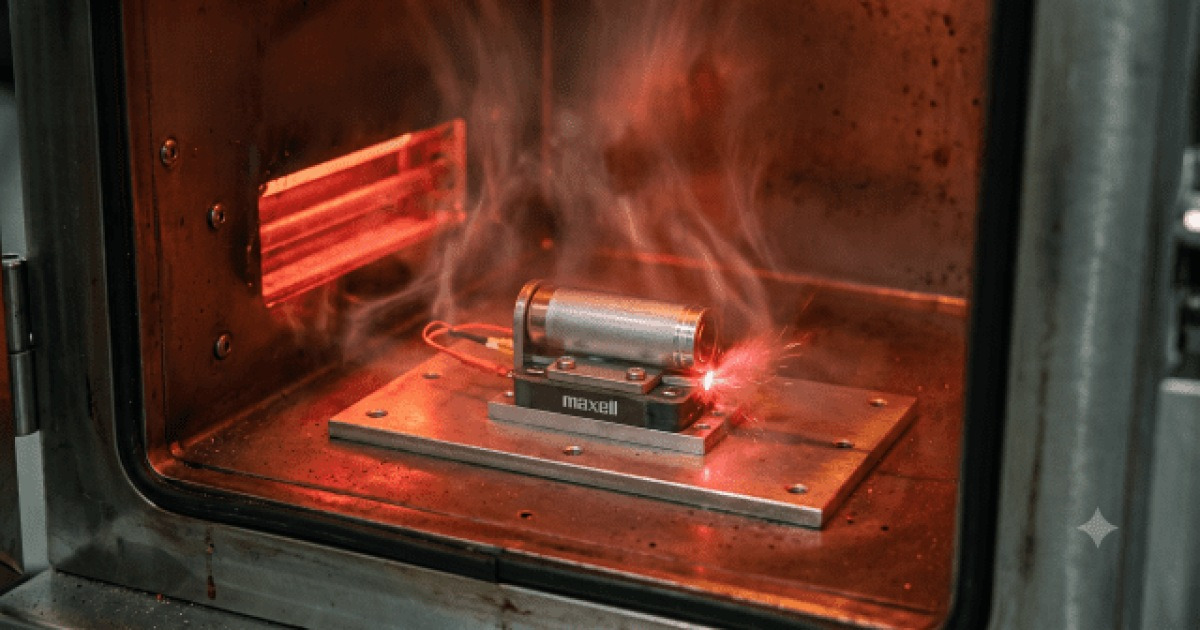
The 150°C Threshold Just Crossed
Maxell has built a rechargeable all-solid-state battery that survives 150°C without degrading. Two variants exist—one rated to 125°C, the other to 150°C—and both carry wireless-charging circuitry inside a 1/2AA-shaped module. The company announced the work through Interesting Engineering, and it is, on its face, a genuine materials-science milestone.
Why 150°C matters is simpler than most coverage makes it sound. Most lithium-ion chemistries begin breaking down near 60°C. Electrolyte decomposition, separator shrinkage, and dendrite growth all accelerate as temperatures climb. A solid-state electrolyte removes the liquid layer that normally catches fire, but the interface between that electrolyte and the electrodes still degrades under extreme heat. Getting a cell to charge and discharge at 150°C means Maxell has solved—or at least deferred—that interfacial problem enough to prove the concept.
Who This Battery Is For (And Who It Isn’t)
Maxell is not aiming at electric vehicles with this first product. The form factor is tiny: 14.5 millimeters in diameter, 25.2 millimeters tall, outputting 3.6 volts. It replaces the disposable lithium thionyl chloride (Li-SOCl₂) ER batteries that power smart meters, industrial sensors, and a wide range of IoT devices. Those batteries are ubiquitous precisely because they last years on a single charge—but they cannot be recharged, which means they must be replaced, often in hard-to-reach or hazardous installations.
A rechargeable, wirelessly-charged replacement that also survives oven-level temperatures opens doors that were previously sealed. Maxell points to temperature sensors inside tortoise-food sterilization lines as a prototype application. Those sensors must endure repeated exposure to high heat and resist moisture ingress. A conventional rechargeable cell would fail; a disposable ER cell would eventually run dry and require a housing modification to access for replacement—something that compromises the very sealing the process demands.
The Wireless-Charging Twist
Embedding a boost converter and wireless-charging coil inside the same module as the solid-state cell is not trivial. It means Maxell has packaged power-management circuitry alongside an electrolyte that must stay stable at temperatures that would cook most polymer seals. The result is a truly sealed unit with no opening for a charging port. Equipment manufacturers no longer need to design around battery-compartment access, which improves environmental sealing across the board.
That packaging advantage may matter as much as the chemistry for early adopters. Industrial and infrastructure clients pay a premium for reliability and service-life reductions—not just energy density.
The Unanswered Question: Can This Scale to Cars?
Here is where the story gets interesting and uncertain. Solid-state batteries have been the dream of every major EV maker for a decade because they promise two things simultaneously: higher energy density and dramatically improved thermal safety. The commercial track record, however, remains thin. Toyota, Samsung SDI, Nissan, and a handful of Chinese startups have all demonstrated cells in the lab. None have delivered volume-produced automotive packs at acceptable cost.
Maxell’s achievement does not solve every scaling problem. Automotive cells are orders of magnitude larger than a 1/2AA module. Manufacturing throughput, yield rates, and stack-pressure requirements shift dramatically when you move from button cells to pouch or cylindrical formats measuring hundreds of watt-hours. Interface impedance between the solid electrolyte and the cathode also tends to increase with cell size, which is why many programs still target niche applications—medical implants, aerospace, deep-sea sensors—before attempting automotive rollout.
That said, clearing the 150°C barrier removes one of the most visible objections to solid-state adoption. Safety regulators, insurers, and fleet operators have all flagged thermal runaway as the single strongest argument against next-generation chemistries. A cell that can be charged at 150°C is unlikely to runaway at anything an EV pack would realistically experience in normal or even abused conditions. That changes the risk calculus.
Who Wins, Who Loses
Winners in the near term are obvious: industrial IoT makers, smart-meter operators, and anyone currently relying on disposable ER cells in harsh environments. House Foods Corporation is already running a joint project with Maxell on a food-processing temperature sensor, according to the report. More partnerships are expected.
The longer-term winners depend on whether Maxell or another solid-state program can translate this thermal resilience into an automotive-scale product. Samsung SDI and LG Energy Solution are already investing heavily in their own solid-state lines, and Toyota continues to push toward a 2027–2028 launch window for a solid-state EV pack. Maxell’s move raises the bar for everyone else—not just on temperature tolerance, but on integration. A module that combines the cell, wireless charger, and boost converter in a replaceable AA-sized form factor is a systems-design statement.
Losers are the incumbents in industrial disposable-cell supply chains. Li-SOCl₂ ER batteries have held their niche for decades because they were cheap, proven, and maintenance-free. A rechargeable solid-state equivalent that offers the same lifespan without replacement work is a direct threat.
What Comes Next
Maxell has not announced a commercial launch date or production timeline. The company is still in partnership-development mode. That caution is typical for solid-state programs; every major player has timed its public announcements to match manufacturing readiness, which usually lags lab demonstrations by two to four years.
What to watch over the next 12 months: whether Maxell reveals automotive-format cells, whether any of its industrial partners publish field-test results at the 150°C rating, and whether competitors—particularly Samsung SDI, LG, or a Chinese maker—announce similarly rated products. The solid-state race is no longer about who can build a working cell. It is about who can ship one at scale under real-world conditions. Maxell has now proven it can survive conditions most people never encounter. The next step is proving it can do so cheaply enough for the world to care.