Maxell's 150°C solid-state battery changes the high-heat game
Japan's Maxell has built a rechargeable solid-state cell that survives 150°C, targeting industrial and IoT devices where lithium chemistry fails. The milestone may seem narrow, but it signals that the hardest engineering problem in solid-state—thermal stability—is finally yielding.
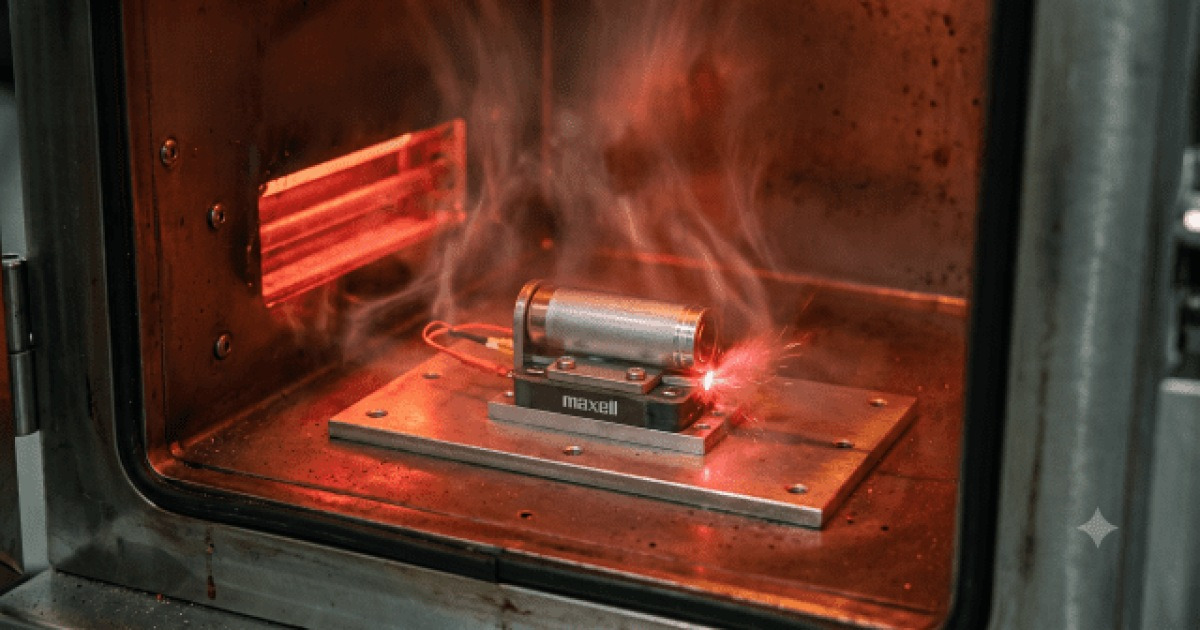
The real breakthrough is not the chemistry. It is the temperature.
Japan’s Maxell has built a rechargeable solid-state battery that can charge and discharge at 150°C without degrading. The product itself is small—14.5 mm in diameter, 25.2 mm tall, roughly the size of a standard ER industrial lithium thionyl chloride cell—and aimed at industrial sensors, smart meters, and IoT nodes that live inside sterilization equipment, food processing lines, and other high-heat environments. But the significance reaches far beyond the spec sheet.
For decades, the solid-state battery story has been dominated by EV ambitions: longer range, faster charging, lower cost. The headline numbers have always been 300 km per charge or 10-minute fast fills. What Maxell is doing here is different. It is proving that solid-state electrolytes can survive repeated cycling in conditions where conventional lithium-ion chemistry collapses within weeks, sometimes days. That is a materials science victory, and it changes how the rest of the industry should think about the timeline for commercial adoption.
Why 150°C matters
Conventional Li-ion cells begin to degrade rapidly above 60°C. At 85°C, electrolyte decomposition accelerates. Past 100°C, most commercial lithium systems enter thermal runaway territory or suffer irreversible capacity loss. Liquid electrolytes evaporate. Separators shrink. Solid electrolytes do none of those things.
Maxell’s two variants—rated for 125°C and 150°C respectively—fill a gap that no rechargeable cell has reliably occupied. Industrial monitoring equipment in food sterilization tunnels, for example, sits inside environments where temperature spikes are routine. These devices need sealed enclosures to keep moisture out, which means wired charging ports are a liability. A wireless-charged, solid-state cell solves both problems: the device stays hermetically sealed, and the battery never needs replacement.
The ER cell that Maxell is replacing is everywhere in industrial settings. It is the workhorse primary battery for memory backup, metering, and sensor applications. It delivers 3.6 V and has a multi-year shelf life. The fatal flaw is that it cannot be recharged. When it dies, it is thrown away or recycled. Maxell’s module combines the same voltage output with a built-in wireless charging coil and boost circuit, all in a single package. The result is a battery that does not need swapping.
The quiet competitor in the solid-state race
South Korea and China have been the loud voices in solid-state battery development, with Samsung SDI, SK On, LG Energy Solution, and CATL publishing aggressive timelines and pilot-line announcements. Japan has trailed in public messaging, but companies like Maxell and Toyota continue to file patents and ship hardware quietly.
Maxell is not targeting EVs with this cell. The energy density is not competitive with automotive-grade pouch cells. But the message is clear: the commercial path for solid-state may not run through cars first. It may run through industrial equipment, medical devices, and embedded sensors—applications where reliability trumps energy density, and where the current alternatives are either non-rechargeable or dangerously unstable at operating temperature.
If solid-state cells can prove themselves in 150°C industrial environments, the same electrolyte formulations can be adapted upward for higher-capacity formats. The manufacturing learning curve begins in small cells and scales from there. That is how battery companies have always operated.
What Maxell is testing, and why it matters
Maxell is working with House Foods Corporation on temperature monitoring equipment for food processing. That partnership is instructive. Food sterilization lines operate at extreme temperatures and demand sealed, maintenance-free sensors. If the Maxell cell passes real-world validation there, it unlocks a category of industrial IoT applications that currently rely on primary batteries or wired rechargeable systems with poor environmental sealing.
Smart meters in underground vaults, pipeline monitoring nodes, and agricultural sensors in high-heat zones are all candidates. None of them are EVs. All of them represent addressable markets that solid-state batteries are uniquely suited to serve.
Maxell has not announced a commercial launch date or mass-production schedule. The cell is still in validation with partners. But the existence of a working 150°C rechargeable solid-state cell is no longer theoretical. It is a hardware artifact.
The supply chain implication
Korean battery makers have been racing to secure lithium, nickel, and rare-earth supply chains for EV-scale production. That strategy assumes automotive adoption comes first. Maxell’s move suggests an alternative trajectory: industrial and IoT markets may commercialize solid-state faster, generate revenue earlier, and fund the scale-up that eventually makes EV cells viable.
This is not a threat to Korean ambitions. It is a parallel path. Companies that can manufacture solid-state cells for high-temperature industrial use will have accumulated process knowledge—electrolyte sintering, interface engineering, cycle-life validation—that translates directly into automotive cell production. The reverse is not true: an EV-focused line has far less incentive to optimize for 150°C operation.
Who wins, who loses
The winners are industries that have been stuck with disposable primary batteries in harsh environments. They get wireless charging, sealed enclosures, and batteries that outlast the equipment they monitor. Maxell wins market positioning in a segment it can own outright—no Korean or Chinese competitor has a comparable product shipping today.
The losers are primary ER-cell manufacturers who will face pressure to justify their business model when a rechargeable alternative appears at the same form factor. They also lose the recurring revenue from replacement cycles. Maxell’s module eliminates that entirely.
For the broader EV supply chain, the implication is indirect but real. Every kilowatt-hour of industrial solid-state production teaches the supply chain how to handle sulfide and oxide electrolytes at scale. Those lessons compound. When automotive solid-state eventually arrives, the manufacturing base will already exist.
What happens next
The next 12 months will reveal whether Maxell’s 150°C cell passes the real-world validation with House Foods and other partners. If it does, expect a commercial announcement and a shift in how the industry talks about solid-state deployment order. The narrative will move from “when will solid-state cars arrive?” to “which industrial sectors will adopt solid-state first, and what does that teach us about scale-up?”
Korean battery makers should watch this closely. Their advantage in cost and volume is real, but Maxell is winning on a parameter—thermal tolerance—that their current roadmaps do not prioritize. In battery technology, the winning parameter is rarely the one everyone is measuring.
The 150°C cell is small. The signal it sends is not.