Micron's Record Run Exposes the Real Bottleneck in AI Memory
Micron is poised for its largest quarter ever, with $50 billion in revenue and 86 percent gross margins driven by surging AI memory demand. But the 16 long-term contracts locking in $100 billion of guaranteed minimums reveal a market where geopolitics, not capacity, will define who wins next.
Micron’s $50 Billion Quarter and What It Hides
Micron is about to report the biggest quarter in its history. Revenue is projected at $50 billion with a gross margin of 86 percent, both climbing roughly 20 percent from the already-record-breaking $41.5 billion and 81 percent margin it posted in the prior three months. The company will release those figures on October 1 — a full month ahead of Samsung and SK Hynix, which means the Korean memory giants’ September results will effectively be read as a reaction to Micron’s numbers rather than the other way around.
That sequencing is not accidental. In memory, Micron’s early report sets the tone for the entire cycle. But what makes this quarter distinctive goes beyond the headline revenue number.
The $100 Billion Lock-In
The more consequential detail sits in Micron’s contract book. The company has signed 16 strategic customer agreements — long-duration, minimum-guarantee deals — with a combined floor of $100 billion in revenue. Those price floors are reportedly set above every prior quarterly high-margin level. In practical terms, this means a growing share of Micron’s output is pre-sold at protected prices well before the market can arbitrage them down.
This is a structural shift, not a cycle peak. Traditional memory booms have always been driven by spot-market pricing volatility: prices surge, everyone builds capacity, prices collapse, and the industry restarts. What Micron is demonstrating here is a move toward contracted certainty — locking in volumes and margins years ahead of delivery. For customers like Microsoft, Amazon, or Google, that certainty is the whole point. AI data centers need predictable memory supply the way nuclear plants need predictable fuel rods. Spot-market panic helps no one at that scale.
HBM4 Is Already a Billion-Dollar Business
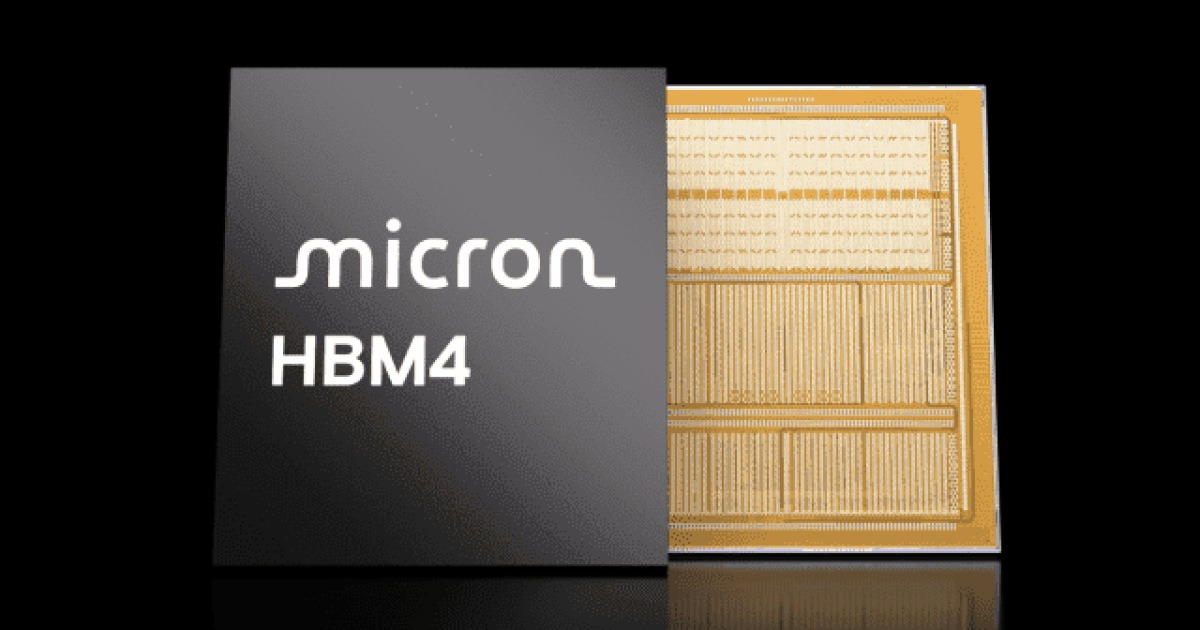
Micron disclosed that cumulative HBM4 revenue surpassed $1 billion in the first half of 2026 alone. The company also showed a sample of HBM4 at what appears to be an industry event — a hardware product that only recently moved out of the prototype phase. For context, HBM generation cycles have historically been 18 to 24 months apart. HBM4 arriving ahead of schedule and generating seven-figure revenue mid-cycle signals that the product ramp is moving faster than typical memory roadmaps would predict.
HBM is not a commodity. It requires advanced packaging — specifically, hybrid bonding — that few fabs can execute at volume. That concentration of capability is why SK Hynix currently dominates HBM shipments and why Samsung has reportedly accelerated its D0a DRAM roadmap to catch up. Micron’s ability to cross the $1 billion HBM4 threshold so quickly suggests it is closing the gap, not just in process but in customer adoption.
The Real Constraint Is Not Fabrication
Micron’s own guidance pointedly framed the outlook this way: supply-demand conditions will remain tight through 2027, and even in 2028, when supply gradually improves, demand growth from AI and robotics will make it difficult to predict when the market reaches equilibrium. In plain language, the bottleneck is not how many wafers the industry can run — it is whether those wafers can be manufactured in jurisdictions that customers and governments will accept.
This is where the geopolitical dimension enters. Samsung is adjusting its roadmap. SK Hynix’s subsidiary Solidium is pursuing its first NAND fab in the United States. Micron has been building capacity in Texas and planning further expansions. The common thread is location, not lithography. Every major AI memory buyer now factors export controls, tariff risk, and allied-supply-chain requirements into their procurement decisions. A fab in Taiwan or South Korea may be technically superior but geopolitically exposed. A fab in the United States or Japan carries different risks — higher cost, slower ramp, but political insulation.
Who Wins and Who Loses
The winners are clear. Customers who secured SCA positions early — particularly the hyperscalers — are insulated from spot-market price spikes. Micron benefits from both higher realized ASPs and the margin protection those contracts provide. SK Hynix, despite trailing on HBM4 volume, still commands the leadership position in HBM and will see its existing contract portfolio reprice upward alongside Micron’s.
The losers are less obvious but equally real. Memory buyers who entered the cycle late and relied on spot purchases will face the steepest prices. Smaller AI startups without contracted supply are the most exposed. And Korean fabs that depend on concentrated geographic production face a slow, costly diversification mandate whether they want it or not — a mandate that Samsung and SK Hynix are already acting on, just not fast enough to avoid the scramble.
What Comes Next
Micron’s October 1 report will give the market its first unambiguous read on Q3 memory pricing and shipment trends. If gross margin holds near 86 percent, it confirms that contracted pricing, not spot-market strength, is carrying the cycle. If it compresses, the spot market is still fighting back — a less likely but not impossible scenario.
Samsung and SK Hynix will report within weeks. Their results will reveal whether the Korean companies can match Micron’s margin trajectory or whether the HBM4 gap is costing them real revenue. Either outcome will reshape the sector’s second-order narrative: is memory still a Korean-dominated industry, or has the AI cycle permanently redistributed advantage?
The answer will not come from capacity numbers. It will come from contract books, geography, and the speed at which each company can convert HBM4 samples into shipped volume. The era of cyclical memory booms is ending. The era of contracted, geopolitically filtered memory supply has already begun.