The MOAB Gambit: Why Trump Is Flirting With Iran
The Pentagon is reportedly drafting plans to drop the largest non-nuclear bomb on Iran's nuclear sites — a weapon that may lack the penetration to destroy them but carries enormous political weight. Inside the calculus behind the escalation.
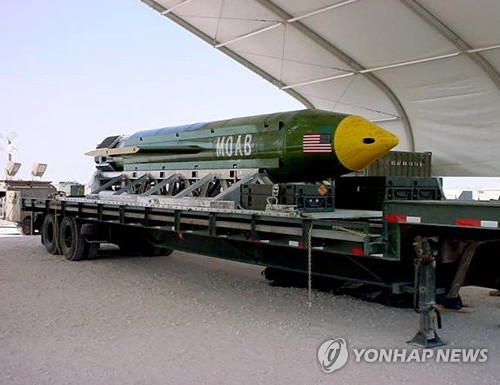
The Bomb That Can’t Reach the Target — But Can Change Everything
The Pentagon has begun drafting new strike plans against Iran that include the GBU-43/B, a 9.8-ton non-nuclear bomb popularly known as the Mother of All Bombs — or MOAB. According to a CNN report published October 15, President Donald Trump directed the military to incorporate the weapon into operations targeting Iran’s nuclear facilities and energy infrastructure. The report also confirms that one of the intended targets is the underground Kumtushun complex, a nuclear installation believed to be buried beneath granite bedrock.
Here is the problem: the MOAB was never designed for that kind of job.
The weapon detonates in the air, just above ground level, producing a massive blast radius and a devastating shockwave. It was first used operationally in 2017, when Trump ordered it dropped on an ISIS tunnel complex in Afghanistan. That was a surface-level target. Kumtushun is not. US intelligence estimates place the facility significantly deeper underground, shielded by layers of granite that a conventional high-explosive warhead — nuclear or otherwise — cannot penetrate. An intelligence source told CNN that if there is no munition capable of reaching that depth, the administration is turning to the MOAB for what amounts to a strategic bluff: its psychological impact, not its kinetic effect.
That distinction matters more than most Western analysts are acknowledging.
The Real Target Is Not Tehran — It Is the American Electorate
The timing of this escalation narrative is impossible to ignore. Trump is approaching the midterm elections with approval ratings that remain stubbornly flat and a foreign policy record that critics on both sides have labeled erratic. A kinetic strike against Iran would provide a visceral symbol of executive resolve — the kind of image that dominates cable news cycles and polarizes opinion in predictable ways. The MOAB, regardless of whether it ever reaches the target, functions as theater: a weapon the public can understand instantly because it has a nickname, a history, and a reputation for devastation.
An insider cited by CNN put it bluntly: “The president has unfortunately cornered himself into a situation where he feels he must do something.” The word unfortunately is doing heavy lifting in that sentence. It acknowledges that the decision is driven more by domestic political pressure than by a clear military objective. When leaders feel compelled to act primarily for political survival, they tend to choose options that look dramatic rather than options that work. That is exactly the logic that produced the MOAB contingency.
Who Wins and Who Loses
The immediate winner of this posture is the hardline faction within the Trump circle that has long argued for maximum pressure on Iran. They now have a weapon of mass destruction language applied to a conventional bomb, a narrative hook, and a credible escalation ladder that Iran cannot easily dismiss. The Iranian leadership, however, reads the threat differently. Tehran’s strategic culture prizes asymmetry and patience. A public US threat to drop a 10-ton bomb on an underground facility signals desperation more than capability — and desperation invites defiance, not compliance.
The losers are harder to name but easier to identify. Civilian populations living near Iran’s energy infrastructure would bear the brunt of any MOAB strike. The weapon’s airburst pattern creates a wide casualty radius, and energy facilities are rarely sited in isolated military zones. The International Crisis Group and other monitoring organizations have warned repeatedly that strikes on petrochemical sites risk catastrophic secondary fires, toxic plumes, and regional economic spillover. Iran’s oil exports, already volatile, would face new disruptions — and global energy markets do not respond kindly to uncertainty in the Strait of Hormuz.
The United States itself is also a potential loser. Deploying the MOAB against a state actor — not a terrorist cell in a cave system — sets a precedent that rivals like China and Russia will note with interest. It signals that the United States is willing to escalate to strategic conventional weapons in a conflict that has not yet been formally declared. That ambiguity is precisely what makes the threat credible, and also what makes the post-strike environment unpredictable.
What Happens Next
The White House declined to comment on the specifics of the plans, as expected. But it confirmed that Trump has kept all options on the table regarding Iran’s nuclear program. That phrasing — all options — is deliberate diplomatic language. It means the administration is not committing to a strike, nor is it ruling one out. The MOAB is now part of the bargaining menu, whether or not it ever leaves a B-52 bomb bay.
Several scenarios could unfold in the coming weeks. One: Trump orders a limited strike on a peripheral Iranian military site, testing the MOAB again in combat conditions. Two: The weapon remains a talking point, used to extract concessions from Tehran through intimidation alone. Three: The plans leak or are discovered, prompting an Iranian counter-move — perhaps a blockade of the Strait of Hormuz or an attack on US assets in the Gulf — that forces the administration into an unplanned escalation spiral.
The second scenario is the most likely in the near term. But the first and third are not far behind. The MOAB was built to destroy tunnels and bunkers. In the hands of an administration looking for a political win before the midterms, it may end up destroying something else entirely: the fragile restraint that has kept the Middle East from another full-scale war.
The bomb may never reach Kumtushun. But the threat of it arriving is already changing the calculus of a region that can afford very little more instability.