NATO Just Crossed a New Line in the Baltics — and Putin Is Testing It
A NATO jet shot down a suspicious drone over Lithuania, but the real story is how Russia is rewriting the rules of engagement on Europe's eastern flank — one low-intensity provocation at a time.
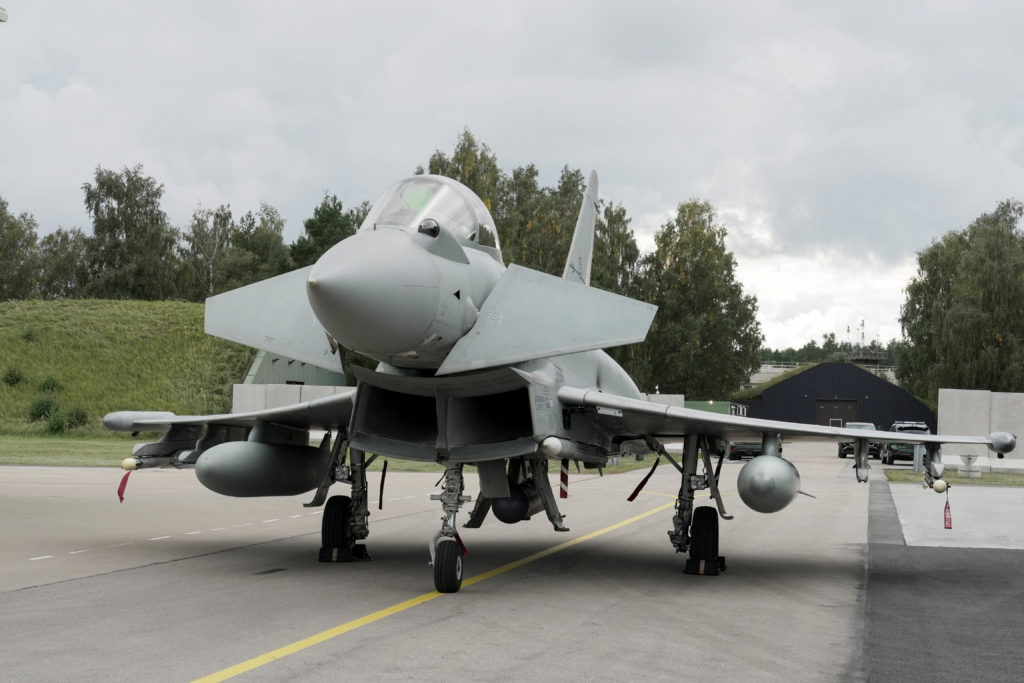
The drone entered Lithuanian airspace from the east, tracked for 30 minutes before an Italian F-16 destroyed it over a field near the village of Pratkunai, roughly 60 miles west of Vilnius.
That’s the public version. The harder questions are still being asked in closed rooms across NATO capitals.
Was the drone Russian? Belarusian? A Ukrainian drone that drifted across a border it was never meant to cross? Lithuania says none of the answers have been ruled out. What is clear is that a potentially armed unmanned system flew over populated territory before being shot down — the first time this has happened in Lithuanian airspace.
And it’s not happening in isolation.
A pattern wearing down a flank
Lithuania sits between two Russian-adjacent territories: Belarus to the south and the Kaliningrad exclave to the west. It is the narrowest part of the Suwałki Gap — the 60-mile stretch of Polish and Lithuanian territory that connects the Baltics to the rest of NATO. Any Russian move to seize that corridor would isolate Estonia, Latvia, and Lithuania from their alliance partners.
This drone was flying over that corridor.
Drone incursions have become routine along NATO’s eastern flank. Estonia and Latvia have intercepted drones before, some suspected to be Ukrainian systems that lost their way. But the incidents are accelerating. Within days of the Lithuanian shootdown, officials from multiple NATO countries accused Russia of sabotage operations, surveillance missions, and a foiled plot to strike a German airport with an explosive-laden drone.
In the Baltic Sea, a Russian warship fired flares near a Danish military helicopter — an act Denmark’s prime minister called intimidation. The EU’s top diplomat, Kaja Kallas, did not mince words: these were not accidents. “Putin will not stop unless he’s stopped,” she said.
Redefining the threshold
The strategic significance of this incident is not just that a drone was shot down. It’s what the incident reveals about how Russia is recalibrating its approach to NATO.
Under the old playbook, the Kremlin’s hybrid operations — cyberattacks, disinformation, election interference, undersea cable cuts — were designed to destabilize without triggering Article 5. They occupied a gray zone deliberately engineered to keep NATO divided and hesitant.
Russia is now pushing deeper into that gray zone. Drone incursions over NATO territory sit at the outer edge of provocation. They are not acts of war under the strictest reading of the treaty. But they are closer than anything seen in decades, and they are happening with increasing frequency.
The risk is not that Russia intends to trigger Article 5. The risk is that it is moving so close to the threshold that an accident or misperception could do it unintentionally.
Lieutenant General Douglas Lute — the former U.S. ambassador to NATO — put it plainly during a PBS interview: if the drone that struck a Ukrainian passenger train near the Polish border over the weekend had been slightly misguided and hit a train carrying senior European and U.S. officials, the consequences would have been immediate and catastrophic.
That is the game being played right now. Not calculation. Contingency.
Why now
Two factors are converging to embolden the Kremlin.
First, the war in Ukraine is grinding on. Russia has suffered enormous losses but refuses to negotiate. Hybrid attacks against NATO allies serve a dual purpose: they divert attention and resources away from Ukraine while inflicting political cost on European governments that feel directly threatened.
Second, and perhaps more importantly, Russia perceives an opening in the transatlantic relationship. The United States under the current administration has signaled a more skeptical stance toward NATO commitments — the kind of doubt that has echoed through European defense ministries for months. Putin, according to Lute, sees an opportunity to exploit that uncertainty and drive wedges between the United States and its European partners.
It has not worked — not yet. But persistence matters. Lute noted that the countries bordering Russia and Belarus — the Baltics, Poland, Bulgaria, Romania, Finland, Turkey — are paying the closest attention. The rest of the alliance is not. Geography, it turns out, still dictates threat perception in the 21st century.
Who wins and who loses
Russia wins whatever happens here. If NATO overreacts and invokes Article 5 over a single drone, Moscow frames it as imperial aggression and uses the optics to legitimize its narrative abroad. If NATO underreacts, Moscow proves it can operate with impunity inside allied airspace. Both outcomes serve the Kremlin’s objective of making NATO’s eastern flank feel unsafe and the alliance’s response seem indecisive.
Europe loses because it bears the brunt of a conflict the United States is treating as secondary. The Baltics lose because they are on the front line of a campaign that has no clear off-ramp. Germany loses because its airports and infrastructure become targets in a war it did not start.
The United States loses if it continues to signal ambivalence. Every drone that flies over NATO territory without a definitive response makes the alliance’s collective defense guarantee look like a paper promise.
What happens next
Lithuania’s defense minister, Robertas Kaunas, offered a direct message: “If we do not force Russia to negotiate for peace, then unfortunately such incidents in the Baltic region may become more frequent.”
That is the central dilemma. Russia has already decided to prolong the war in Ukraine. Hybrid aggression against NATO is a tool — and tools are only effective if they keep working. The question is whether NATO can impose enough cost to change that calculus, or whether the alliance will keep responding to each incident with calibrated statements and nothing more.
The drone over Pratkunai was destroyed before it reached populated areas. That is the best-case outcome. But the fact that it was flying at all — over NATO territory, near a critical choke point, carrying what may have been explosives — signals a strategy that is becoming more aggressive and more dangerous by the week.
Putin is testing the alliance one drone at a time. The question for NATO is whether it notices the pattern before the pattern becomes a precedent.