Neptune Is Losing Heat Faster Than Any Model Predicted
Webb's discovery of Neptune's auroras came with a quiet revelation: the planet's upper atmosphere has cooled by hundreds of degrees since Voyager's 1989 flyby, shattering ice giant climate models and rewriting what we expect from worlds on the solar system's edge.
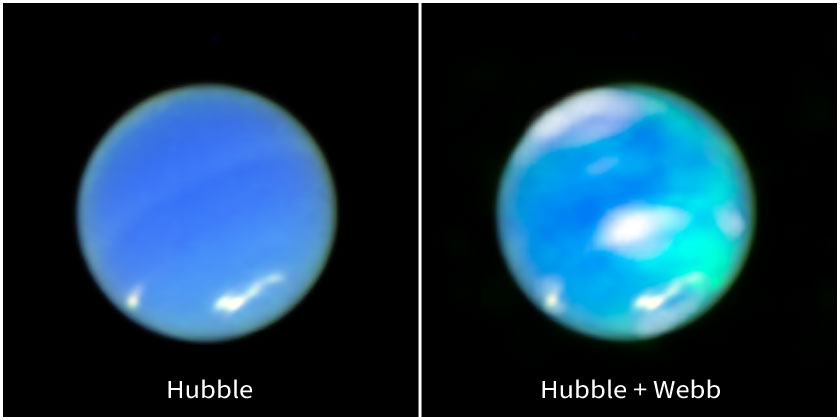
When Neptune Cooled, the Models Broke
In March 2025, astronomers announced that the James Webb Space Telescope had finally caught Neptune’s auroras—confirming a decades-long hunt. The story was supposed to end there. A molecule, H3+, glowing faintly in infrared, tracing where charged particles slam into Neptune’s upper atmosphere. A clean detection. A box checked.
Instead, the same data revealed something far more unsettling. Between 1989 and 2023, Neptune’s upper atmosphere shed roughly 400 kelvin. That is not a measurement error. It is not a difference in which atmospheric layer each instrument probed. It is a real, dramatic shift between two snapshots separated by 34 years, and no existing model of how ice giants work can comfortably account for it.
Voyager 2 measured an exospheric temperature near 750 kelvin during its August 1989 flyby. Webb measured about 358 kelvin when it observed Neptune on June 22, 2023. The paper’s own atmospheric correction suggested the two readings should agree within 10 percent. They do not. The gap swallows the correction whole.
That gap is now the most important open question in ice giant science.
The Aurora Was the Easier Discovery
Auroras on Earth paint the poles. Neptune does not share that courtesy. Its magnetic axis is tilted 47 degrees from its rotation pole and offset from the planet’s center. The result is a magnetosphere that sweeps through space like a lighthouse with a crooked beam. Wherever charged particles are funneled into the atmosphere, the aurora appears—somewhere other than the geographic pole, and at unpredictable locations as the planet rotates on its 16-hour clock.
Webb’s strongest H3+ signal appeared around southern mid-latitudes, not at the pole. That geometry is consistent with Neptune’s magnetosphere but unusual enough to be noteworthy. More importantly, the detection itself settled a long debate. Ground-based observatories had chased H3+ emissions for years without success. Jupiter, Saturn, and Uranus had all yielded the signature. Neptune held out.
The reason Neptune held out may have been exactly this cold ionosphere. H3+ emission strength is acutely sensitive to temperature. At 750 kelvin, the molecule radiates hard enough to be within reach of earlier instruments. At 358 kelvin, that same signal drops below detection thresholds that previously seemed adequate. Webb’s sensitivity and spectral range finally pulled the signature from Neptune’s light. The molecule was always there. The atmosphere just made it harder to see.
What You Lose When You Assume One Baseline
The immediate implication is methodological. For 34 years, Voyager 2’s hot measurement became the default reference point for Neptune’s upper atmosphere. Textbooks treated it as a planetary constant. Climate models for ice giants baked it in.
It was not a constant. It was a snapshot of a specific moment—Neptune’s late summer in the northern hemisphere, during a period of magnetospheric activity we cannot currently characterize.
That matters because temperature determines scale height, the distance over which atmospheric density falls off. A shift from 750 kelvin to 350 kelvin more than halves that scale height. The upper atmosphere contracts. Ring particles spiraling inward encounter a denser, thinner layer. Future spacecraft planning their trajectories above Neptune’s clouds are now operating on outdated assumptions. The planet that Voyager measured is physically larger in its upper reaches than the one Webb found.
The Question No One Can Answer Yet
Three candidate explanations dominate the conversation, and none of them settles it.
Seasonal change is the most intuitive. Neptune takes 165 Earth years to orbit the Sun, so each season lasts roughly four decades. The interval between Voyager and Webb is almost exactly one season. But the paper notes that atmospheric changes of this magnitude can unfold on timescales shorter than Neptune’s seasonal rhythm, and Neptune does not experience the extreme axial tilt that drives Uranus into its dramatic seasonal swings. Temperature alone does not make the case.
Solar cycle variability is the second candidate. The Sun’s ultraviolet output was broadly similar around both observation periods. However, solar wind dynamic pressure at Neptune’s distance—about 30 times Earth’s—can fluctuate independently of UV output, and Webb’s 2023 observation may have coincided with one of the stronger modeled increases in that pressure. The timing carries uncertainty measured in weeks, which is both a weakness and a clue: if solar forcing were the primary driver, we should see tighter correspondence between wind pressure spikes and atmospheric response.
The third possibility is internal: atmospheric waves rising from below, magnetospheric chemistry altering cooling rates, material cycling between the rings and the atmosphere. These are not speculative fantasies. They are known processes on other planets that simply have not been measured at Neptune with sufficient resolution to assign them responsibility here.
Why This Changes Everything for Future Missions
Two missions are planned or in early development for the outer solar system. Both target ice giants. Both will visit Uranus before Neptune, if they visit Neptune at all. Every atmospheric model, every thermal profile, every trajectory calculation built on the assumption of a stable Neptunian thermosphere now carries a flag.
The same uncertainty applies to Uranus. If Neptune’s atmosphere can shift by 400 kelvin between observations, then Uranus—observed only by Voyager and Hubble, never by Webb until recently—may be hiding similar variability. The ice giants were always the poor cousins of the gas giants in terms of observational coverage. This discovery makes that disadvantage more expensive.
Webb can return. That is its advantage over any flyby spacecraft. The team’s proposal calls for repeated observations across the Sun’s roughly 11-year activity cycle, tracking whether H3+ emission brightens or fades, whether the auroral map shifts, whether temperature tracks solar wind conditions. A single additional observation would convert a two-point mystery into the beginning of a time series.
Neptune’s upper atmosphere is still far warmer than sunlight alone can explain—about 130 kelvin is what absorbed solar energy would support. The mystery is not just that it cooled, but that it remains heated by something we cannot yet quantify. The energy problem that plagues all giant planet atmospheres just grew more specific, more urgent, and far less answerable from a distance.
The aurora closed one search. The temperature opened ten more.