Nobel Chemistry Win Explains Why Life Chose One Handed Molecule
The 2026 Nobel Prize in Chemistry honors discoveries that solve a century-old mystery: how molecules with the same atoms can end up overwhelmingly one-handed. The implications reach far beyond the lab bench.
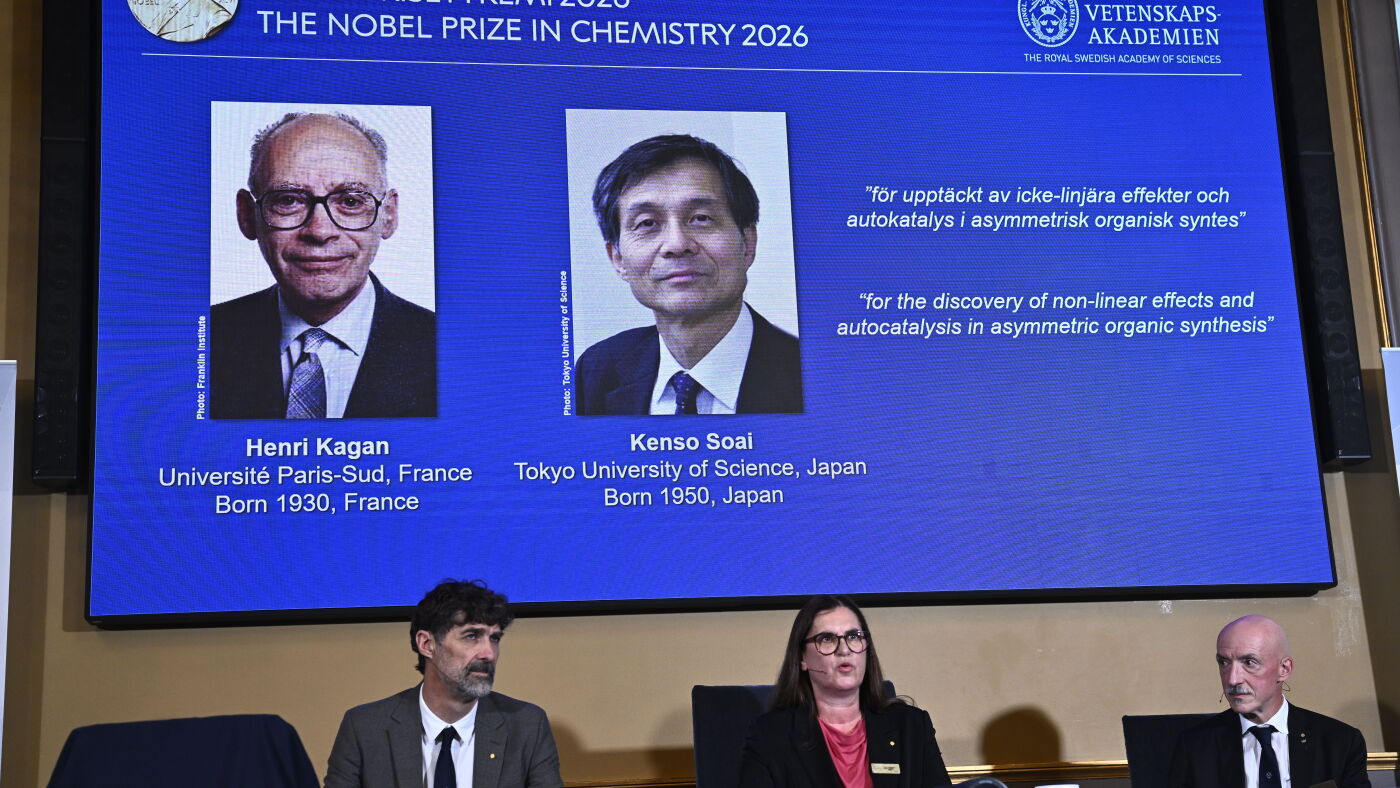
A century-old puzzle, finally answered
The 2026 Nobel Prize in Chemistry went to Henri B. Kagan and Kenso Soai for work that sounds narrow on paper but cuts to the heart of why life exists in the form it does. Their discoveries explain how molecules — otherwise identical twins that are mirror images of each other — can spontaneously favor one version over the other. That single shift is what chemists call homochirality, and it is one of the oldest unsolved questions in science.
All living things run on one-handed molecules. Amino acids in your body are left-handed. Sugars in your DNA are right-handed. But in a flask, without any apparent guidance, a chemical reaction should produce both versions equally. Life does not do that. It chooses. And for over a century, no one could fully explain how that choice emerged from chemistry alone.
Heiner Linke, chair of the Nobel Committee for Chemistry, put it plainly in the official announcement: Kagan and Soai have provided a solution to a chemical mystery that is over a century old. He called their reactions spectacular. They are understated about it, probably because the real story here is not just that the reactions work — it is that they reveal something about the conditions under which life itself could have gotten its start.
The Kagan insight: amplification through non-linearity
Henri Kagan, born in France and long affiliated with Université Paris-Sud in Orsay, worked out what is now known as the Kagan non-linear effect. His key observation was this: when you introduce even a tiny excess of one molecular handedness into a reaction, the product does not merely reflect that small bias. The bias gets amplified. The reaction essentially reads the initial imbalance and runs with it, producing far more of one version than the starting conditions would suggest.
This is not a subtle rounding error. The amplification is dramatic enough that a reaction mixture starting with just a few percent of one handedness can end up overwhelmingly dominated by it. That means homochirality does not require a perfectly clean starting point. It only requires a small push — and once that push happens, the chemistry does the rest.
The Soai reaction: autocatalysis that proves the point
Kenso Soai, now 95 and based at the Tokyo University of Science, took the principle further. In the experiment that now bears his name, he demonstrated a reaction in which the product itself acts as a catalyst for its own production — and does so in a way that strictly favors one handedness. This is autocatalysis with a memory. The reaction is self-reinforcing in a chiral sense, meaning the more product forms, the faster the same product continues to form, while the mirror-image version is effectively sidelined.
Soai’s experiment did not just confirm the theory. It created a system in the lab where you could watch homochirality emerge from near-symmetry, sometimes starting from virtually nothing more than statistical noise. That is the kind of result that changes the conversation from whether homochirality could happen to observing it happen in real time.
Why this matters beyond the lab bench
The immediate application is pharmaceutical synthesis. Making drugs that contain the correct molecular handedness is not a nice-to-have — it is often a matter of life and death. The wrong enantiomer of a drug can be inactive, harmful, or in worst-case scenarios, toxic. Kagan and Soai’s work gave chemists reliable methods for steering reactions toward the desired handedness, and the Nobel citation explicitly notes their discoveries have been decisive for chemists who design reactions for pharmaceutical manufacturing.
But the deeper implication concerns biology and the origins of life. Homochirality is not merely a quirk of Earth life. It is a prerequisite for the kind of complex, self-replicating chemistry that any origin-of-life scenario must explain. If the starting soup of early Earth contained both handednesses in equal measure, a mechanism like the one Soai and Kagan described would be essential for tipping the balance. Their work does not solve the entire origin-of-life problem, but it removes one of the most stubborn objections to the idea that homochirality could arise spontaneously from purely chemical processes.
What comes next
Soai’s reaction is already being studied as a model for how prebiotic chemistry might have selected molecular handedness before biology took over. Researchers are exploring whether similar amplification mechanisms could have operated on mineral surfaces, in hydrothermal vents, or in evaporating tide pools — environments that were likely abundant on the early Earth. Kagan’s non-linear effect provides the mathematical and conceptual framework for understanding how those systems could amplify tiny imbalances into the decisive ones.
The two laureates come from different traditions and different generations. Kagan was born in France and built his career in European chemistry. Soai is Japanese and spent his career at the Tokyo University of Science. They may not have worked directly together, but their discoveries are deeply complementary. Kagan showed how small chiral biases grow. Soai showed how a reaction can bootstrap itself into full asymmetry.
The Nobel money this year is 12 million Swedish kronor, split between the two winners. That is roughly $1.2 million. The prize recognizes work that began decades ago and has since become foundational in asymmetric synthesis. The chemistry community will continue building on it. The question of why life is one-handed — not the other, not both, but one — now has an answer that sits firmly inside chemistry rather than outside it.