North Korea's 50,000-Troop Gambit in Russia Resets Peninsula Risk
Zelensky's claim that Pyongyang could deploy up to 50,000 troops to Russia isn't just a Ukraine story. It rewrites the security math for Seoul, Tokyo, and Washington simultaneously.
The Number That Changes Everything
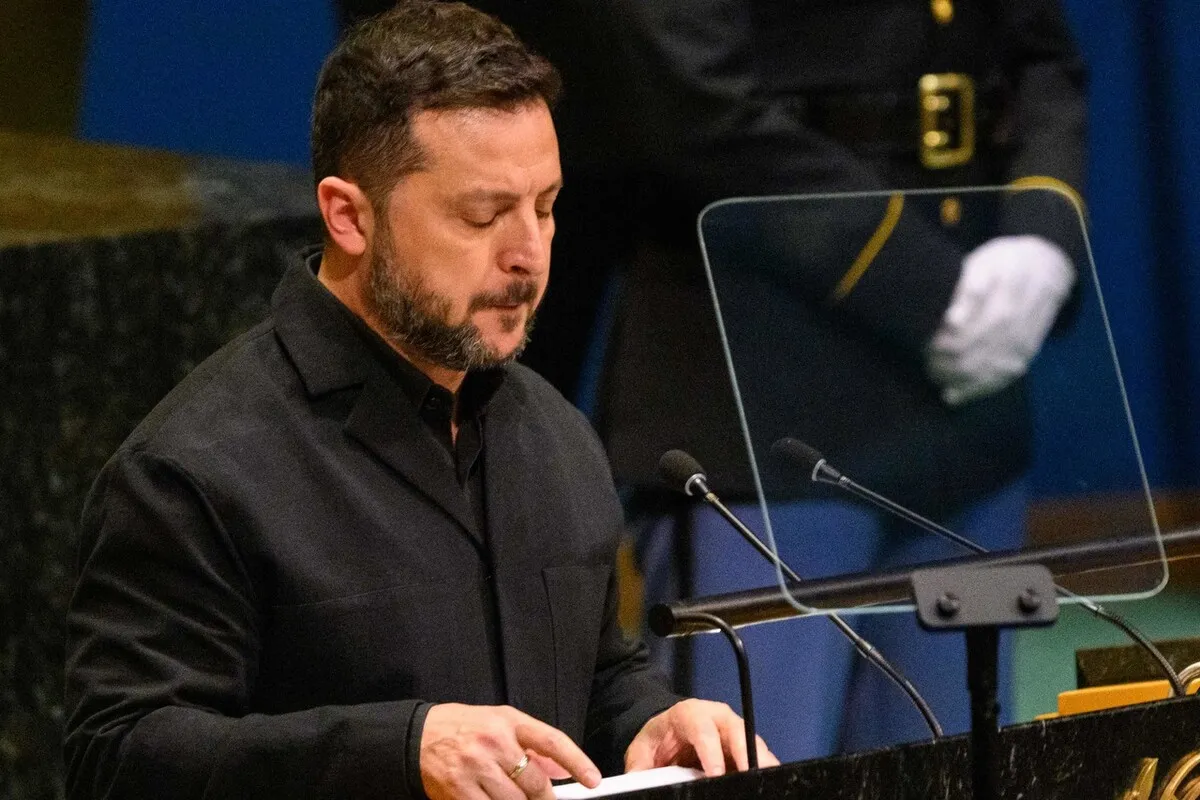
Volodymyr Zelensky did not raise his voice when he delivered the figure on September 28. Standing before the Ukrainian public after receiving a intelligence briefing, the president stated that more than 8,000 North Korean soldiers were already deployed on Russian territory, with preparations underway for an additional 10,000. TheKyiv Post, reporting on the address, noted that Kyiv’s own assessment envisions a longer-term ceiling of up to 50,000 North Korean troops rotating through Russia over time.
The jump from earlier Western estimates — which hovered around a few thousand — to this new taxonomy of 8,000 already present plus 10,000 en route plus a potential 50,000 total pool is not incremental. It is a category shift. And its reverberations extend far beyond the Donbas.
What Moscow Is Buying
Russia’s calculus is transparent. After two years of attritional warfare that has bled its conventional manpower reserves dry, Vladimir Putin turned to the one authoritarian partner willing to supply bodies at minimal political cost. North Korea brings disciplined infantry, a population conditioned for hardship, and a leadership structure that does not fracture under combat stress — exactly the qualities Russia needs for positional warfare around Bahmut, Vuhledar, and the current line of contact.
The quid pro quo is equally clear. Zelensky confirmed that Russia has begun transferring technology to North Korea specifically to enable domestic production of Shahed-type loitering munitions. This is not merely financial aid in rubles or yuan. It is the transfer of precision-guided weapons manufacturing know-how to a regime that has spent years struggling to build a credible drone program. If Pyongyang can mass-produce cheap attack drones, it transforms the entire threat profile of the Korean Peninsula — a point this article returns to.
The Seoul Shock
For South Korea, the numbers arriving from Kyivland are a strategic earthquake. The Yoon Suk Yeol administration has already moved toward a harder line on Pyongyang following North Korea’s constitutional rewriting to incorporate territorial claims over the South and its repeated missile tests. But those moves were calibrated against a threat model of sporadic provocation, not a full-scale committed formation fighting alongside the Russian Army in Europe.
Eight thousand troops on Russian soil means eight thousand North Korean soldiers have undergone Russian military integration — doctrine, communications, perhaps joint command structures. Ten thousand more in staging areas means the pipeline is operational. Fifty thousand over time means North Korea has become, in effect, a junior partner in Russia’s war machine with institutionalized troop-sharing arrangements.
Seoul’s immediate question is not about Ukraine. It is about the 30 kilometers north of the Demilitarized Zone. If North Korea has proven it can sustain deployments of this magnitude abroad, what happens to its conventional force posture along the border? Are there gaps in the front-line divisions that Moscow’s request has created? And if Pyongyang learns Russian drone-production technology, does Seoul face a more dangerous adversary at home — one with indigenous loitering munition capability aimed directly at the Seoul metropolitan area, home to 25 million people?
The risk premium on the peninsula just rose sharply.
The Budget Implications
South Korea’s defense budget has been climbing. The 2024 appropriation hit approximately 72 trillion won, and the 2025 draft is expected to push past 80 trillion won. But even those increases were predicated on a threat environment that did not include North Korean troops fighting alongside Russia in a European war. The new calculus demands answers that existing budget trajectories do not cover.
First, there is the high-end deterrent gap. Seoul has invested heavily in strike capabilities — the Kill Chain system, the Korea Air and Missile Defense (KAMD) network, and plans for three-domain command integration. None of these directly address the scenario of a reinforced North Korean army that has absorbed Russian tactical doctrines and potentially drone-production technology. The budget needs to account for defending against an enemy that is, in some dimensions, better equipped than the one Seoul planned for.
Second, there is the alliance coordination cost. The United States has pulled two batallions from its Korea-forward presence to reinforce NATO’s eastern flank — a decision made while North Korean troops were already en route to Russia. Seoul’s complaint to Kyiv about the premature disclosure of POW repatriation details is diplomatically sharp but strategically revealing: South Korea feels it is being managed rather than consulted in a security architecture that increasingly involves its peninsula.
Third, and most quietly urgent, is the technology transfer dimension. Shahed drone production capacity in North Korea changes the economics of Korean air defense. A single Shahed costs roughly $20,000 to build and $200,000 to shoot down with a Patriot missile. If Pyongyang can produce these domestically at scale — which Russian technology transfer would enable — the cost asymmetry becomes a strategic liability for Seoul’s entire layered defense architecture. Budget conversations that assumed a static threat baseline are now obsolete.
The Washington Angle
The United States faces a triangulated dilemma. Washington wants Russia degraded in Ukraine. It wants North Korea isolated and pressured. It wants South Korea aligned and well-defended. These goals are converging into a single awkward reality: North Korean troops in Russia are succeeding in their primary mission of sustaining Russian combat power, which prolongs the war Ukraine is fighting with American weapons.
There is no easy lever. Sanctions on North Korea have failed to stem the flow. Public exposure of troop deployments, as Zelensky has now done, may galvanize sanctions enforcement but does not physically remove the soldiers. A military response is impossible without triggering a wider conflict. The United States is left with the same constrained set of options it has always had regarding Pyongyang, now complicated by the fact that North Korea’s most dangerous capability export is not missiles or nukes but trained soldiers who are learning how to fight a peer adversary in real combat conditions.
What Comes Next
Several trajectories are plausible, and none are comforting.
Russia may issue a general mobilization order this autumn, as some outlets speculate. That would accelerate the North Korean rotation and deepen the integration between the two armies. North Korea, having demonstrated its reliability as a military partner, may demand additional concessions — more technology, more investment, perhaps political recognition that further isolates it from the international community it already inhabits.
South Korea faces a choice between doubling down on conventional deterrence, which is expensive and may still be inadequate against a technologically improved North Korea, or pursuing diplomatic channels that currently have no viable path. The Yoon administration’s hard line has bought domestic political credibility but not strategic flexibility.
The United States will likely intensify sanctions enforcement and deepen trilateral coordination with Seoul and Tokyo, but the fundamental asymmetry remains: Washington is fighting a proxy war in Europe while North Korean soldiers are proving their worth on the front lines, and the regime in Pyongyang is collecting technology that makes the Korean Peninsula objectively more dangerous.
Zelensky’s announcement was framed as a call to unite against a growing axis of aggression. It is also, unintentionally, a notification to Asia that the world’s most fortified border may soon face an adversary far more capable than anyone in Seoul or Washington currently assumes.