North Korea's Second Destroyer Signals a Dangerous Naval Acceleration
Pyongyang's commissioning of the Kang Kon joins the Choe Hyon as the most powerful warships ever built for the North Korean navy — and it arrives amid trilateral US-SK-Japan drills, escalating a naval arms race few are talking about openly.
A Ship That Shouldn’t Have Worked, Now Under Water
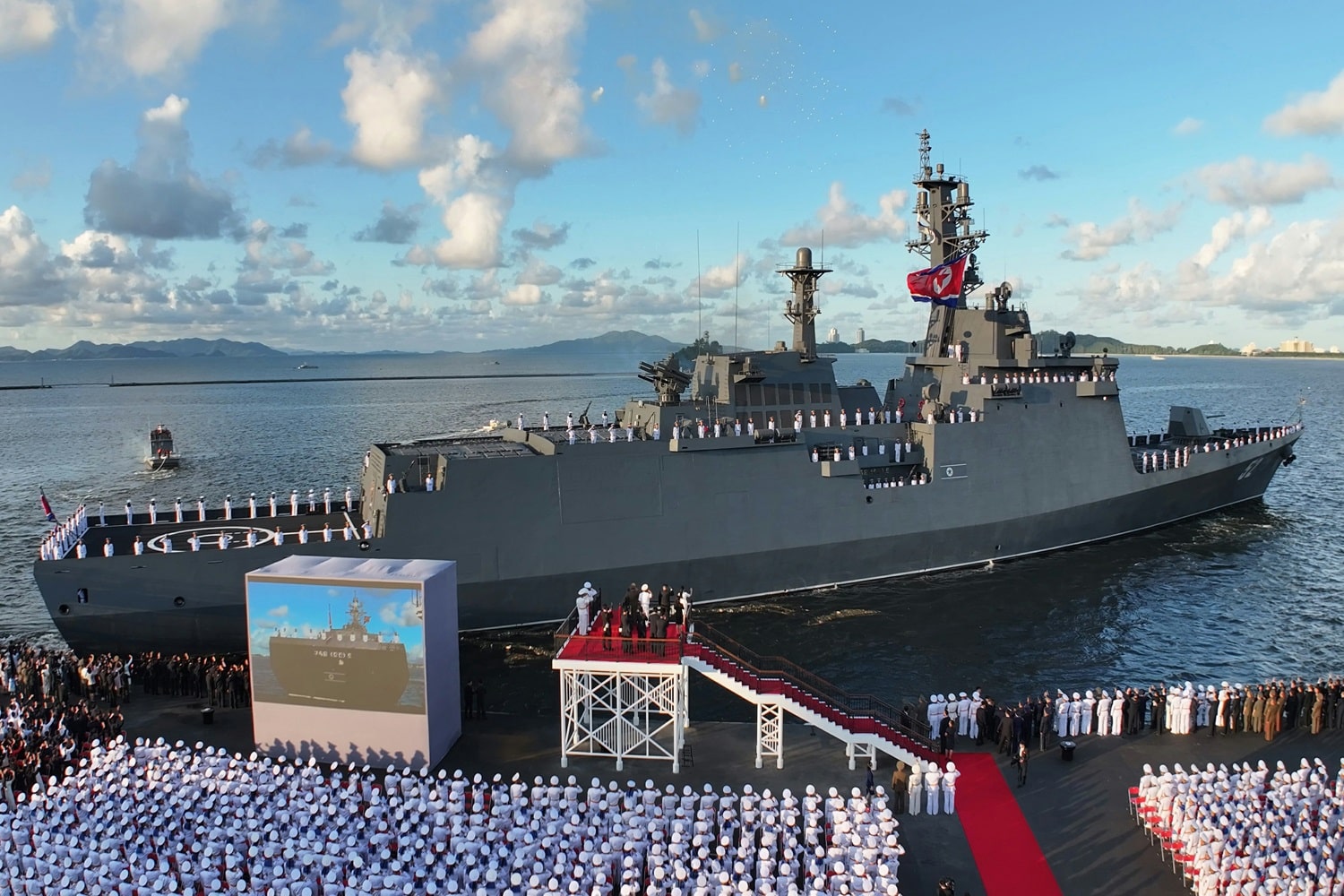
North Korea commissioned its second Choe Hyon-class guided-missile destroyer, the Kang Kon, on September 6, 2026 — barely over a year after the vessel capsized during its launch at Chongjin Shipyard in May 2025. That recovery timeline is not just a logistical feat; it is a signal.
The Kang Kon displaces approximately 5,000 tons and measures 145 meters in length, making it the largest, most heavily armed, and most technologically advanced warship North Korea has ever operated. Its lead ship, the Choe Hyon, was commissioned just two months earlier on June 23. Two more ships of the class are under construction. Kim Jong Un himself attended the ceremony alongside his daughter, a visual choice that underscores the political weight attached to this naval milestone.
The Real Capability: 104 Missiles and a Nuclear Question
The missile architecture aboard each Choe Hyon-class destroyer is staggering for a navy that, five years ago, could barely project beyond its immediate coastline. Eighty-eight vertical launch system cells — 64 aft, 24 forward — combined with eight inclined launchers and eight short-range missile pods mounted within the superstructure gives Pyongyang a total payload estimated at 104 missiles. These are not training rounds.
The VLS configurations support anti-ship, anti-aircraft, and land-attack cruise missiles. Reports indicate some of these missiles are designed to carry nuclear warheads. North Korea has already tested hypersonic projectiles and claimed breakthroughs in submarine-launched ballistic missile technology. Placing nuclear-capable cruise missiles aboard ships that can operate beyond the Yellow Sea changes the calculus of any conflict scenario in East Asia.
A 127mm naval gun, two six-barrel 30mm close-in weapon systems resembling the Chinese Type 730, and a Pantsir-M-type air-defense system aft provide layered defense. Eighty-eight VLS cells and 104 total missiles is not impressive because of raw numbers alone — it is impressive because those numbers are being integrated with modern electronic warfare suites and four fixed-face phased-array radar panels. These are systems that compete with 1990s-era Aegis-like capabilities. North Korea did not build these by accident.
The Blue-Water Ambition That Was Hidden in Plain Sight
Kim Jong Un’s statement that North Korea is implementing an important plan to strengthen its naval forces, with further details expected within eight months, should not be read as vague reassurance. It is a timetable. In the context of North Korean leadership communication, promises like this carry specific institutional weight. The regime does not make broad promises without execution pathways.
The more alarming signal lies in Pyongyang’s stated ambition to develop guided-missile cruisers with roughly twice the displacement of the Choe Hyon-class — ships in the 10,000-ton range. A cruiser-class vessel with a similar or larger missile suite would effectively turn the North Korean navy from a coastal-defense force into a credible blue-water threat capable of operating in the waters surrounding Japan, the Philippines, and potentially even the western Pacific.
Trilateral Drills and the Missing Countermeasure
The commissioning arrives during a period of heightened trilateral US-South Korea-Japan military exercises — precisely the scenario in which such naval acceleration matters most. The alliance has responded with increasing sophistication in missile defense coordination. But the alliance’s current posture assumes North Korea remains largely constrained to ballistic and cruise missile threats concentrated on land-based platforms.
That assumption is no longer sufficient.
Choe Hyon-class destroyers are not coastal patrol vessels. Their displacement, range, sensor architecture, and missile payload suggest North Korea envisions them operating in open-water scenarios — shadowing allied supply lines, threatening maritime chokepoints, or providing fire-support coverage for amphibious operations. An 88-cell VLS destroyer with nuclear-capable cruise missiles operating in the East Sea or the waters near the Tsushima Strait introduces variables that existing trilateral defense architectures were not designed to address comprehensively.
Who Wins and Who Loses
Pyongyang wins the first order of the day. It demonstrates that despite economic constraints, sanctions pressure, and what would appear to be a significant construction setback, it can deliver sophisticated warships at a pace that outpaces most Western estimates. The recovery from the May 2025 capsize to September 2026 commissioning is a propaganda victory and an industrial one.
The United States, South Korea, and Japan lose the strategic surprise factor. For years, observers assumed North Korea’s naval modernization would be incremental — small craft, limited range, constrained missile deployment. Each new shipclass commissioning reveals a faster, more ambitious timeline than previously assessed. Regional defense planners now face the prospect of a North Korean navy that can contest maritime domain awareness and project power farther from its shores than any analyst comfortable with current deterrence models would prefer.
What Comes Next
The eight-month window Kim Jong Un referenced for further naval details is the critical timeframe to watch. Expectations should include announcements regarding the cruiser-class program, expanded shipyard output, and potentially operational doctrine changes that position these destroyers as frontline assets rather than symbolic platforms.
The two additional Choe Hyon-class vessels under construction will push the class to four ships by the end of the current building cycle. Four ships with 88 VLS cells each means a potential 352 vertical launch cells deployed across a single class — a missile volume that demands a proportional response in allied sea-control and missile-defense postures.
North Korea’s naval acceleration is not happening in a vacuum. It is the maritime counterpart to its accelerating ballistic and hypersonic missile programs. The implication is straightforward: Pyongyang is building a navy that can survive, operate, and strike in the contested waters that have become the focal point of regional tension. The question for allies is not whether the ships will arrive — they already have — but whether current defense architectures can match them before the next class enters service.