Why a Single NSA Patch Took Down a Secret Network for Days
A routine software patch meant to close a PHP vulnerability brought down the NSA's most sensitive internal network for over three days — revealing just how brittle even America's most secure infrastructure has become.
A Vulnerability Nobody Wanted
The weakness began as a line item on a patch list — unremarkable in its description, almost banal in its origin. A security researcher, this time armed with artificial intelligence rather than pure intuition alone, found a flaw in PHP, the aging scripting language that still powers a staggering share of web applications across the internet. PHP has been around since 1994. It was never designed for the kind of mission-critical infrastructure it now underwrites, yet millions of lines of legacy code worldwide continue to run on it because rewriting from scratch remains politically and financially impossible.
The NSA, as custodian of American cybersecurity guidance and the government’s primary authority on software vulnerabilities, issued its standard recommendation: apply the patch. This is the normal posture, the expected rhythm of modern digital defense. Identify the hole. Close the hole. Move on.
What happened next was anything but standard.
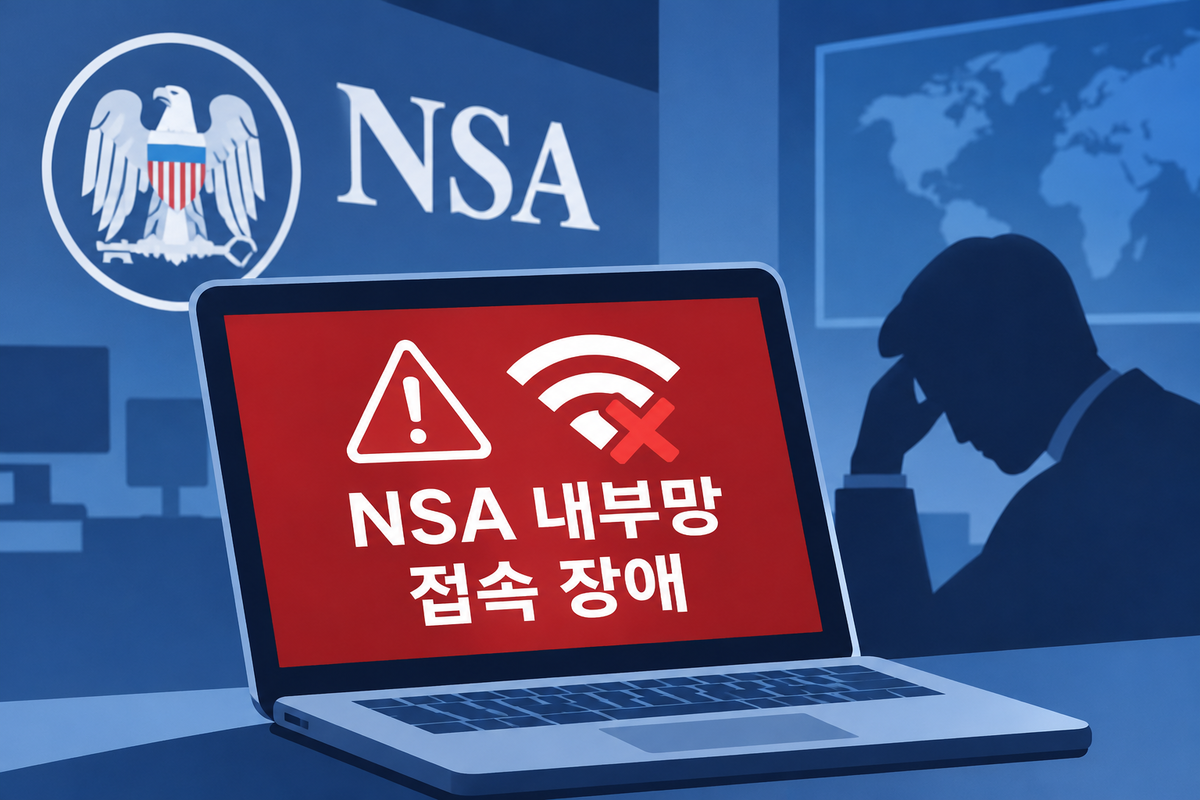
Over three days last week, NSANet — the classified internal network that handles everything from confidential email to day-to-day communications between analysts and case officers — went dark. There was no dramatic explosion of systems, no cascading red alerts flashing across dashboards. The failure was quieter and more insidious: authentication services simply stopped responding. Staffers who reported to work at the massive Fort Meade complex found themselves staring at login screens that refused to accept their credentials. Several simply turned around and left, unable to access any of the tools required for their jobs.
Management ordered staggered returns, trying to manage the flood of people attempting to reconnect all at once after the patch finally landed. The phased re-entry protocol itself became a source of confusion, with some employees receiving clearance windows hours apart. The fact that a facility housing some of the most sophisticated surveillance technology on Earth could not reliably verify who worked there represents a particular kind of institutional embarrassment.
This was not an adversary strike. There was no foreign hacker behind the blackout. The enemy was a software update designed to make the system more secure.
Who Was Hit, and How Hard
The human cost of the outage was immediate and oddly mundane. Analysts missed emails — routine messages that normally would have flowed through encrypted channels without a second thought. Officers lost touch with field sources through compromised fallback channels, creating small but real gaps in operational continuity that could not be easily closed. Case files sat unread, accumulating in digital inboxes like unsent letters.
A senior US administration official told CNN that the remediation work took longer than anyone anticipated, offering a bureaucratic euphemism that essentially means the patch broke things faster than the people fixing them could un-break them. The agency’s best engineers, the same technicians responsible for maintaining code-breaking machines that operate at the edge of what is computationally possible, found themselves unable to reverse-engineer their way out of a problem created by their own infrastructure improvements.
Some employees who made it into the building could not log in at all. They showed up, stood around in the corridors and cafeterias of one of the world’s most fortified facilities, and eventually went home. This image — qualified personnel physically present at a highly classified campus but entirely cut off from the work they were cleared and trained to do — captures something essential about the outage’s magnitude.
Importantly, the outage did not touch the NSA’s core signals intelligence collection apparatus. Foreign eavesdropping systems reportedly stayed online, their satellites and ground stations continuing their quiet work of intercepting communications around the globe. Dedicated backup communication paths for classified correspondence held firm. But those are the systems designed for watching the world. NSANet is where the agency lives when it is not looking outward. It is the difference between being able to tap a phone line somewhere in a hostile capital and being able to email your supervisor about the results.
Why the Pattern Is Worse Than the Event
Three days is an unusually long time for a disruption at an organization that treats minutes of downtime as operational emergencies. In intelligence culture, where the ability to communicate securely can determine whether a covert operation succeeds or collapses, seventy-two hours of degraded internal capability is not a minor inconvenience — it is a serious operational window that adversaries could theoretically exploit, even if they were unaware of the specific technical cause.
Former and current officials who spoke on background confirmed that outages occur periodically. The NSA’s networks, like every large IT environment, experience disruptions. None compared to this one in duration or institutional inconvenience. The contrast between routine glitches and this event highlights something structural about the agency’s technological trajectory rather than a one-time misfortune.
The reason should not surprise anyone who has watched American infrastructure age in real time. The PHP vulnerability at the center of this mess was not discovered because the NSA lacked tools or talent. It was found by civilian security researchers using AI-assisted analysis, working outside the government’s classification perimeter. The agency had already warned about it and urged a patch. Yet when the patch arrived, it carried enough risk to bring down the very network it was supposed to protect.
This is the paradox of modern cybersecurity at scale: every fix introduces the possibility of a worse failure. Complexity creates surface area. Surface area creates dependencies. And dependencies create single points of failure disguised as redundancy. The more layers of protection you stack onto an environment, the less visible the interconnections become until someone pushes on a thread and the whole tapestry unravels.
The NSA’s architecture reflects this contradiction at nearly every level. Decades of incremental additions, legacy integrations, and classification-driven design choices mean that even simple code changes ripple through environments that nobody fully understands anymore. Systems were built to talk to each other during the Cold War, then modified through successive technology refreshes, each layer adding new protocols while preserving old ones to maintain backward compatibility. The result is an institution that can intercept communications orbiting millions of miles above Earth but cannot safely run a firmware update on its internal messaging platform without risking total blackout.
Second-Order Effects and Institutional Reckoning
The fallout from the outage extended well beyond Fort Meade and the immediate disruption to daily operations. Every organization inside the US government that shares infrastructure, standards, or personnel with the NSA is now recalibrating its own patch tolerance. Defense contractors operating networks that interface with classified systems suddenly find themselves questioning the same assumptions the agency had to learn the hard way. Court systems, financial regulators, and critical infrastructure operators all depend on networks similar in complexity and similarly burdened by legacy code.
The revelation that a PHP patch — a vulnerability affecting public-sector websites, small business portals, and municipal servers alongside government internals — could destabilize the nation’s premier intelligence network sent tremors through procurement and policy circles. Budget committees that had been skeptical about funding infrastructure modernization received a sudden, vivid demonstration of why those investments mattered. The argument shifted from abstract risk assessment to documented operational failure.
Private sector counterparts also faced uncomfortable mirror questions. Companies running similar PHP-dependent stacks on their own classified or sensitive networks began conducting emergency audits, not because they had received an official notice but because the mere existence of the NSA incident served as a stress test for everyone else’s assumptions. Supply chain vulnerabilities — the tendency for failures in one part of a connected ecosystem to propagate unpredictably — moved from textbook concept to headline reality.
There is also a quieter psychological dimension worth tracking. For decades, the prevailing assumption within large organizations has been that better security tools and more frequent patching would inevitably produce more secure systems. The NSA outage undermined that confidence at a fundamental level. When the entity responsible for defining cybersecurity standards cannot implement those standards without catastrophic consequences, the moral authority behind prescriptive security frameworks weakens. Organizations everywhere are now forced to confront the distinction between theoretically sound security policy and practically executable security operations.
What Happens Next
Watch for two developments in coming weeks. First, the formal post-mortem. Whatever emerges from the NSA’s internal review will almost certainly avoid specifics about which version of PHP triggered the failure or exactly which subsystem cascaded into collapse. Classification constraints and competitive considerations will ensure that the technical details remain tightly controlled. But the structural lessons will be unmistakable regardless of how carefully they are packaged: patch management processes designed for enterprise IT fail catastrophically when applied to classified environments with interdependent systems that resist isolation.
Second, watch for accelerated investment in architectural simplification. The NSA and its partners within the intelligence community have been talking about modernizing legacy infrastructure for years. Events like this one tend to convert talk into budget. Expect procurement cycles that previously moved in years to compress into quarters. The language shifting through Washington will move from incremental improvement toward something closer to systemic replacement — an acknowledgment that patching holes in deteriorating structures has diminishing returns and that sometimes the only safe upgrade path is starting from cleaner foundations.
Funding priorities are likely to shift as well. Resources that currently flow toward vulnerability monitoring and response may see redistribution toward infrastructure hardening, network segmentation, and the kind of deliberate architectural restraint that prevents single updates from becoming system-wide threats. The question driving those decisions will not be whether another outage occurs — it will be how quickly the agency can restore confidence in its own ability to maintain the systems it depends on.
The Real Takeaway
A security researcher used AI to find a hole. An agency applied band-aids to seal it. The band-aids caused an infection severe enough to require hospitalization.
That sequence should unsettle everyone responsible for critical infrastructure outside the intelligence community. When the nation’s most funded and best-staffed cybersecurity organization cannot run a patch without crippling its classified network for seventy-two hours, the rest of American digital infrastructure is running on optimism rather than engineering. Hospitals, power grids, transportation systems, and financial networks all face the same basic challenge: increasing complexity creates increasing fragility, and the gap between theoretical security and operational resilience widens with every added layer.
The NSA’s surveillance machines kept watching throughout the outage. Its messengers stayed silent. That distinction tells the whole story — a reminder that the ability to observe the world and the ability to function within it are not the same thing, and that for institutions built on the latter, the former provides little comfort when the lights go out.